AI Bubble Expected to Burst in Late 2027
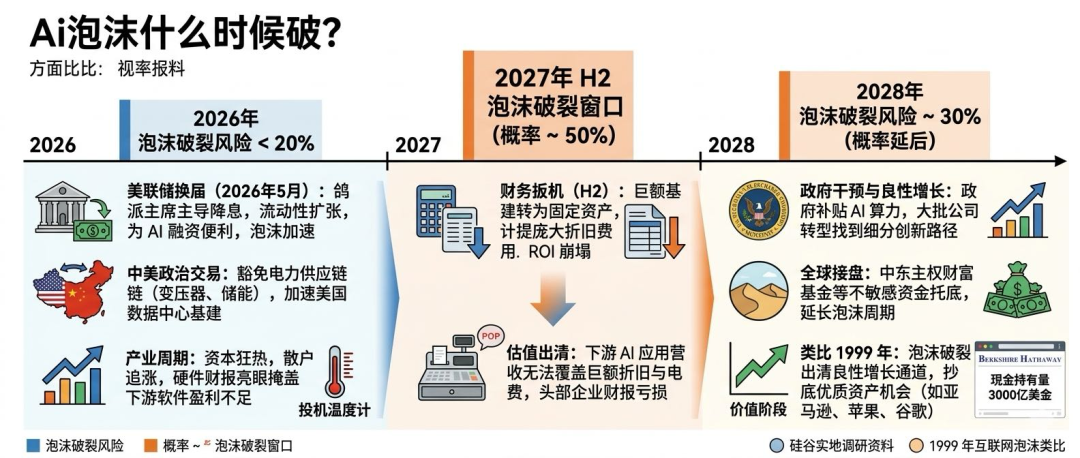
💡Understand the macro-cycle risks threatening AI startups and how to prepare for a 2027 market correction.
⚡ 30-Second TL;DR
What Changed
Current AI investment is driven by capital expenditure rather than internal profitability.
Why It Matters
Practitioners should prepare for a potential tightening of capital in the AI sector, shifting focus from pure scaling to sustainable, revenue-generating applications.
What To Do Next
Audit your project's burn rate and prioritize features that demonstrate clear, immediate ROI to survive a potential funding winter.
Key Points
- •Current AI investment is driven by capital expenditure rather than internal profitability.
- •2026 market volatility serves as a stress test revealing the fragility of AI asset valuations.
- •Infrastructure bottlenecks in power, data centers, and storage are becoming the primary constraints.
- •The market is expected to transition from 'valuation' to 'value' after a 2027 bubble correction.
🧠 Deep Insight
Web-grounded analysis with 22 cited sources.
🔑 Enhanced Key Takeaways
- •Leading AI tech firms are increasingly relying on debt financing and engaging in circular investment patterns to fund massive capital expenditures, raising concerns about artificially inflated valuations and the sustainability of their business models.
- •Despite the significant capital being poured into AI infrastructure, actual AI revenues remain modest, with some estimates suggesting a 100-fold increase is needed by 2030 to justify current buildouts, and many AI companies are characterized by high cash burn rates and lower profit margins.
- •AI data centers are encountering unprecedented technical challenges with existing power infrastructure, as their constant, unpredictable, and high-intensity load movements stress equipment, lead to unpredictable backup system behavior, and can even result in utilities requiring disconnections.
- •While some analysts draw parallels between the current AI investment surge and the dot-com bubble, others argue that the present situation is distinct due to stronger leadership from profitable companies, more diversified business models, and valuations that are often backed by actual earnings growth in leading firms.
- •High interest rates, which typically dampen venture capital funding across industries, have not deterred significant investment in AI startups, particularly those focused on deep tech applications and infrastructure tools, though this environment also pushes companies towards demonstrating clearer paths to profitability.
🛠️ Technical Deep Dive
AI data centers present unique and demanding technical requirements for infrastructure:
- Power Density: Modern AI clusters, driven by GPU-accelerated workloads, push rack densities well beyond traditional data center limits of 5-10 kW, requiring sustained, high-intensity power.
- Load Variability: AI training workloads typically generate long-duration, steady-state power draw, while inference introduces rapid and unpredictable variability, both of which stress power systems in distinct ways.
- Infrastructure Stress: Existing power distribution equipment, UPS systems, and voltage regulation mechanisms were not designed for the constant, unpredictable power movement of AI loads, leading to accelerated equipment wear and unpredictable backup system behavior.
- Cooling Demands: Increased rack densities necessitate advanced thermal management solutions, accelerating the adoption of liquid and hybrid cooling models over traditional air cooling for high-density GPU environments.
- Grid Stability: The volatile power demands of AI data centers can destabilize local utility feeders, sometimes leading to utilities requiring newly energized data center phases to disconnect.
- Power Buffering: Long-duration batteries are being explored as a necessary volatility buffer between AI data centers and the electrical grid to manage these new operating realities.
- Resource Constraints: Beyond power, AI data centers face constraints from water availability for cooling and significant delays (up to seven years in some regions) in obtaining building permit approvals.
🔮 Future ImplicationsAI analysis grounded in cited sources
⏳ Timeline
📎 Sources (22)
Factual claims are grounded in the sources below. Forward-looking analysis is AI-generated interpretation.
- Google Search Source
- Google Search Source
- Google Search Source
- Google Search Source
- Google Search Source
- Google Search Source
- Google Search Source
- Google Search Source
- Google Search Source
- Google Search Source
- Google Search Source
- Google Search Source
- Google Search Source
- Google Search Source
- Google Search Source
- Google Search Source
- Google Search Source
- Google Search Source
- Google Search Source
- Google Search Source
- Google Search Source
- Google Search Source
Weekly AI Recap
Read this week's curated digest of top AI events →
👉Related Updates

AI-curated news aggregator. All content rights belong to original publishers.
Original source: 虎嗅 ↗