🐯虎嗅•Stalecollected in 8m
AI API Proxies: Launches and Traps
💡Cheap AI APIs hide bans/data theft—learn safe alternatives like OpenRouter
⚡ 30-Second TL;DR
What Changed
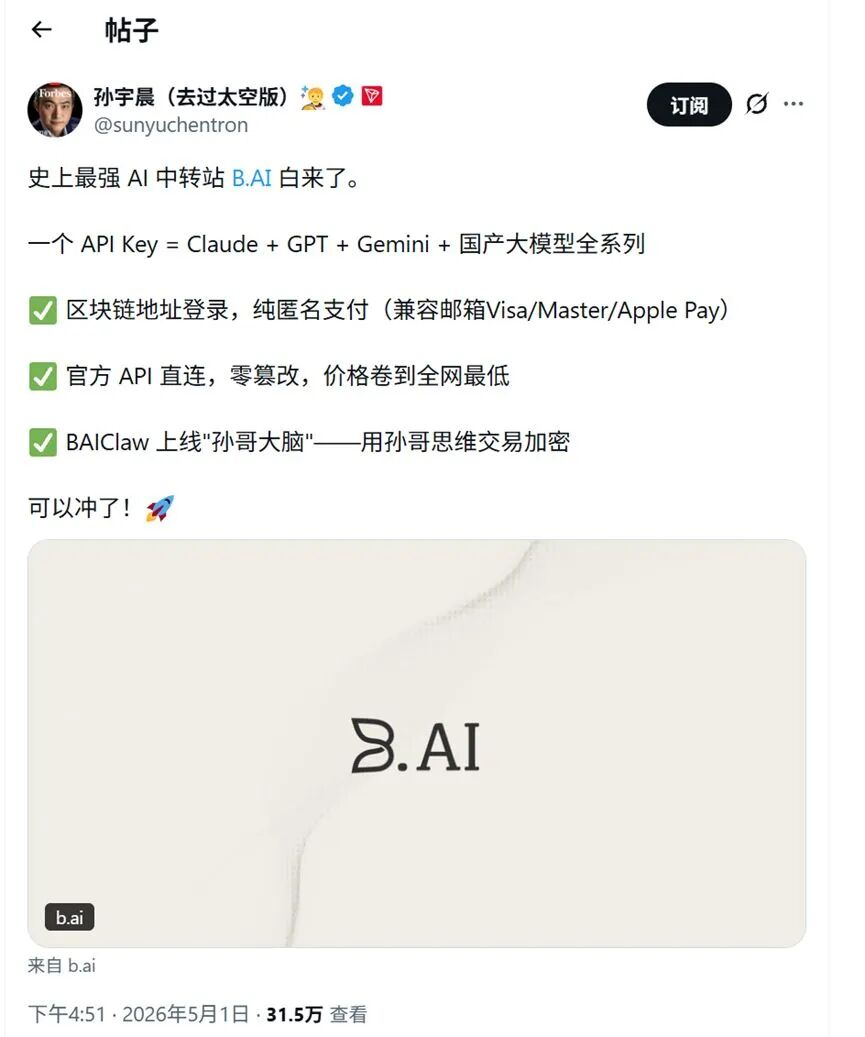
Sun Yuchen's B.AI subsidizes 100B tokens daily for Claude/GPT/Gemini access.
Why It Matters
Exposes instability in cheap proxies, pushing users toward reliable platforms like OpenRouter. Boosts legitimate infrastructure plays amid explosive Token demand.
What To Do Next
Test OpenRouter's unified API for multi-model routing to bypass unreliable proxies.
Who should care:Developers & AI Engineers
Key Points
- •Sun Yuchen's B.AI subsidizes 100B tokens daily for Claude/GPT/Gemini access.
- •Fu Sheng's EasyRouter offers 85% discounts on 40+ models like DeepSeek.
- •OpenRouter serves 5M+ devs with 5.5% fee, $50M annualized revenue.
- •Risks include shared accounts causing OpenAI bans and data theft.
🧠 Deep Insight
AI-generated analysis for this event.
🔑 Enhanced Key Takeaways
- •The surge in AI API proxies is driven by 'arbitrage' strategies where providers exploit regional pricing disparities, enterprise bulk-rate discounts, and the use of 'leaked' or illicitly obtained API keys to undercut official provider pricing.
- •Regulatory scrutiny is intensifying as major model providers (OpenAI, Anthropic) update their Terms of Service to explicitly prohibit unauthorized third-party proxying, leading to mass account terminations and the implementation of stricter rate-limiting based on IP fingerprinting.
- •Security researchers have identified that several 'low-cost' proxy services act as man-in-the-middle (MITM) nodes, logging user prompts and system instructions to train proprietary models or sell sensitive data to third-party data brokers.
📊 Competitor Analysis▸ Show
| Feature | OpenRouter | B.AI / EasyRouter | Official Provider APIs |
|---|---|---|---|
| Pricing | Market-driven (variable) | Aggressive subsidies/discounts | Standardized (fixed) |
| Model Access | Unified API (40+ models) | Curated/Subsidized selection | Single-vendor focus |
| Data Privacy | Opt-in logging | High risk (potential logging) | Enterprise-grade (SOC2/GDPR) |
| Reliability | High (Load balancing) | Variable (Account ban risk) | Very High |
🛠️ Technical Deep Dive
- •Proxy architecture typically utilizes a load-balancing layer (often Nginx or custom Go-based proxies) that maps incoming requests to a pool of rotating API keys.
- •Implementation often involves 'Request Transformation' layers that strip or modify headers to bypass provider-side rate limiting and geo-blocking.
- •Advanced proxies employ 'Token Estimation' algorithms to calculate costs before forwarding requests, allowing for pre-paid credit systems that differ from the post-paid model used by official providers.
- •Many services utilize 'Reverse Proxy' patterns to mask the origin of the request, making it difficult for model providers to distinguish between legitimate enterprise traffic and proxy-aggregated traffic.
🔮 Future ImplicationsAI analysis grounded in cited sources
Consolidation of the proxy market will occur through acquisition by major model providers.
Model providers will likely acquire successful routing platforms to gain control over distribution channels and eliminate unauthorized arbitrage.
API providers will shift to hardware-bound or device-attestation authentication.
To combat proxy-based account sharing, providers will move away from simple API keys toward cryptographic signatures tied to specific hardware or verified enterprise environments.
⏳ Timeline
2023-06
OpenRouter launches, pioneering the unified API routing model for LLMs.
2025-02
Sun Yuchen announces B.AI, signaling a shift toward high-subsidy, crypto-integrated AI access.
2026-01
Fu Sheng's EasyRouter gains traction by offering deep discounts on Chinese-developed models like DeepSeek.
📰
Weekly AI Recap
Read this week's curated digest of top AI events →
👉Related Updates


AI-curated news aggregator. All content rights belong to original publishers.
Original source: 虎嗅 ↗