AI Agents Become the New Office Front Door
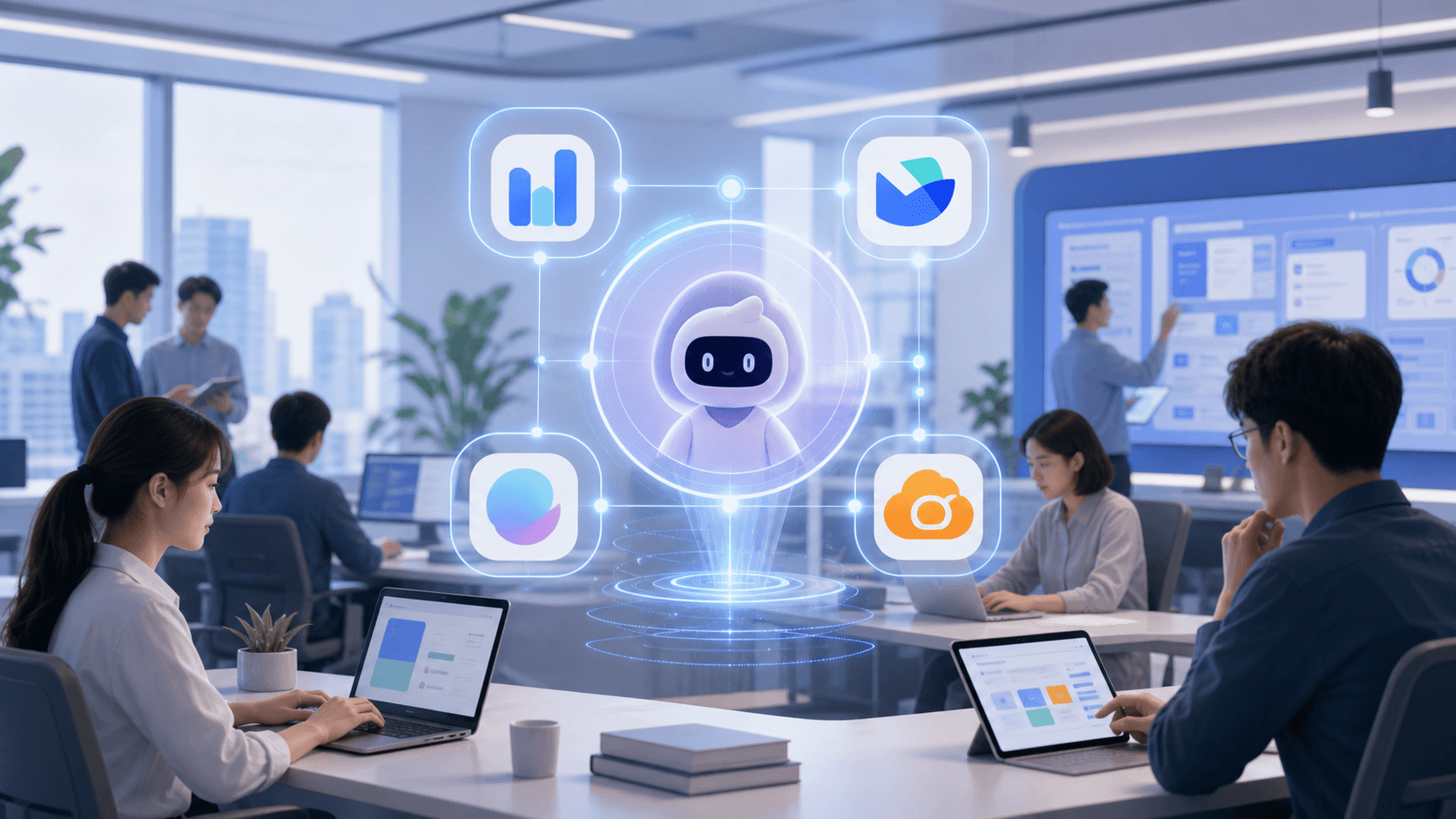
Learn why Chinese tech giants are making agents the front door to enterprise workflows.
30-Second TL;DR
What Changed
Kingsoft, Tencent, Alibaba, and ByteDance are competing to own the enterprise agent entry point.
Why It Matters
If this model succeeds, enterprise software adoption may increasingly depend on which agent can coordinate tasks across existing systems. Builders should expect stronger demand for integrations, permissions, workflow context, and reliable action execution rather than simple conversational answers.
What To Do Next
Map one internal workflow across Feishu, DingTalk, or WeChat Work and identify the permissions and APIs an agent would need to execute it end to end.
Key Points
- •Kingsoft, Tencent, Alibaba, and ByteDance are competing to own the enterprise agent entry point.
- •Agents are shifting from chat interfaces toward task initiation and workflow orchestration.
- •Feishu, DingTalk, and WeChat Work may increasingly function as execution and collaboration layers.
- •The competitive focus is moving from standalone assistants to integrated enterprise workflows.
Deep Insight
AI-generated analysis for this event — not the original article.
Enhanced Key Takeaways
- •The transition toward agent-centric interfaces is driven by 'Agentic Workflow' architectures, where LLMs are granted autonomous control over API calls to enterprise SaaS tools rather than just generating text.
- •Major Chinese tech firms are adopting a 'Model-as-a-Service' (MaaS) strategy, allowing enterprises to fine-tune proprietary agents on private data silos within Feishu or DingTalk environments.
- •Data privacy and sovereignty concerns have led to the development of 'Local-First' agent deployment options, where sensitive enterprise workflows are processed on-premise or within private cloud VPCs.
- •The shift is causing a decline in traditional 'App-based' usage metrics, as users increasingly interact with natural language interfaces that bypass the need to navigate complex UI menus.
- •Integration of multi-modal capabilities allows these agents to process not just text, but also real-time video conferencing data and document images to automate meeting minutes and project tracking.
Competitor Analysis
- Kingsoft Lingxi
- WPS Office Integration
- Tencent QClaw
- WeChat Ecosystem
- Alibaba Qianwen Office
- Cloud/Data Analytics
- ByteDance Doubao-Feishu
- Workflow Automation
- Kingsoft Lingxi
- Subscription/Enterprise
- Tencent QClaw
- Freemium/API-based
- Alibaba Qianwen Office
- Consumption-based
- ByteDance Doubao-Feishu
- Per-seat/Enterprise
- Kingsoft Lingxi
- High (Doc-centric)
- Tencent QClaw
- Medium (Social-centric)
- Alibaba Qianwen Office
- High (Data-centric)
- ByteDance Doubao-Feishu
- High (Task-centric)
| Feature | Kingsoft Lingxi | Tencent QClaw | Alibaba Qianwen Office | ByteDance Doubao-Feishu |
|---|---|---|---|---|
| Core Strength | WPS Office Integration | WeChat Ecosystem | Cloud/Data Analytics | Workflow Automation |
| Pricing Model | Subscription/Enterprise | Freemium/API-based | Consumption-based | Per-seat/Enterprise |
| Agent Autonomy | High (Doc-centric) | Medium (Social-centric) | High (Data-centric) | High (Task-centric) |
Technical Deep Dive
- Agents utilize ReAct (Reasoning + Acting) prompting frameworks to decompose complex user requests into sequential API calls.
- Implementation relies on Function Calling capabilities where LLMs map natural language intents to specific enterprise software endpoints.
- Systems employ RAG (Retrieval-Augmented Generation) pipelines that index internal enterprise knowledge bases, including wikis, chat logs, and project management tickets.
- Orchestration layers use Directed Acyclic Graphs (DAGs) to manage dependencies between agentic tasks and ensure workflow consistency.
- Security is enforced via Role-Based Access Control (RBAC) tokens that limit agent permissions to the specific user's authorized data scope.
Future ImplicationsAI analysis grounded in cited sources
Timeline
- 2023-04Alibaba Cloud launches Tongyi Qianwen, laying the foundation for its enterprise AI strategy.
- 2023-09ByteDance integrates AI capabilities into Feishu, marking the start of its agent-first office strategy.
- 2024-05Kingsoft Office announces the 'WPS AI' upgrade, focusing on document-centric agentic workflows.
- 2025-02Tencent introduces QClaw, expanding its enterprise AI footprint within the WeChat Work ecosystem.
- 2026-01Major Chinese tech firms shift focus from standalone chatbots to integrated enterprise agent orchestration.
Weekly AI Recap
Read this week's curated digest of top AI events →
Related Updates




AI-curated news aggregator. All content rights belong to original publishers.
Original source: Pandaily ↗
This is a summary, not the original. Read the source, or get the weekly briefing.
The weekly digest
One email a week. Unsubscribe anytime.