AI Agents Seize Your Decision Rights
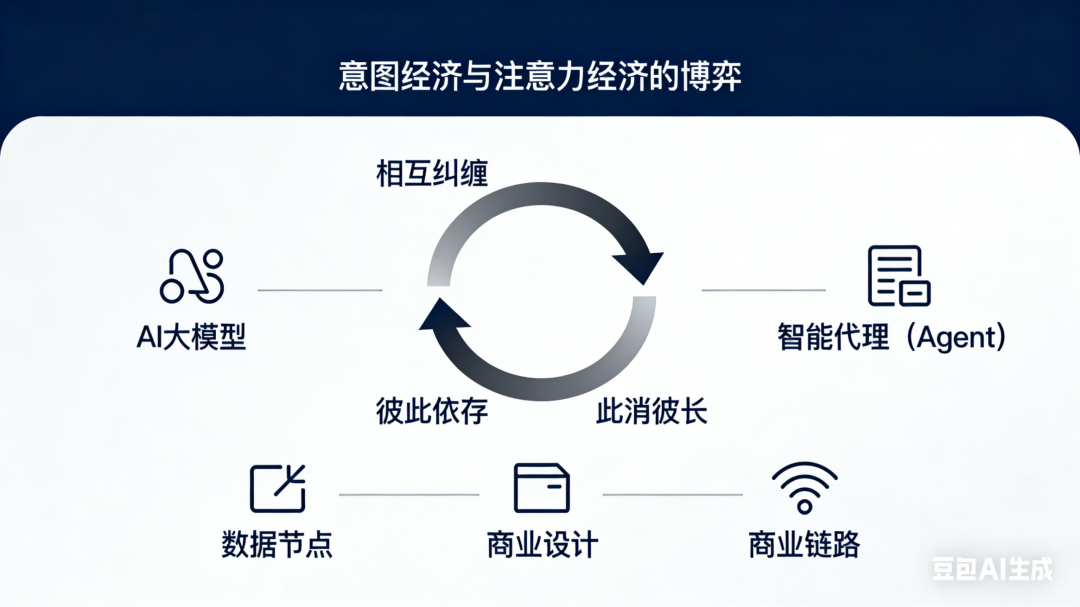
💡AI Agents to dominate decisions by 2026—master intention economy now
⚡ 30-Second TL;DR
What Changed
Intention economy lets Agents handle orders like milk tea without user browsing or comparing.
Why It Matters
Platforms must pivot to Agent-friendly services; users face dependency on biased proxies, eroding autonomy. AI builders gain from new orchestration tools but risk trust if opacity persists.
What To Do Next
Build a LangChain-based Agent to proxy e-commerce intents and audit its recommendation biases.
Key Points
- •Intention economy lets Agents handle orders like milk tea without user browsing or comparing.
- •Agents create black-box choices: higher commissions, better APIs, or platform alliances prevail.
- •Power migrates from app opens to Agent intent entry; winner-takes-all dynamics intensify.
- •Coexists with attention economy but reverses goal: less user time, direct results.
🧠 Deep Insight
Background and context from public sources — not the original article. 5 sources cited.
🔑 Enhanced Key Takeaways
- •AI agents employ Autonomous OODA Loops (Observe, Orient, Decide, Act) with self-correction via Critique Layers to enable trusted real-time decision-making in high-stakes domains like finance and infrastructure.[1]
- •Multi-agent systems (MAS) emerge as the 2026 standard, where specialized agents collaborate under orchestration layers for complex workflows such as full sales cycles, akin to Kubernetes for containers.[2]
- •Model Context Protocol (MCP) standardizes agent connections to diverse data sources like BigQuery, powering digital assembly lines for employee-supervised multi-agent teams in marketing and analytics.[4]
🛠️ Technical Deep Dive
- •Agents use World Models for contextualizing data during the Orient phase of OODA loops.[1]
- •Chain-of-Thought (CoT) reasoning simulates multiple outcome paths in the Decide phase.[1]
- •Critique Layer implements self-reflection prompts as devil's advocate checks before high-stakes actions to mitigate hallucinations.[1]
- •Orchestration layers enable multi-agent collaboration with shared context handoffs, supported by frameworks like LangGraph, AutoGen, and platforms like Microsoft Copilot Studio.[2][5]
🔮 Future ImplicationsAI analysis grounded in cited sources
📎 Sources (5)
Factual claims are grounded in the sources below. Forward-looking analysis is AI-generated interpretation.
- saawahiitsolution.com — How AI Agents Are Reshaping Decision Making in Modern Systems
- joget.com — AI Agent Adoption in 2026 What the Analysts Data Shows
- kore.ai — AI Agents in 2026 From Hype to Enterprise Reality
- gappsgroup.com — AI Agent Trends 2026 From Chatbots to Autonomous Business Ecosystems
- usaii.org — AI Agents in 2026 a Comparative Guide to Tools Frameworks and Platforms
Weekly AI Recap
Read this week's curated digest of top AI events →
👉Related Updates
AI-curated news aggregator. All content rights belong to original publishers.
Original source: 虎嗅 ↗
This is a summary, not the original. Read the source, or get the weekly briefing.
Weekly AI briefing
One email a week. Unsubscribe anytime.