AI Agents Reshape SaaS Landscape
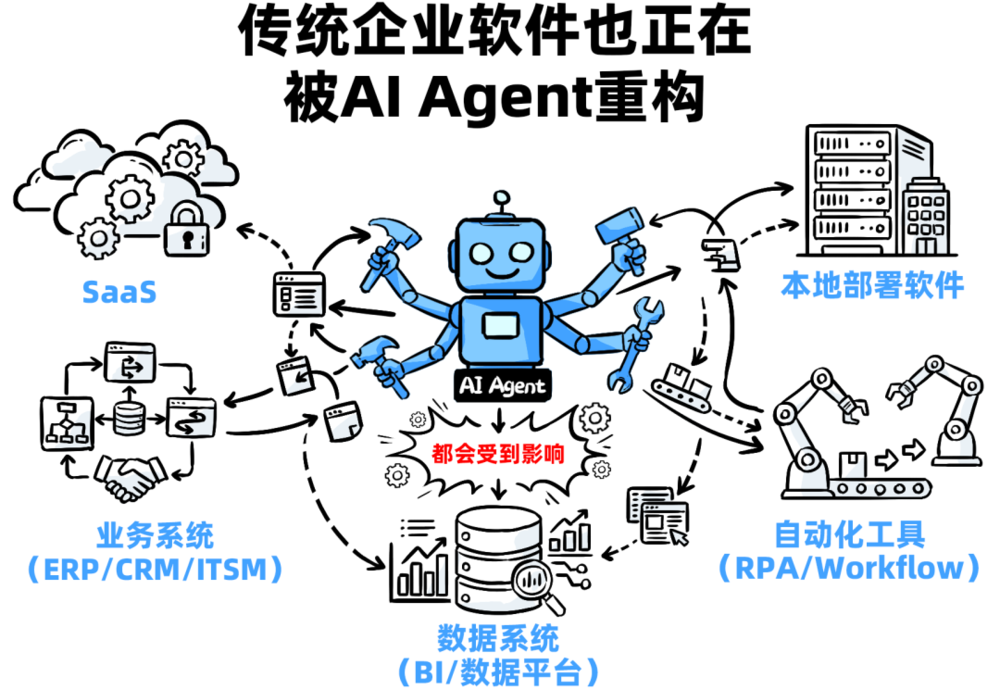
💡SaaS at risk from AI Agents? How to pivot before 'SaaS-pocalypse' hits.
⚡ 30-Second TL;DR
What Changed
UI shifts from menu clicks to natural language intents executed across systems.
Why It Matters
SaaS founders must integrate Agents or face disruption; creates opportunities for AI-native platforms and backend services. Giants like Microsoft/Salesforce position as Agent hubs.
What To Do Next
Prototype an autonomous Agent in Microsoft Copilot Studio for your SaaS workflow automation.
Key Points
- •UI shifts from menu clicks to natural language intents executed across systems.
- •Workflows evolve from static app integrations to LLM-driven dynamic orchestration.
- •Pricing moves from per-seat to hybrid human + Agent workload billing.
- •Vulnerable SaaS: single-function, weak data/integration moats.
- •Valued SaaS: core data records, heavy compliance workflows as Agent foundations.
🧠 Deep Insight
Background and context from public sources — not the original article. 6 sources cited.
🔑 Enhanced Key Takeaways
- •Enterprise adoption of AI agents has reached a critical inflection point: 87% of sales teams now use AI for core functions like prospecting and forecasting, with 54% deploying agents for deeper automation, indicating the shift from experimentation to essential infrastructure is already underway[5].
- •Data quality remains a fundamental bottleneck limiting AI agent effectiveness: nearly 70% of enterprises report their data as unreliable for AI purposes, driving demand for AI-native data platforms that can serve as reliable foundations for autonomous agent systems[2].
- •Horizontal SaaS platforms are evolving into AI orchestration hubs rather than being displaced by agents: successful platforms like Salesforce Agentforce are positioning themselves as integration layers that connect specialized vertical agents while maintaining centrality to enterprise workflows[3].
- •Multimodal AI capabilities are expanding agent scope beyond text: 2026 marks a pivotal shift as AI agents can now process and generate video in real-time, enabling more comprehensive analytics and autonomous decision-making across diverse data types[2].
- •Investment concentration in AI automation is accelerating budget reallocation: Deloitte predicts up to 75% of companies will invest in agentic AI in 2026, with approximately half of organizations dedicating over 50% of digital transformation budgets to AI automation[1].
📊 Competitor Analysis▸ Show
| Platform | Primary Positioning | Agent Capabilities | Integration Approach | Pricing Model Evolution |
|---|---|---|---|---|
| Salesforce Agentforce | Sales orchestration hub | Prospecting, quoting, 24/7 engagement | Deep CRM integration, Zapier Central | Hybrid human + agent workload |
| Microsoft Dynamics 365 | Enterprise ERP + sales | AI-driven workflows across modules | Native Microsoft ecosystem | Per-task + per-seat hybrid |
| HubSpot Sales Hub | Mid-market sales platform | Email drafting, forecasting, prospecting | Native integrations, third-party APIs | Transitioning to usage-based |
| Zapier Central | Workflow automation hub | Multi-step agent orchestration | 6,000+ app integrations | Per-task execution model |
| Vertical AI Solutions | Domain-specific expertise | Industry-deep analysis (legal, design, HR) | API-first, platform-agnostic | Per-task or subscription |
Note: Horizontal platforms (Salesforce, Microsoft, HubSpot) are competing to become orchestration layers, while vertical agents threaten to unbundle specialized functions[3].
🛠️ Technical Deep Dive
- Agent Architecture: Modern SaaS agents operate as intermediaries that fetch data and execute tasks across integrated systems, moving from static app connectors to LLM-driven dynamic orchestration[3].
- Memory and Context: Leading agents utilize long-term memory and company-specific knowledge bases to maintain brand consistency and strategic alignment across autonomous operations[4].
- Multimodal Processing: 2026 agents can process text, video, and voice inputs simultaneously, enabling comprehensive analytics and real-time decision-making across heterogeneous data sources[2].
- Integration Patterns: Seamless integration occurs via tools like Zapier Central and Salesforce Agentforce, enabling deep embedding into existing enterprise stacks without requiring custom development[4].
- Data Foundation Requirements: AI-native platforms are becoming essential infrastructure because traditional data architectures fail to support agent reliability; nearly 70% of enterprises report data quality issues that impede AI deployment[2].
🔮 Future ImplicationsAI analysis grounded in cited sources
⏳ Timeline
📎 Sources (6)
Factual claims are grounded in the sources below. Forward-looking analysis is AI-generated interpretation.
- deloitte.com — Saas AI Agents
- gleap.io — AI Driven Analytics Transforming Saas
- bettercloud.com — Saas Industry
- noimosai.com — 8 Best AI Agents for Saas Growth in 2026 Scaling Content and Operations
- futurumgroup.com — AI Agents Take Center Stage Will Sales Teams That Automate Win in 2026
- youtube.com — Watch
Weekly AI Recap
Read this week's curated digest of top AI events →
👉Related Updates


AI-curated news aggregator. All content rights belong to original publishers.
Original source: 虎嗅 ↗
This is a summary, not the original. Read the source, or get the weekly briefing.
Weekly AI briefing
One email a week. Unsubscribe anytime.