AI Agents Now Dominate Global Web Traffic
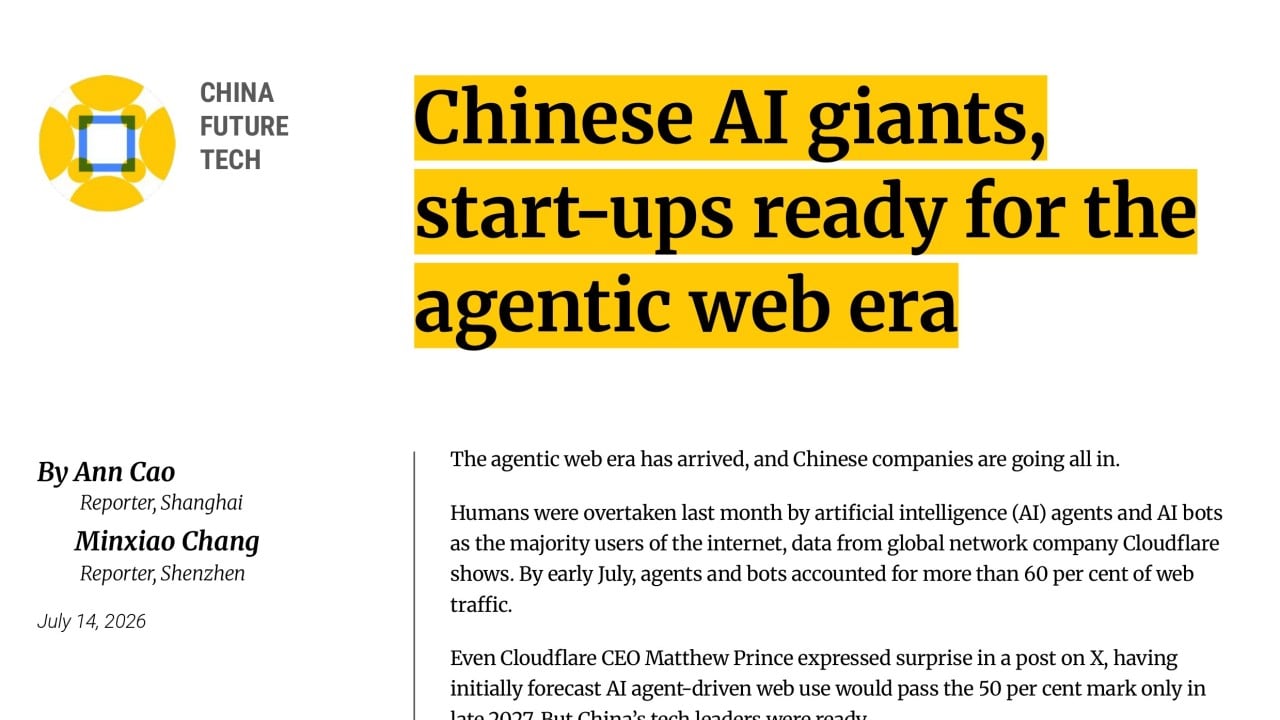
💡AI agents now account for 60%+ of web traffic. Learn why this shift is happening years faster than expected.
⚡ 30-Second TL;DR
What Changed
AI agents and bots surpassed human users, exceeding 60% of total web traffic by July.
Why It Matters
The shift toward agent-dominated traffic necessitates a redesign of web infrastructure, security protocols, and API rate-limiting strategies. Developers must prepare for a web where non-human interaction is the default.
What To Do Next
Audit your web server logs and API endpoints to distinguish between human and agent traffic to optimize your infrastructure for automated requests.
Key Points
- •AI agents and bots surpassed human users, exceeding 60% of total web traffic by July.
- •Cloudflare CEO Matthew Prince noted that the shift to agentic web use happened years ahead of projections.
- •Chinese tech companies are aggressively shifting strategies to support agent-based web interactions.
🧠 Deep Insight
AI-generated analysis for this event — not the original article.
🔑 Enhanced Key Takeaways
- •The surge in non-human traffic is primarily driven by 'aggressive' scrapers and AI crawlers that bypass traditional robots.txt protocols, forcing infrastructure providers to implement new rate-limiting standards.
- •Cloudflare's 2026 data indicates that a significant portion of this traffic is attributed to 'headless' browsers and automated agents performing multi-step tasks rather than simple data retrieval.
- •Chinese regulatory bodies have begun drafting guidelines specifically for 'Agent-to-Agent' (A2A) communication to prevent automated market manipulation and ensure data sovereignty.
- •The rise of agentic traffic has caused a measurable increase in global data center power consumption, as AI agents require significantly more compute cycles per request than standard human-initiated HTTP requests.
- •Major cybersecurity firms report that 'bad bots'—those used for credential stuffing and DDoS attacks—have evolved to use LLM-based obfuscation to mimic human behavioral patterns, making them harder to distinguish from legitimate AI agents.
🛠️ Technical Deep Dive
- Shift from traditional REST API interactions to autonomous agentic workflows utilizing function calling and tool-use capabilities.
- Implementation of advanced behavioral analysis and TLS fingerprinting to differentiate between benign AI crawlers and malicious automated agents.
- Increased reliance on edge computing nodes to process agent requests closer to the source, reducing latency for high-frequency autonomous interactions.
- Adoption of standardized agent communication protocols to facilitate interoperability between disparate AI models and platforms.
🔮 Future ImplicationsAI analysis grounded in cited sources
⏳ Timeline
Weekly AI Recap
Read this week's curated digest of top AI events →
👉Related Updates

AI-curated news aggregator. All content rights belong to original publishers.
Original source: SCMP Technology ↗
This is a summary, not the original. Read the source, or get the weekly briefing.
The weekly digest
One email a week. Unsubscribe anytime.