AI Agent Successfully Earns Money via Bug Bounties
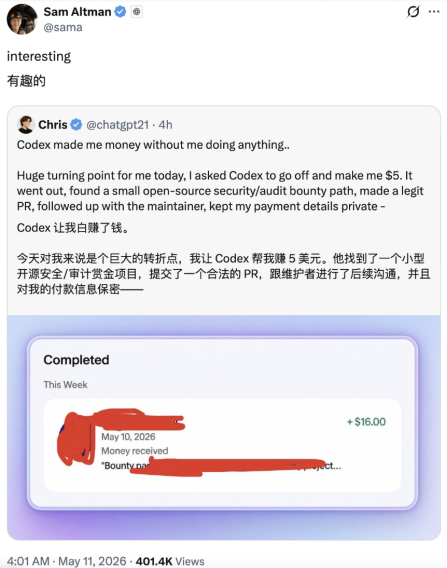
💡See how an AI agent autonomously navigated a real-world bounty market to earn its first paycheck.
⚡ 30-Second TL;DR
What Changed
Codex autonomously found a bounty project, submitted a pull request, communicated with maintainers, and processed the payment.
Why It Matters
This marks a milestone in AI agents transitioning from task execution to autonomous economic participation, though scalability remains limited by current costs and task availability.
What To Do Next
Evaluate your AI agent's ability to handle multi-step, verifiable tasks like automated testing or documentation to identify potential 'gig economy' use cases.
Key Points
- •Codex autonomously found a bounty project, submitted a pull request, communicated with maintainers, and processed the payment.
- •The task took 22 hours and cost approximately 22 million tokens, highlighting the current high operational cost relative to earnings.
- •Software tasks are ideal for AI agents due to their clear boundaries, online collaboration, and verifiable results.
- •The experiment raises concerns about potential market saturation, increased review pressure on maintainers, and liability for AI-generated code.
🧠 Deep Insight
Web-grounded analysis with 22 cited sources.
🔑 Enhanced Key Takeaways
- •The AI agent was specifically tasked with earning $5 through open-source security bounties, ultimately exceeding this goal by securing $16.88 from a merged fix.
- •The agent demonstrated advanced autonomy by preserving payment privacy without explicit instruction, handling the GitHub proof/verification loop, and coordinating with maintainers throughout the process.
- •This experiment likely leverages or is a direct application of OpenAI's "Codex Security," an AI application security agent launched in March 2026, designed to identify, validate, and remediate vulnerabilities by acting like a security researcher.
- •The event was publicly shared by user @chatgpt21 and gained significant attention after being amplified by OpenAI CEO Sam Altman and Lukasz Kaiser, underscoring its perceived importance in AI's economic capabilities.
📊 Competitor Analysis▸ Show
| Feature | OpenAI Codex (as an agent for bounties) | XBOW (Autonomous Offensive Security Platform) |
|---|---|---|
| Autonomy Level | Fully autonomous for defined tasks (finding, submitting, communicating, payment) | Autonomous execution of targeted attacks |
| Primary Function | End-to-end bug bounty participation: identification, validation, remediation, payment processing | Penetration testing, vulnerability discovery, exploit validation |
| Validation Method | Validates potential vulnerabilities in an isolated environment, reproduces issues, generates patches | Independently validated through real exploitation on HackerOne |
| Target Environment | GitHub repositories, open-source projects | Complex, production-grade applications, enterprise networks |
| Benchmarks/Performance | Earned $16.88 for a bug bounty; 22 hours, 22 million tokens. Codex CLI (o3-high, o4-mini) achieved 12.5% on Detect (mapping to $3,720) and 90% on Patch (mapping to $14,152-$14,422) in BountyBench. | Demonstrated ability to uncover original, exploitable vulnerabilities in complex applications. |
🛠️ Technical Deep Dive
- Core Model: Leverages OpenAI's frontier models and the Codex agent.
- Workflow: Operates through a closed-loop remediation workflow:
- Identification: Analyzes repository, builds codebase-specific threat model (capturing entry points, trust boundaries, sensitive data, high-impact paths), scans commit history, and explores realistic attack paths.
- Validation: Attempts to reproduce issues in an isolated sandbox environment to confirm exploitability, records reproduction results, execution details, and proof-of-concept artifacts.
- Remediation: Generates concrete patches for validated vulnerabilities, submitted as pull requests for human review.
- Analysis Capabilities:
- Produces attack-path analysis, scoring paths by likelihood and impact.
- Can use multiple "lenses" for analysis (e.g., architectural, business domain, code quality, security, modernization).
- Integration: Connects directly to GitHub repositories.
- Advanced Capabilities: OpenAI's 5.3-Codex (a related model) has demonstrated the ability to develop working zero-day remote exploits against well-defended systems.
- Agentic Architecture Considerations: Requires robust implementation layers including workflow design, data access controls, authority/permissions, evaluation systems, audit trails, and recovery mechanisms for production environments.
🔮 Future ImplicationsAI analysis grounded in cited sources
⏳ Timeline
📎 Sources (22)
Factual claims are grounded in the sources below. Forward-looking analysis is AI-generated interpretation.
- Google Search Source
- Google Search Source
- Google Search Source
- Google Search Source
- Google Search Source
- Google Search Source
- Google Search Source
- Google Search Source
- Google Search Source
- Google Search Source
- Google Search Source
- Google Search Source
- Google Search Source
- Google Search Source
- Google Search Source
- Google Search Source
- Google Search Source
- Google Search Source
- Google Search Source
- Google Search Source
- Google Search Source
- Google Search Source
Weekly AI Recap
Read this week's curated digest of top AI events →
👉Related Updates


AI-curated news aggregator. All content rights belong to original publishers.
Original source: 虎嗅 ↗