🐯虎嗅•Stalecollected in 25m
AI + Intuition: Human-AI Innovation Model
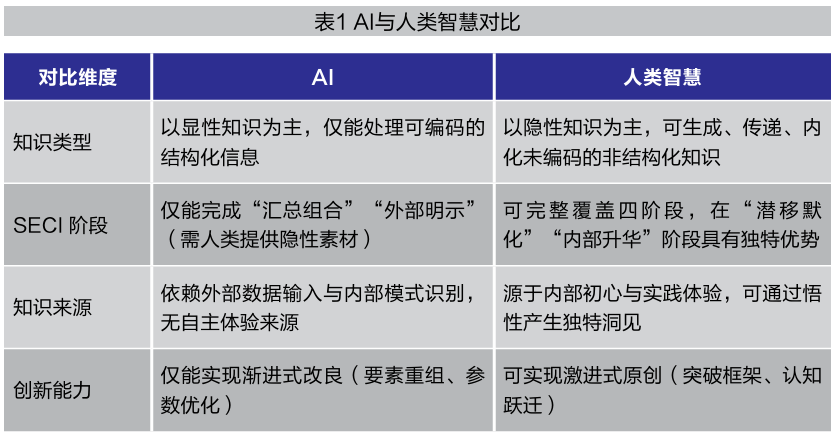
💡New 'AI + 悟性' model unlocks radical innovation beyond AI's combo limits.
⚡ 30-Second TL;DR
What Changed
AI limited to combinatorial/gradual innovation, can't generate implicit knowledge or paradox insights.
Why It Matters
Offers framework for researchers to boost breakthrough innovation by integrating human intuition with AI efficiency.
What To Do Next
Map your innovation pipeline to SECI stages and assign AI to combination tasks.
Who should care:Researchers & Academics
Key Points
- •AI limited to combinatorial/gradual innovation, can't generate implicit knowledge or paradox insights.
- •Wùxìng (intuition) enables hidden knowledge activation, metaphor fusion, and cognitive boundary breaks.
- •SECI model: AI shines in combination stage; humans essential for socialization, externalization, internalization.
- •Radical innovation via human-AI collab: 悟性 as pivot for breakthrough learning.
🧠 Deep Insight
AI-generated analysis for this event.
🔑 Enhanced Key Takeaways
- •The 'AI + 悟性' (Intuition) framework aligns with emerging research in 'Human-in-the-loop' (HITL) systems, specifically focusing on bridging the gap between Large Language Models' (LLMs) probabilistic reasoning and the 'tacit knowledge' gap identified in Nonaka and Takeuchi’s original SECI model.
- •Recent industry discourse in China emphasizes that relying solely on 'Combination' (AI-driven synthesis) leads to 'model collapse' or 'homogenization of innovation,' necessitating human-led 'Socialization' to inject novel, non-digitized cultural and experiential context into the training loop.
- •The model addresses the 'Black Box' problem of neural networks by proposing that human intuition acts as a heuristic filter, allowing organizations to navigate high-entropy VUCA environments where AI-generated outputs often lack the ethical and strategic nuance required for radical market shifts.
🔮 Future ImplicationsAI analysis grounded in cited sources
Enterprise adoption of 'Human-in-the-loop' (HITL) knowledge management systems will increase by 40% by 2028.
Organizations are shifting away from fully autonomous AI agents toward hybrid models to mitigate the risks of AI-generated hallucinations in strategic decision-making.
The integration of 'tacit knowledge' capture tools will become a standard feature in Knowledge Management (KM) software.
Current AI systems struggle with non-codified expertise, creating a market demand for platforms that facilitate the 'Socialization' and 'Externalization' phases of the SECI model.
📰
Weekly AI Recap
Read this week's curated digest of top AI events →
👉Related Updates

AI-curated news aggregator. All content rights belong to original publishers.
Original source: 虎嗅 ↗