AgentCore Unlocks Cross-Account Knowledge Base Access
💡Learn how to share governed knowledge across AWS accounts without copying source data.
⚡ 30-Second TL;DR
What Changed
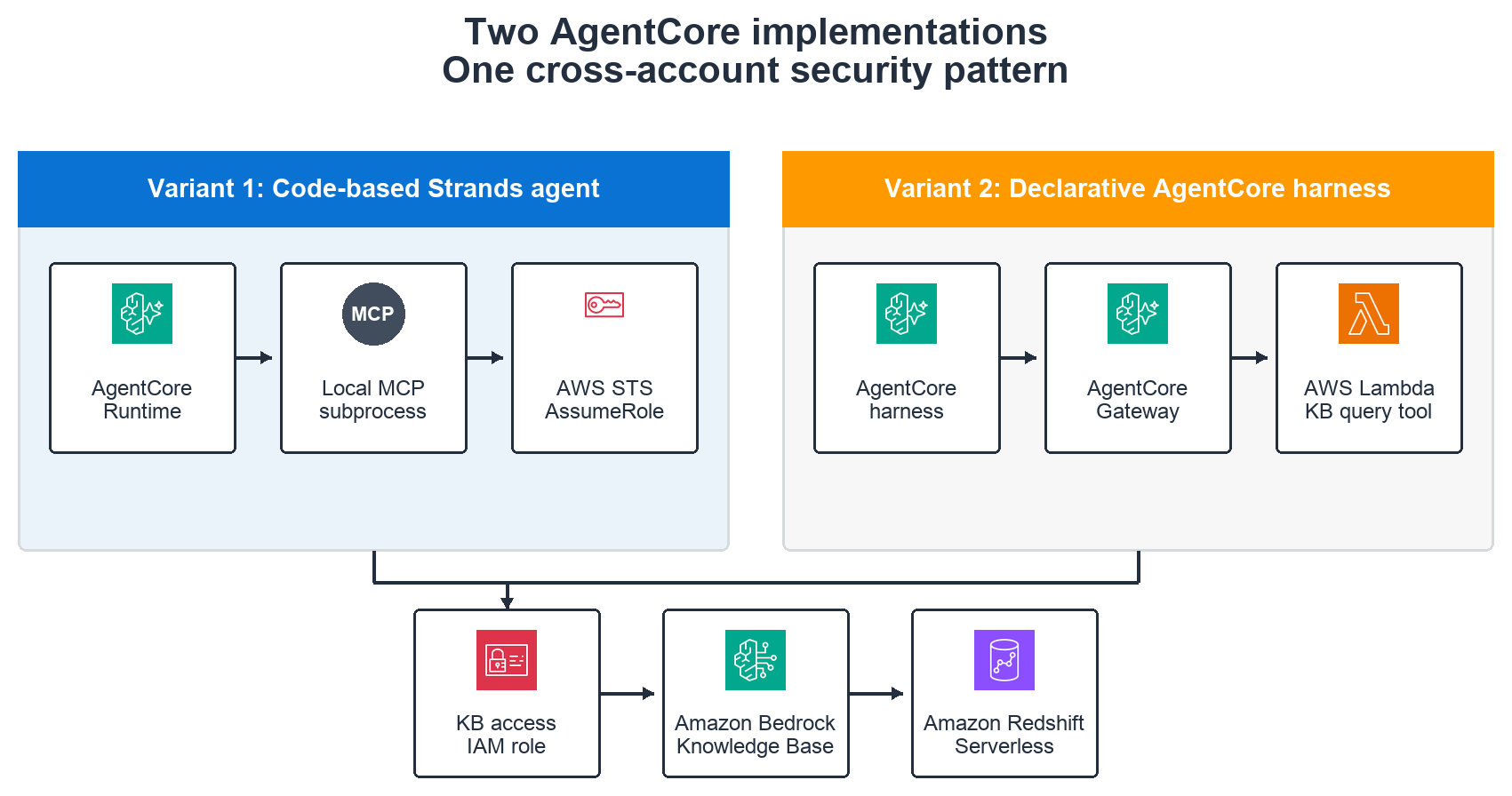
Agents in one AWS account can query a knowledge base located in another account.
Why It Matters
This enables organizations to centralize governed enterprise data while allowing AI agents in separate application accounts to use it. It can reduce data duplication and simplify multi-account architectures, but requires careful permission and trust-boundary design.
What To Do Next
Prototype a cross-account AgentCore setup using a Redshift Serverless-backed knowledge base and validate IAM permissions with both Strands and the declarative harness.
Key Points
- •Agents in one AWS account can query a knowledge base located in another account.
- •The knowledge base is backed by Amazon Redshift Serverless, with source data remaining in its original account.
- •The integration supports both a code-based Strands agent and a declarative AgentCore harness.
- •The design defines a security boundary for cross-account access without requiring data duplication.
🧠 Deep Insight
Background and context from public sources — not the original article. 11 sources cited.
🔑 Enhanced Key Takeaways
- •Amazon Bedrock AgentCore utilizes the Model Context Protocol (MCP) via a Gateway integration to expose managed knowledge bases as standardized tools.
- •User authorization context is propagated through agents, ensuring downstream services enforce access control based on the end-user's identity rather than the agent's service role.
- •Security is enforced via 'temporal policies' at the Gateway perimeter, which analyze agent trajectories and session history to prevent prompt injection or unauthorized tool usage.
- •Organizations can implement stateful, trajectory-aware governance using 'Dogwood,' an open-source policy language compatible with AWS Cedar.
- •AgentCore supports cross-account delivery of payloads and event streaming to Amazon S3, SNS, and Kinesis, enabling complex multi-account architectural patterns.
📊 Competitor Analysis▸ Show
| Feature | Amazon Bedrock AgentCore | LangChain/LangGraph (Enterprise) | Microsoft Semantic Kernel |
|---|---|---|---|
| Governance | Infrastructure-layer (Cedar/Dogwood) | Application-layer (Custom) | Application-layer (Custom) |
| Cross-Account | Native Resource-Based Policies | Requires manual IAM/STS setup | Requires manual IAM/STS setup |
| Security | Temporal/Trajectory-aware | Framework-dependent | Framework-dependent |
| Pricing | Pay-per-use (Bedrock/Redshift) | Open-source/Self-managed | Open-source/Self-managed |
🛠️ Technical Deep Dive
- Resource-based policies are attached directly to memory resources to facilitate cross-account data plane API calls.
- Integration with Model Context Protocol (MCP) allows for standardized tool exposure across heterogeneous agent environments.
- Temporal policy enforcement engine operates at the Gateway perimeter to evaluate tool call validity against cumulative session state.
- Dogwood governance language provides stateful, trajectory-aware constraints including budget caps and time-based access rules.
- AgentCore Runtime supports persistent session management for up to 14 days, maintaining state across multi-agent interactions.
🔮 Future ImplicationsAI analysis grounded in cited sources
⏳ Timeline
📎 Sources (11)
Factual claims are grounded in the sources below. Forward-looking analysis is AI-generated interpretation.
Weekly AI Recap
Read this week's curated digest of top AI events →
👉Related Updates
AI-curated news aggregator. All content rights belong to original publishers.
Original source: AWS Machine Learning Blog ↗
This is a summary, not the original. Read the source, or get the weekly briefing.
Weekly AI briefing
One email a week. Unsubscribe anytime.