AgentCore Adds Sequence Controls and Cost Guardrails
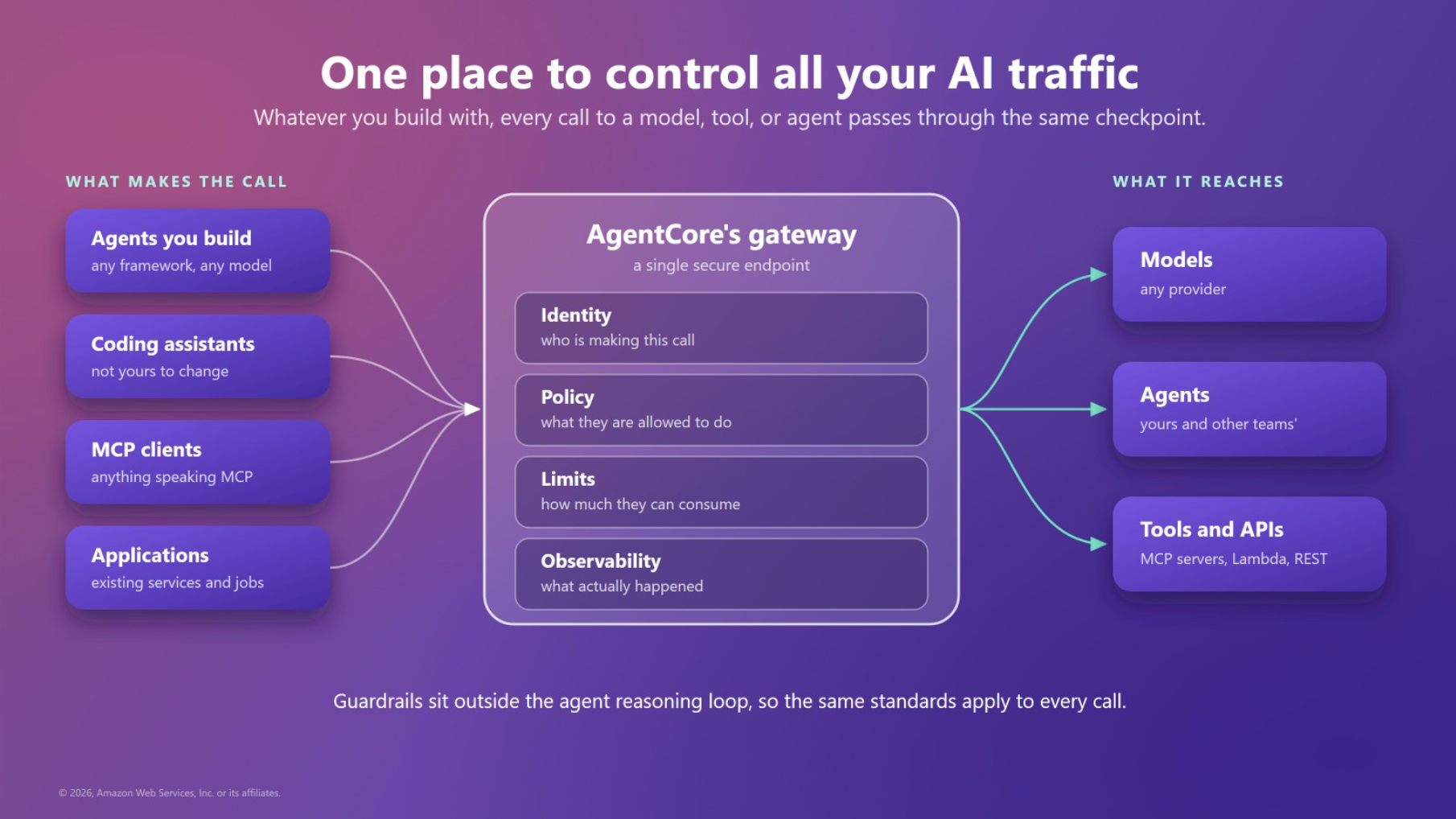
Set hard limits on multi-step agent behavior and spending instead of trusting prompts alone.
30-Second TL;DR
What Changed
Temporal policies provide deterministic control over sequences of agent actions.
Why It Matters
These controls can make production agents safer and more financially predictable, especially when agents perform multi-step tasks. Teams can govern behavior at the policy and gateway layers instead of relying solely on prompt instructions.
What To Do Next
Prototype a multi-step AgentCore workflow with Dogwood temporal policies and gateway rate limits, then verify its action and cost ceilings under repeated runs.
Key Points
- •Temporal policies provide deterministic control over sequences of agent actions.
- •Dogwood introduces an open-source policy language for defining AI agent behavior.
- •Gateway rate limiting helps enforce predictable usage and cost ceilings.
Deep Insight
AI-generated analysis for this event — not the original article.
Enhanced Key Takeaways
- •Dogwood utilizes a declarative syntax based on Rego, allowing developers to write policies that are decoupled from the agent's core reasoning engine.
- •The integration of gateway rate limiting operates at the infrastructure layer, preventing 'infinite loop' scenarios where agents repeatedly call expensive APIs.
- •AgentCore's temporal policies support state-based transitions, enabling developers to enforce strict ordering of tool execution (e.g., 'Verify' must precede 'Execute').
- •The update includes a new observability dashboard that visualizes policy violations in real-time, providing audit logs for compliance-heavy industries.
- •Amazon Bedrock AgentCore now supports cross-region policy synchronization, ensuring consistent cost guardrails across global deployments.
Competitor Analysis
- Amazon Bedrock AgentCore
- Dogwood (Rego-based)
- LangGraph (LangChain)
- Python/LangGraph State
- Microsoft Semantic Kernel
- Native Planner/Plugins
- Amazon Bedrock AgentCore
- Native Infrastructure-level
- LangGraph (LangChain)
- Custom Implementation
- Microsoft Semantic Kernel
- Middleware/Custom
- Amazon Bedrock AgentCore
- Deterministic Temporal
- LangGraph (LangChain)
- Graph-based Flow
- Microsoft Semantic Kernel
- Sequential/Step-based
- Amazon Bedrock AgentCore
- Dogwood (Policy)
- LangGraph (LangChain)
- Fully Open Source
- Microsoft Semantic Kernel
- Fully Open Source
| Feature | Amazon Bedrock AgentCore | LangGraph (LangChain) | Microsoft Semantic Kernel |
|---|---|---|---|
| Policy Language | Dogwood (Rego-based) | Python/LangGraph State | Native Planner/Plugins |
| Cost Guardrails | Native Infrastructure-level | Custom Implementation | Middleware/Custom |
| Sequence Control | Deterministic Temporal | Graph-based Flow | Sequential/Step-based |
| Open Source | Dogwood (Policy) | Fully Open Source | Fully Open Source |
Technical Deep Dive
- Dogwood Architecture: Implements a sidecar pattern where the policy engine evaluates agent action requests against a set of Rego rules before forwarding to the Bedrock model.
- Gateway Rate Limiting: Utilizes a token bucket algorithm implemented at the AWS API Gateway level, specifically tuned for LLM token consumption rates rather than just request counts.
- Temporal Policy Engine: Operates as a state machine that tracks the history of agent actions in a DynamoDB-backed session store to enforce sequence constraints.
- Latency Impact: The policy evaluation layer adds a sub-10ms overhead to the agent's decision loop, ensuring minimal impact on user-facing response times.
Future ImplicationsAI analysis grounded in cited sources
Timeline
- 2023-09Amazon Bedrock Agents launched to enable autonomous task execution.
- 2024-04Introduction of advanced prompt engineering and orchestration features for Bedrock Agents.
- 2025-02Release of AgentCore framework to standardize agent lifecycle management.
- 2026-08Integration of Dogwood policy language and gateway rate limiting into AgentCore.
Weekly AI Recap
Read this week's curated digest of top AI events →
Related Updates

AI-curated news aggregator. All content rights belong to original publishers.
Original source: AWS Machine Learning Blog ↗
This is a summary, not the original. Read the source, or get the weekly briefing.
The weekly digest
One email a week. Unsubscribe anytime.