Agent Plugins Standardizes Portable AI Extensions
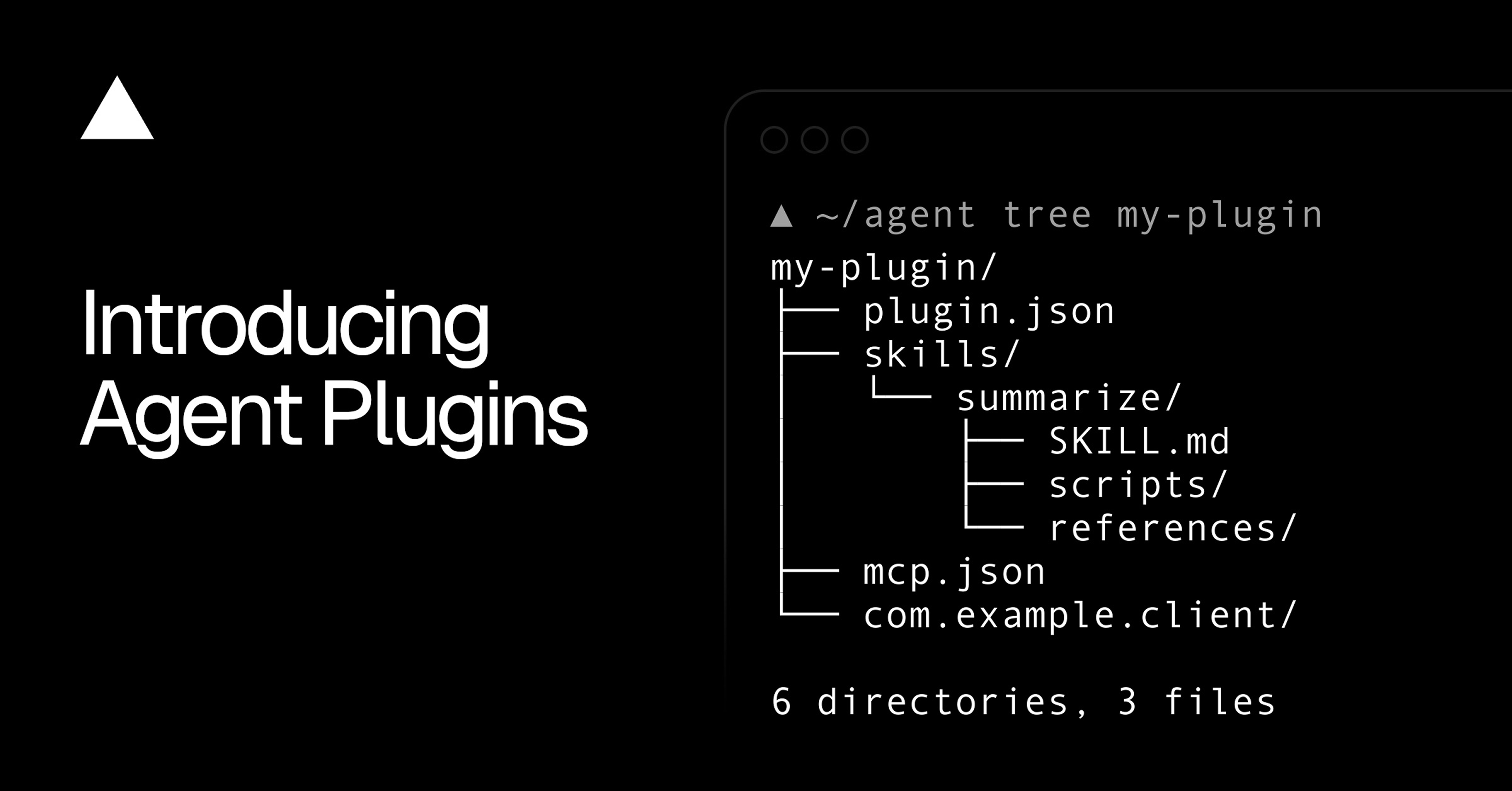
A common plugin format could make Agent Skills and MCP servers portable across AI clients.
30-Second TL;DR
What Changed
Agent Plugins uses a root plugin.json manifest requiring only the specification version and plugin name.
Why It Matters
The standard could reduce duplicate packaging work for developers distributing the same Skill or MCP server across multiple agent clients. It also gives client implementers a small, deterministic discovery contract without forcing uniform installation, policy, or user-experience choices.
What To Do Next
Package one existing Agent Skill or MCP server with plugin.json and test discovery in every client your product supports.
Key Points
- •Agent Plugins uses a root plugin.json manifest requiring only the specification version and plugin name.
- •Compatible clients discover Skills under skills/ and MCP server configuration under mcp.json.
- •Skills and MCP servers are validated independently, so an invalid component does not disable unrelated components.
- •Version 1 focuses on portability for Agent Skills and MCP servers, while commands, hooks, and agents remain client-specific.
- •A namespaced extension mechanism allows clients to add proprietary data and files.
Deep Insight
AI-generated analysis for this event — not the original article.
Enhanced Key Takeaways
- •The standard leverages the existing Model Context Protocol (MCP) ecosystem, allowing developers to package MCP servers as portable plugins without modifying the underlying protocol logic.
- •Vercel has open-sourced a reference implementation CLI tool that validates plugin directory structures against the 1.0.0 schema before deployment.
- •The specification includes a 'capabilities' field in the manifest, enabling agents to declare required permissions (e.g., file system access, network requests) before execution.
- •Major AI framework maintainers have signaled support for the standard to reduce fragmentation between agentic workflows in Vercel AI SDK and competing runtimes.
- •The plugin format is designed to be content-addressable, facilitating secure distribution via decentralized registries or private artifact repositories.
Competitor Analysis
- Agent Plugins (Vercel)
- Vendor-neutral
- LangChain Toolkits
- Framework-specific
- Anthropic MCP
- Protocol-level
- Agent Plugins (Vercel)
- High (Cross-client)
- LangChain Toolkits
- Low (LangChain only)
- Anthropic MCP
- High (Protocol-level)
- Agent Plugins (Vercel)
- Open Source (Free)
- LangChain Toolkits
- Open Source (Free)
- Anthropic MCP
- Open Source (Free)
- Agent Plugins (Vercel)
- Packaging/Distribution
- LangChain Toolkits
- Orchestration
- Anthropic MCP
- Connectivity
| Feature | Agent Plugins (Vercel) | LangChain Toolkits | Anthropic MCP |
|---|---|---|---|
| Standardization | Vendor-neutral | Framework-specific | Protocol-level |
| Portability | High (Cross-client) | Low (LangChain only) | High (Protocol-level) |
| Pricing | Open Source (Free) | Open Source (Free) | Open Source (Free) |
| Primary Focus | Packaging/Distribution | Orchestration | Connectivity |
Technical Deep Dive
- The plugin.json manifest utilizes a JSON Schema draft-07 structure to enforce strict type checking for plugin metadata.
- MCP server integration is achieved via a sidecar pattern where the plugin directory contains a local mcp.json file defining the transport mechanism (stdio or SSE).
- Namespaced extensions are implemented using a reserved 'x-' prefix in the manifest, following the OpenAPI specification pattern to ensure compatibility with non-aware parsers.
- The directory structure mandates a 'skills/' subdirectory where each skill must contain a 'manifest.json' and an executable entry point, typically a WASM module or a Node.js script.
Future ImplicationsAI analysis grounded in cited sources
Timeline
- 2024-11Anthropic introduces the Model Context Protocol (MCP) to standardize data connectivity.
- 2025-04Vercel begins internal development of a unified plugin architecture for the AI SDK.
- 2026-02Vercel initiates community RFC process for the Agent Plugins specification.
- 2026-08Vercel officially releases Agent Plugins 1.0.0.
Weekly AI Recap
Read this week's curated digest of top AI events →
AI-curated news aggregator. All content rights belong to original publishers.
Original source: Vercel News ↗
This is a summary, not the original. Read the source, or get the weekly briefing.
The weekly digest
One email a week. Unsubscribe anytime.