Agent landscape: What's hype vs. what's actually working
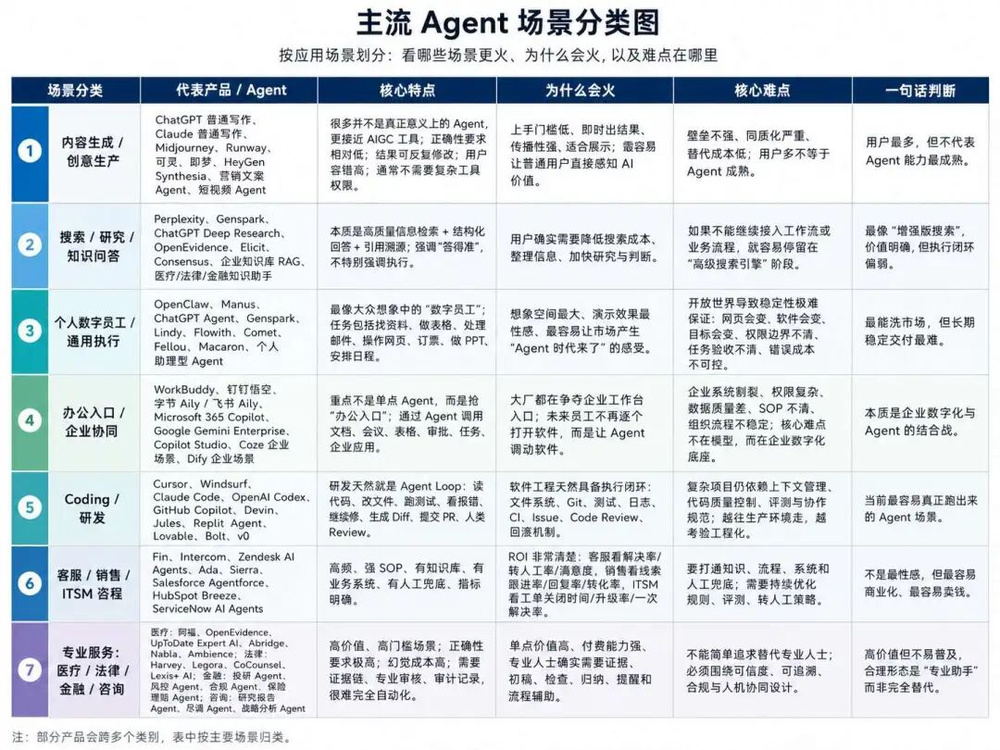
💡Cut through the noise: A clear framework for evaluating which AI agent categories are actually profitable.
⚡ 30-Second TL;DR
What Changed
Coding Agents (e.g., Cursor, Claude Code) are the only proven high-scale, high-retention Agent category.
Why It Matters
Developers should focus on building agents that solve specific, high-value production problems rather than chasing general-purpose 'digital employee' hype.
What To Do Next
Prioritize integrating agents into high-fault-tolerance workflows like coding or low-risk repetitive tasks to ensure immediate ROI.
Key Points
- •Coding Agents (e.g., Cursor, Claude Code) are the only proven high-scale, high-retention Agent category.
- •AI Customer Service is a 'cash cow' providing clear ROI through efficiency gains.
- •Most 'Digital Employee' demos (like OpenClaw) struggle with real-world complexity and lack high-frequency usage.
- •Agent success depends on balancing fault tolerance with action complexity.
🧠 Deep Insight
AI-generated analysis for this event — not the original article.
🔑 Enhanced Key Takeaways
- •The emergence of 'Agentic Workflows'—where models iteratively self-correct through multi-step reasoning—has been identified as the primary driver for the success of coding agents compared to single-turn LLM interactions.
- •Enterprise adoption of AI agents is increasingly shifting toward 'Human-in-the-loop' (HITL) architectures, where agents act as copilots for complex decision-making rather than fully autonomous entities to mitigate liability risks.
- •Evaluation benchmarks for agents have evolved from static datasets (like HumanEval) to dynamic, environment-based testing (like OSWorld), which better simulates real-world computer interaction.
- •The 'Agent Tax'—the latency and cost overhead associated with multi-step reasoning chains—remains a significant barrier to scaling agents in high-frequency, low-latency environments like real-time trading or gaming.
- •Memory management architectures, specifically the transition from simple RAG (Retrieval-Augmented Generation) to long-term episodic memory stores, are currently the most critical technical bottleneck for 'Digital Employee' agents.
📊 Competitor Analysis▸ Show
| Feature | Coding Agents (e.g., Cursor) | Customer Service Agents (e.g., Intercom Fin) | Digital Employee Demos (e.g., OpenClaw) |
|---|---|---|---|
| Primary ROI | Developer Velocity | Cost Reduction (Deflection) | Speculative/Experimental |
| Usage Frequency | High (Daily) | High (Continuous) | Low (Demo-based) |
| Fault Tolerance | High (Compiler Feedback) | Medium (Human Escalation) | Low (Open-ended) |
| Pricing Model | Subscription/Seat-based | Usage/Resolution-based | N/A (Often Open Source/Research) |
🛠️ Technical Deep Dive
- Agentic reasoning loops typically utilize ReAct (Reasoning + Acting) patterns, allowing models to observe environment states, think, and execute tool calls sequentially.
- Implementation often involves a 'Controller' model (e.g., GPT-4o or Claude 3.5 Sonnet) orchestrating smaller, specialized 'Worker' models for specific tasks.
- State persistence is managed through vector databases (e.g., Pinecone, Milvus) combined with structured session logs to maintain context across long-running tasks.
- Tool-use capability is enabled via Function Calling APIs, where the model generates structured JSON outputs that the execution environment maps to local or remote API calls.
🔮 Future ImplicationsAI analysis grounded in cited sources
⏳ Timeline
Weekly AI Recap
Read this week's curated digest of top AI events →
👉Related Updates


AI-curated news aggregator. All content rights belong to original publishers.
Original source: 虎嗅 ↗
This is a summary, not the original. Read the source, or get the weekly briefing.
The weekly digest
One email a week. Unsubscribe anytime.