A New Agent App Challenges Google
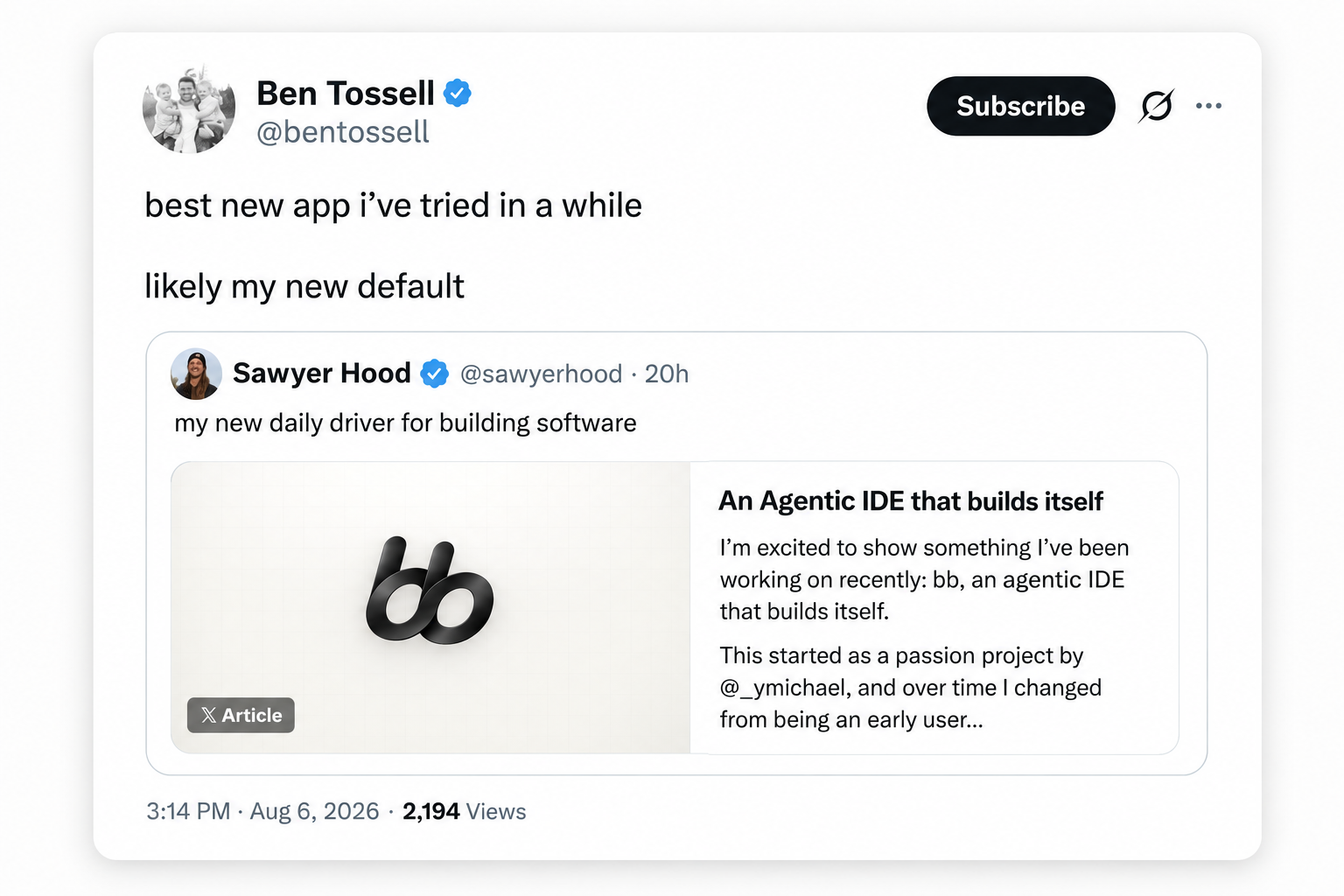
A vague but intriguing signal that a new AI agent app could pressure Google.
30-Second TL;DR
What Changed
The author is actively using a new agent app.
Why It Matters
If the app delivers useful autonomous workflows, it could signal growing competition for Google in AI-powered applications. However, the limited excerpt does not support conclusions about market impact or product quality.
What To Do Next
Read the full Ben's Bites article to identify the app, then test its core agent workflow against your current automation stack.
Key Points
- •The author is actively using a new agent app.
- •The app’s name, developer, and technical capabilities are not disclosed.
- •The article frames the development as a possible competitive challenge to Google.
Deep Insight
AI-generated analysis for this event — not the original article.
Enhanced Key Takeaways
- •The 'agent app' referenced in recent industry discourse is widely speculated to be a reference to emerging autonomous browser-based agents that utilize Large Action Models (LAMs) to execute multi-step workflows.
- •Industry analysts suggest the threat to Google stems from the shift from 'search-and-click' paradigms to 'agentic-execution' models, which bypass traditional search engine results pages (SERPs) entirely.
- •Many of these new agent applications are leveraging open-source frameworks like LangChain or AutoGPT, allowing them to integrate directly with third-party APIs rather than relying on Google's index.
- •Venture capital interest in agentic AI has surged in mid-2026, with significant funding rounds directed at startups focusing on 'personal operating systems' that manage user tasks across disparate web applications.
- •Google has responded to this competitive pressure by accelerating the integration of 'Project Jarvis' and similar agentic capabilities into the Chrome browser to retain user engagement within its ecosystem.
Competitor Analysis
- Google (Project Jarvis)
- Browser-integrated automation
- Emerging Agent Apps
- API-driven task execution
- Traditional Search
- Keyword-based retrieval
- Google (Project Jarvis)
- Bundled/Freemium
- Emerging Agent Apps
- Subscription/Usage-based
- Traditional Search
- Ad-supported (Free)
- Google (Project Jarvis)
- High (Deep ecosystem integration)
- Emerging Agent Apps
- Variable (Task success rate)
- Traditional Search
- N/A (Information retrieval)
| Feature | Google (Project Jarvis) | Emerging Agent Apps | Traditional Search |
|---|---|---|---|
| Primary Interaction | Browser-integrated automation | API-driven task execution | Keyword-based retrieval |
| Pricing | Bundled/Freemium | Subscription/Usage-based | Ad-supported (Free) |
| Benchmarks | High (Deep ecosystem integration) | Variable (Task success rate) | N/A (Information retrieval) |
Technical Deep Dive
- Architecture typically utilizes a Large Action Model (LAM) core capable of interpreting UI elements as text/semantic tokens.
- Implementation relies on headless browser automation (e.g., Playwright or Puppeteer) to interact with DOM elements directly.
- Uses ReAct (Reasoning + Acting) prompting patterns to decompose high-level user intent into sequential API calls or UI interactions.
- Often employs local vector databases for long-term memory and context retention across sessions.
Future ImplicationsAI analysis grounded in cited sources
Timeline
- 2025-03Google announces initial research into browser-based autonomous agents.
- 2025-11Release of foundational LAM research papers enabling UI-based navigation.
- 2026-05First wave of independent agent apps gains traction in developer communities.
Weekly AI Recap
Read this week's curated digest of top AI events →
AI-curated news aggregator. All content rights belong to original publishers.
Original source: Ben's Bites ↗
This is a summary, not the original. Read the source, or get the weekly briefing.
The weekly digest
One email a week. Unsubscribe anytime.