💰钛媒体•Freshcollected in 17m
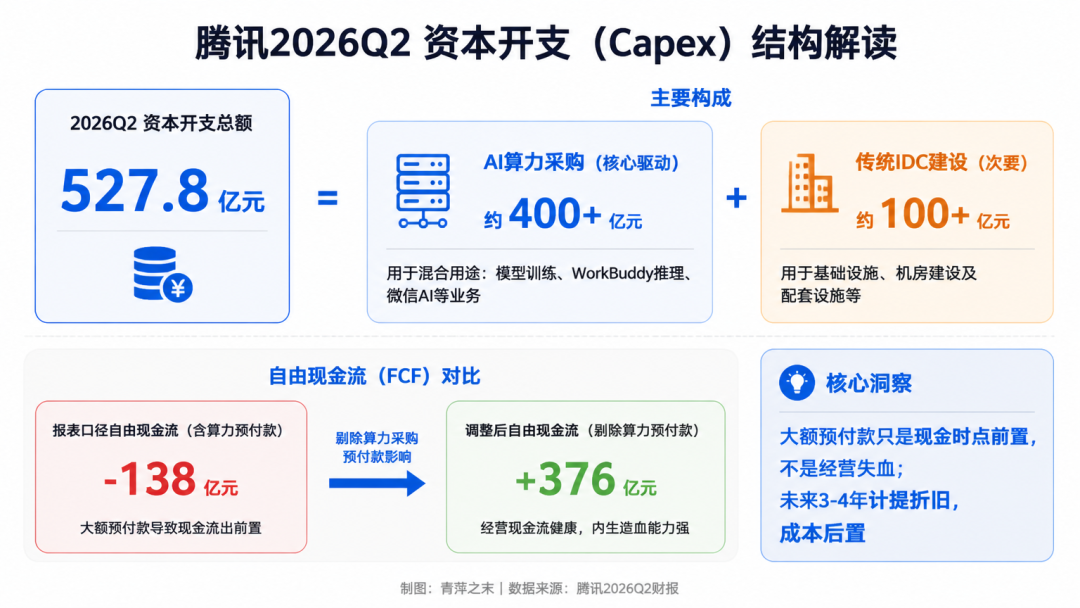
騰訊528億算力押注:模型優先
#ai-compute#capital-expenditure#model-strategy#compute-rentaltencent-ai-compute-strategytencenthunyuanworkbuddy
💡Tencent 把 528 億元算力投入押在哪裡,將影響模型競爭與 AI 基礎設施價格。
⚡ 30-Second TL;DR
What Changed
Tencent 將大額資本支出投入 AI 算力與模型發展。
Why It Matters
Tencent 的資本配置反映大型科技公司正把算力視為模型競爭力與商業基礎設施。若出租業務能消化閒置容量,可能降低 AI 投資風險;但也會面對算力供給、價格與利用率壓力。
What To Do Next
以自身推理工作負載測試 Tencent 的 AI 算力租用方案,對比 Hunyuan API 的成本、延遲與可用性後再決定是否遷移。
Who should care:Founders & Product Leaders
Key Points
- •Tencent 將大額資本支出投入 AI 算力與模型發展。
- •公司策略以自有模型能力為優先,算力出租被視為備選商業化路徑。
- •Hunyuan、WorkBuddy 與 Tencent Q2 財報是理解其 AI 戰略的重要線索。
- •算力出租能否形成足夠寬廣且具利潤的退路,仍是主要不確定性。
🧠 Deep Insight
AI-generated analysis for this event.
🔑 Enhanced Key Takeaways
- •Tencent's capital expenditure surge is heavily driven by the procurement of high-end NVIDIA H20 GPUs, which are specifically optimized for the Chinese market under US export restrictions.
- •The 'Model-First' strategy is integrated into Tencent's 'Full-Stack' AI architecture, which spans from self-developed Hunyuan models to MaaS (Model-as-a-Service) platforms and underlying cloud infrastructure.
- •Tencent has shifted its cloud focus from traditional IaaS (Infrastructure-as-a-Service) to high-margin AI-native services, aiming to capture value from the enterprise digital transformation sector.
- •The company is leveraging its massive WeChat and enterprise software ecosystem to create a 'closed-loop' AI application environment, distinguishing its strategy from pure-play cloud providers.
- •Tencent's investment includes significant R&D in AI-specific data center cooling and high-speed interconnect technologies to optimize the efficiency of its massive GPU clusters.
📊 Competitor Analysis▸ Show
| Feature | Tencent (Hunyuan) | Alibaba (Qwen) | Baidu (Ernie) |
|---|---|---|---|
| Core Strategy | Ecosystem Integration | Open Source/Developer Focus | Search/Industrial AI |
| Model Access | Tencent Cloud/MaaS | ModelScope/Open Source | Baidu Cloud/Baidu Search |
| Key Advantage | WeChat/Enterprise Apps | Strongest Open Source Ecosystem | Early Mover/Search Data |
🛠️ Technical Deep Dive
- Hunyuan utilizes a Mixture-of-Experts (MoE) architecture to balance computational efficiency with model performance across diverse tasks.
- The infrastructure employs a proprietary high-performance computing cluster management system designed to minimize latency in distributed training.
- Tencent's AI stack incorporates a self-developed high-speed network protocol to improve GPU-to-GPU communication efficiency within large-scale clusters.
- WorkBuddy leverages RAG (Retrieval-Augmented Generation) technology to integrate with internal enterprise knowledge bases, ensuring data privacy and accuracy.
🔮 Future ImplicationsAI analysis grounded in cited sources
Tencent will achieve a higher AI-driven cloud revenue growth rate compared to its traditional IaaS business by 2027.
The shift toward high-margin MaaS and AI-native enterprise solutions is designed to offset the commoditization of traditional cloud storage and computing services.
Tencent will reduce its reliance on third-party GPU procurement by accelerating the deployment of proprietary AI accelerators.
Ongoing US export restrictions on high-end chips necessitate a long-term strategy of vertical integration to maintain competitive AI training capabilities.
⏳ Timeline
2023-09
Tencent officially releases the Hunyuan large language model to the public.
2024-05
Tencent upgrades Hunyuan to a Mixture-of-Experts (MoE) architecture.
2025-03
Tencent launches WorkBuddy as a core AI-native productivity tool for enterprise clients.
2026-05
Tencent reports significant Q1 capital expenditure increase focused on AI infrastructure.
📰
Weekly AI Recap
Read this week's curated digest of top AI events →
👉Related Updates


AI-curated news aggregator. All content rights belong to original publishers.
Original source: 钛媒体 ↗