4 Tips to Create Worlds in Project Genie
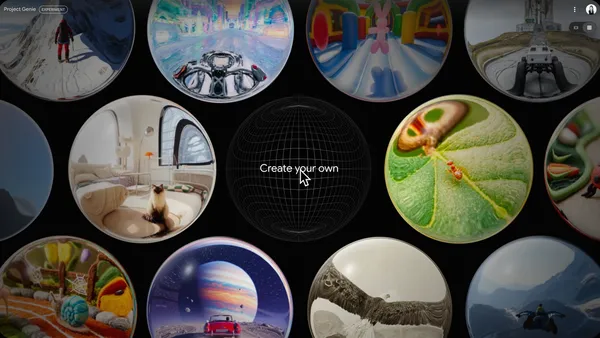
💡DeepMind's 4 tips unlock better prompting for Project Genie world-building.
⚡ 30-Second TL;DR
What Changed
Project Genie from Google DeepMind for prompt-based world generation
Why It Matters
These tips democratize access to advanced world-generation AI, empowering creators to experiment without deep expertise. It could spur innovations in game prototyping and virtual environments.
What To Do Next
Read the Google AI Blog post and test the 4 prompting tips in Project Genie.
Key Points
- •Project Genie from Google DeepMind for prompt-based world generation
- •4 specific tips for crafting effective prompts
- •Enables creation of custom interactive worlds
- •Hosted on Google AI Blog for practical guidance
🧠 Deep Insight
Background and context from public sources — not the original article. 8 sources cited.
🔑 Enhanced Key Takeaways
- •Project Genie is accessible only to Google AI Ultra subscribers in the U.S. (18+), with rollout starting January 29, 2026, and plans for expansion to more territories.[1][2]
- •It integrates Genie 3 (11-billion-parameter autoregressive transformer), Nano Banana Pro for images, and Gemini for language processing, generating worlds at 720p resolution and 24 FPS with a 60-second interaction limit due to compute constraints.[1][3]
- •Genie 3 maintains environmental consistency for several minutes, supports real-time navigation and physics simulation, and enables applications in robotics, gaming, and agent training like with SIMA.[4][5]
🛠️ Technical Deep Dive
- •Genie 3 is an 11-billion-parameter autoregressive transformer model that generates real-time navigable 3D worlds at 720p resolution and 24 frames per second.[1]
- •It achieves consistency by recalling previously seen details during navigation, supporting sustained interaction for several minutes without degradation.[1][4]
- •Project Genie combines Genie 3 for world generation, Nano Banana Pro for image creation, and Gemini for natural language processing to enable world sketching, exploration, and remixing.[1][3]
- •Current limitations include a 60-second generation cap per session due to dedicated compute allocation, imperfect multi-agent interactions, and inaccurate real-world geographic simulation.[1][3][4]
🔮 Future ImplicationsAI analysis grounded in cited sources
⏳ Timeline
📎 Sources (8)
Factual claims are grounded in the sources below. Forward-looking analysis is AI-generated interpretation.
- almcorp.com — Google Deepmind Project Genie Technical Analysis Applications
- Google Blog — Project Genie
- TechCrunch — I Built Marshmallow Castles in Googles New AI World Generator Project Genie
- Google DeepMind — Genie
- Google DeepMind — Genie 3 a New Frontier for World Models
- Google Blog — Tips Prompt Writing Project Genie
- Google DeepMind
- youtube.com — Watch
Weekly AI Recap
Read this week's curated digest of top AI events →
👉Related Updates
AI-curated news aggregator. All content rights belong to original publishers.
Original source: Google AI Blog ↗
This is a summary, not the original. Read the source, or get the weekly briefing.
Weekly AI briefing
One email a week. Unsubscribe anytime.