2026 National Exam implements AI proctoring
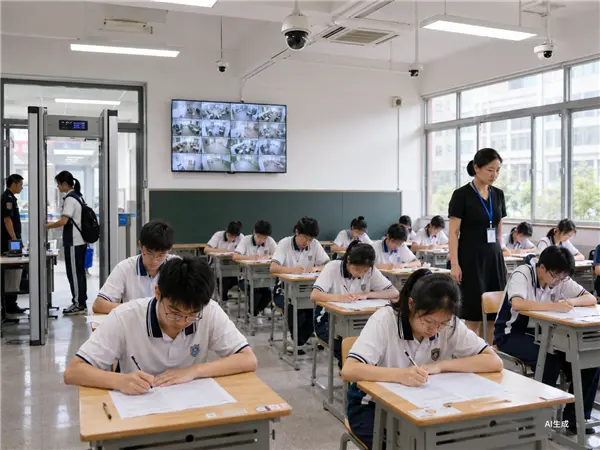
💡Learn how large-scale AI proctoring is being deployed to secure national-level high-stakes examinations.
⚡ 30-Second TL;DR
What Changed
AI proctoring systems deployed across 348,000 exam rooms
Why It Matters
The widespread adoption of AI in high-stakes testing environments signals a shift toward automated, real-time surveillance in public infrastructure. It highlights the growing role of computer vision in behavioral monitoring.
What To Do Next
Review the latest computer vision benchmarks for anomaly detection to understand how AI proctoring systems identify suspicious behavior in crowded environments.
Key Points
- •AI proctoring systems deployed across 348,000 exam rooms
- •Strict ban on smart glasses and unauthorized electronic devices
- •Integration of smart inspection systems to ensure exam integrity
🧠 Deep Insight
Background and context from public sources — not the original article. 18 sources cited.
🔑 Enhanced Key Takeaways
- •The 2026 National College Entrance Exam (Gaokao) in China involves approximately 12.9 million registered students, making it the world's largest college entrance test.
- •AI proctoring systems analyze video feeds from thousands of exam halls in real-time to detect suspicious behaviors such as unusual eye movements, handwriting inconsistencies, and the use of forbidden electronic devices.
- •Beyond general monitoring, biometric technologies like facial recognition, fingerprint, and iris scans are employed for rigorous identity verification of candidates before, during, and after the exam.
- •The strict ban on smart glasses and other unauthorized electronic devices is a direct response to the proven capability of these devices, when linked with AI, to provide real-time answers and significantly boost exam scores.
- •The 2026 deployment of AI-assisted invigilation is significantly more widespread than in previous years, covering a larger number of testing centers across multiple provinces, indicating an accelerating trend of digitizing and automating China's education system.
🛠️ Technical Deep Dive
- AI proctoring systems utilize machine learning models and rule-based logic to identify patterns indicative of academic dishonesty or policy violations.
- Key components include facial recognition for identity verification, eye-tracking, gaze direction analysis, and comprehensive behavior analysis.
- The systems simultaneously monitor multiple data streams: visual input from webcams (detecting faces, head movements, and unauthorized persons), audio signals from microphones (identifying background noise or additional voices), and digital activity (browser usage, tab switching, screen recording, and application usage).
- They are designed to flag anomalies such as repeated eye movement away from the screen, the presence of additional people in the room, unusual audio activity, or attempts to navigate away from the secure exam interface.
- Flagged events are typically timestamped and organized for review by human proctors, ensuring that final integrity decisions are made by people, not solely by algorithms.
- Advanced capabilities include monitoring handwriting inconsistencies and, in some systems, analyzing keyboard pressure and typing speed for keystroke signature verification.
- Biometric authentication systems, such as fingerprint and iris scanners, are also integrated to prevent impersonation.
🔮 Future ImplicationsAI analysis grounded in cited sources
⏳ Timeline
📎 Sources (18)
Factual claims are grounded in the sources below. Forward-looking analysis is AI-generated interpretation.
Weekly AI Recap
Read this week's curated digest of top AI events →
👉Related Updates
AI-curated news aggregator. All content rights belong to original publishers.
Original source: cnBeta (Full RSS) ↗
This is a summary, not the original. Read the source, or get the weekly briefing.
The weekly digest
One email a week. Unsubscribe anytime.