ω-0 Brings Whole-Body Autonomy to Humanoid Robots
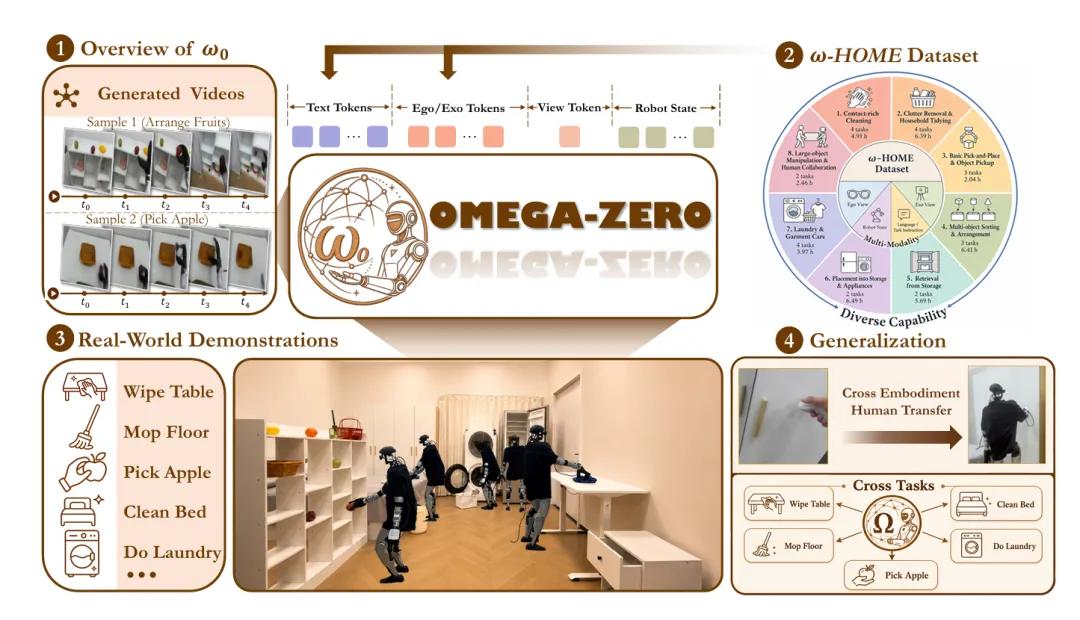
💡See how ω-0 could make humanoid robots coordinate their entire bodies for household work.
⚡ 30-Second TL;DR
What Changed
ω-0 is positioned as a world action model for embodied robots.
Why It Matters
If the approach generalizes across tasks, it could reduce the engineering effort required to build separate controllers for each household activity. It also reinforces the shift toward foundation models for embodied intelligence and robotic autonomy.
What To Do Next
Review ω-0's paper or code release and test its whole-body control approach in a simulated household task before considering hardware deployment.
Key Points
- •ω-0 is positioned as a world action model for embodied robots.
- •The system focuses on whole-body coordination rather than isolated limb control.
- •Its target use case is autonomous household work by humanoid robots.
🧠 Deep Insight
AI-generated analysis for this event.
🔑 Enhanced Key Takeaways
- •ω-0 utilizes a transformer-based architecture specifically trained on large-scale, multi-modal embodied datasets to predict future states and actions simultaneously.
- •The model employs a hierarchical control strategy that decouples high-level task planning from low-level whole-body motor execution to reduce computational latency.
- •Researchers integrated a novel 'Action-Aware World Model' (AAWM) mechanism that allows the robot to simulate the physical consequences of its movements before execution.
- •The system demonstrates zero-shot generalization capabilities, allowing it to perform household tasks in previously unseen environments without additional fine-tuning.
- •The project leverages a proprietary simulation-to-reality (Sim2Real) pipeline that incorporates physics-based noise injection to improve robustness in unstructured home settings.
📊 Competitor Analysis▸ Show
| Feature | ω-0 (Peking/NTU) | Google RT-2 | Tesla Optimus Gen 3 |
|---|---|---|---|
| Core Focus | Whole-Body Action Model | Vision-Language-Action | End-to-End Neural Control |
| Primary Architecture | Transformer-based World Model | VLA (Vision-Language-Action) | FSD-derived Embodied AI |
| Target Environment | Household | General Purpose | Industrial/Household |
| Benchmarks | High Whole-Body Coordination | High Semantic Understanding | High Dexterity/Speed |
🛠️ Technical Deep Dive
- Architecture: Employs a latent space world model that predicts future proprioceptive and visual states conditioned on action sequences.
- Training Data: Utilizes a hybrid dataset combining teleoperation demonstrations and synthetic data generated from high-fidelity physics engines.
- Control Frequency: Operates at a high-frequency control loop (approx. 500Hz) for motor commands while maintaining a lower-frequency (approx. 20Hz) planning loop.
- Modality: Multi-modal input processing including RGB-D camera streams, joint encoders, and IMU data.
- Optimization: Uses reinforcement learning from human feedback (RLHF) to align autonomous actions with human-preferred movement patterns.
🔮 Future ImplicationsAI analysis grounded in cited sources
⏳ Timeline
Weekly AI Recap
Read this week's curated digest of top AI events →
👉Related Updates


AI-curated news aggregator. All content rights belong to original publishers.
Original source: 钛媒体 ↗