Qwen’s Former Lead Launches Pragmatik Labs
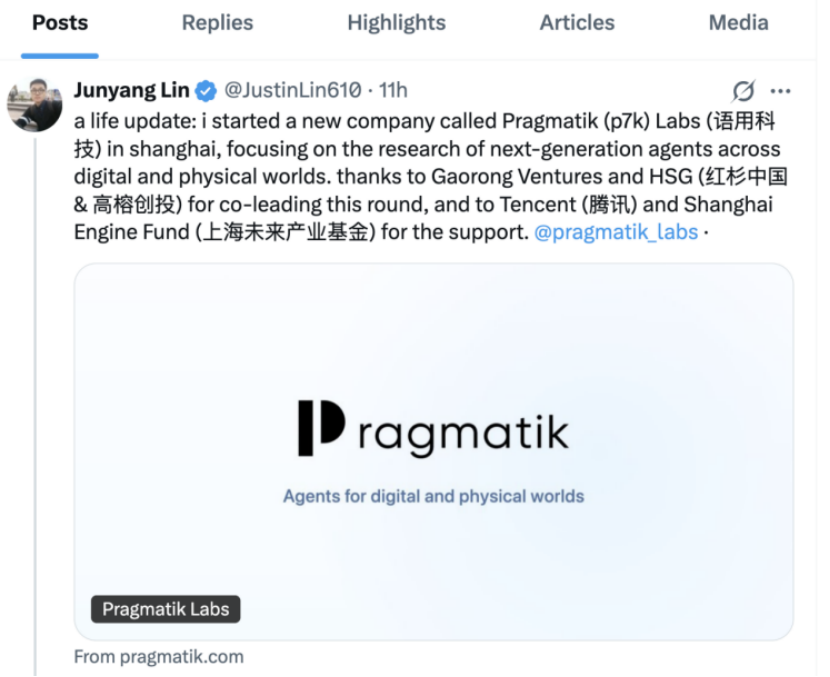
💡Qwen’s former technical lead is betting billions on agents that operate beyond chat and across physical environments.
⚡ 30-Second TL;DR
What Changed
Pragmatik Labs focuses on next-generation agents spanning digital and physical environments.
Why It Matters
The launch gives the agent sector a highly visible founder with deep experience building and open-sourcing Qwen. The large early valuation and participation from major investors may intensify competition among Chinese cities and startups for agent talent, capital, and compute resources.
What To Do Next
Prototype an agent architecture that explicitly models the environment and evaluates end-to-end task completion instead of benchmarking the base model alone.
Key Points
- •Pragmatik Labs focuses on next-generation agents spanning digital and physical environments.
- •The company’s first round was co-led by Gaorong Capital and Sequoia China, with Tencent and Shanghai Future Industry Fund also participating.
- •The startup reportedly reached a post-money valuation of $2 billion before publicly revealing specific models or products.
- •The company is based in Shanghai’s Xuhui Modu Space and uses four strategic themes: digital agents, physical agents, research-to-product, and long-term exploration.
- •Lin’s strategy shifts the AI focus from training standalone models to training complete agent systems composed of models and environments.
🧠 Deep Insight
AI-generated analysis for this event.
🔑 Enhanced Key Takeaways
- •Lin Junyang previously served as a core member of the Qwen team at Alibaba Cloud, playing a pivotal role in the development and scaling of the Qwen large language model series.
- •Pragmatik Labs is positioning itself to solve the 'embodiment gap' by integrating large-scale model training directly with simulated and real-world physical environments rather than relying solely on text-based pre-training.
- •The company's headquarters in Xuhui Modu Space is part of a broader Shanghai government initiative to foster an 'AI Valley' ecosystem, providing Pragmatik Labs with proximity to local compute resources and research talent.
- •The $2 billion valuation is notably high for a seed/early-stage startup, reflecting investor confidence in Lin's specific technical roadmap for 'Agent-Centric' AI architecture over traditional LLM-as-a-service models.
- •The startup's research agenda includes developing proprietary 'World Models' that allow agents to predict physical consequences of actions, a departure from the autoregressive text-prediction paradigm.
📊 Competitor Analysis▸ Show
| Feature | Pragmatik Labs | Figure AI | Physical Intelligence |
|---|---|---|---|
| Primary Focus | Digital & Physical Agent Systems | Humanoid Robotics | General Purpose Robot Foundation Models |
| Architecture | Agent-Environment Co-training | End-to-End Neural Networks | Policy-based Foundation Models |
| Valuation | ~$2B (Post-money) | ~$2.6B+ | Undisclosed (High) |
| Key Differentiator | Integrated Digital/Physical Agent focus | Hardware-first approach | Software/Model-first approach |
🛠️ Technical Deep Dive
- Focuses on 'Environment-in-the-loop' training where agents receive feedback from both digital simulations and physical sensors.
- Utilizes a modular architecture that separates the 'Reasoning Core' (LLM-based) from the 'Action Execution Layer' (Policy-based).
- Employs multi-modal sensory fusion to allow agents to process visual, tactile, and textual data simultaneously.
- Research emphasizes 'Active Inference' frameworks, enabling agents to minimize uncertainty in dynamic environments.
🔮 Future ImplicationsAI analysis grounded in cited sources
⏳ Timeline
Weekly AI Recap
Read this week's curated digest of top AI events →
👉Related Updates


AI-curated news aggregator. All content rights belong to original publishers.
Original source: 虎嗅 ↗