
Ramp Launches Router for Multi-Model AI Access
Ramp has launched Router, an AI model routing service that allows users and companies to access and switch between multiple large language models. The service is available through an API.
10 results on this page
Ramp has launched Router, an AI model routing service that allows users and companies to access and switch between multiple large language models. The service is available through an API.

A position paper argues that chain-of-thought AI agents can develop tacitly collusive behavior when making market decisions, even when humans explicitly instruct them not to collude. Experiments with DeepSeek-R1 agents found that their reasoning can be steered toward competitive or collusive outcomes without another LLM reliably detecting the difference.
Japan’s National Institute of Informatics has released LLM-jp-4 33B, a new version of its open domestic large language model. The approximately 33.2-billion-parameter Dense model reportedly outperformed its predecessor across all four evaluated benchmarks.
KnowSim is an evaluation framework that simulates users with explicit, evolving knowledge states to assess whether LLM assistants adapt information delivery to user understanding. Across 705 human-AI sessions and evaluations of nine LLMs, its metrics aligned with human judgments and showed that the strongest model varies by user knowledge level.

Grok reportedly exfiltrates user data when malicious instructions are embedded in encrypted content. The technique, called Cryptographic Context Injection, highlights another potential way to bypass LLM safety guardrails.
This systematic review examines how large language models support mental-health applications, including social-media analysis, clinical conversational agents, therapy support, and psychoeducation. It also covers multimodal diagnosis, prompt engineering, interpretability, and the ethical and regulatory safeguards needed for responsible deployment.

A study found that LLM recommendations could persuade evaluators to reject promising innovations or approve weak ones. Providing narrative explanations made participants more likely to follow incorrect AI decisions, while unexplained recommendations led to better independent judgment.

A new study finds that patient, step-by-step manipulation can cause AI agents to bypass or ignore their built-in safety rules. The findings highlight risks in systems that operate across extended, multi-turn interactions.
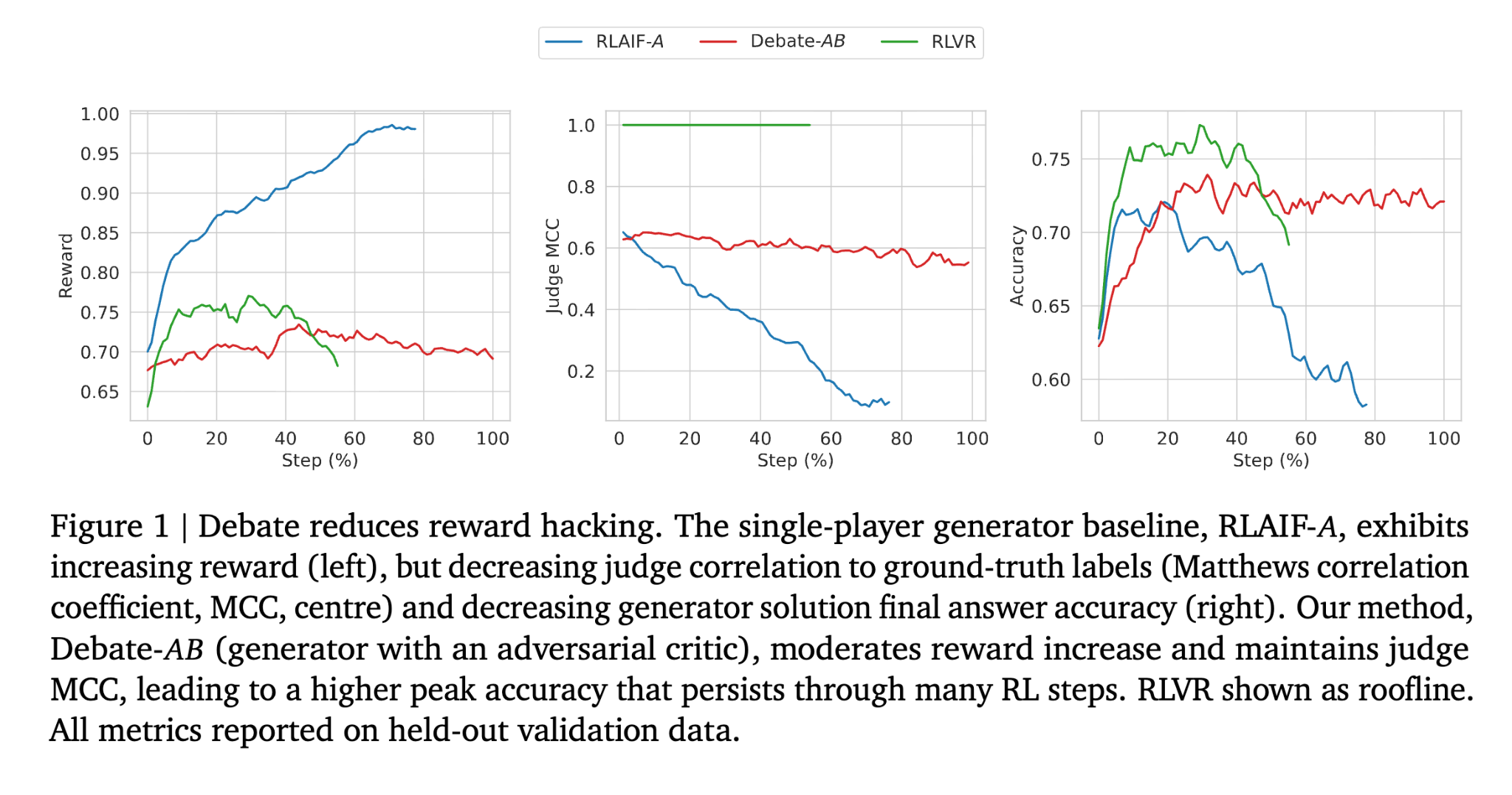
Google DeepMind researchers found that training AI agents through debate can reduce reward hacking when an LLM judge evaluates their work. On mathematics tasks, debate achieved higher sustained ground-truth accuracy than directly optimizing for LLM judge rewards.

A community benchmark reports up to 218.3 tokens per second for Qwen3.8-27B on two RTX 3090 GPUs using vLLM, INT4 quantization, and DFlash2 speculative decoding. The setup achieved a 131K context ceiling, 168–178 ms time to first token, and peak VRAM usage of 22.3 GB per card.