💰钛媒体•較早收集於 28m
西湖大學實現無負極電池技術重大突破
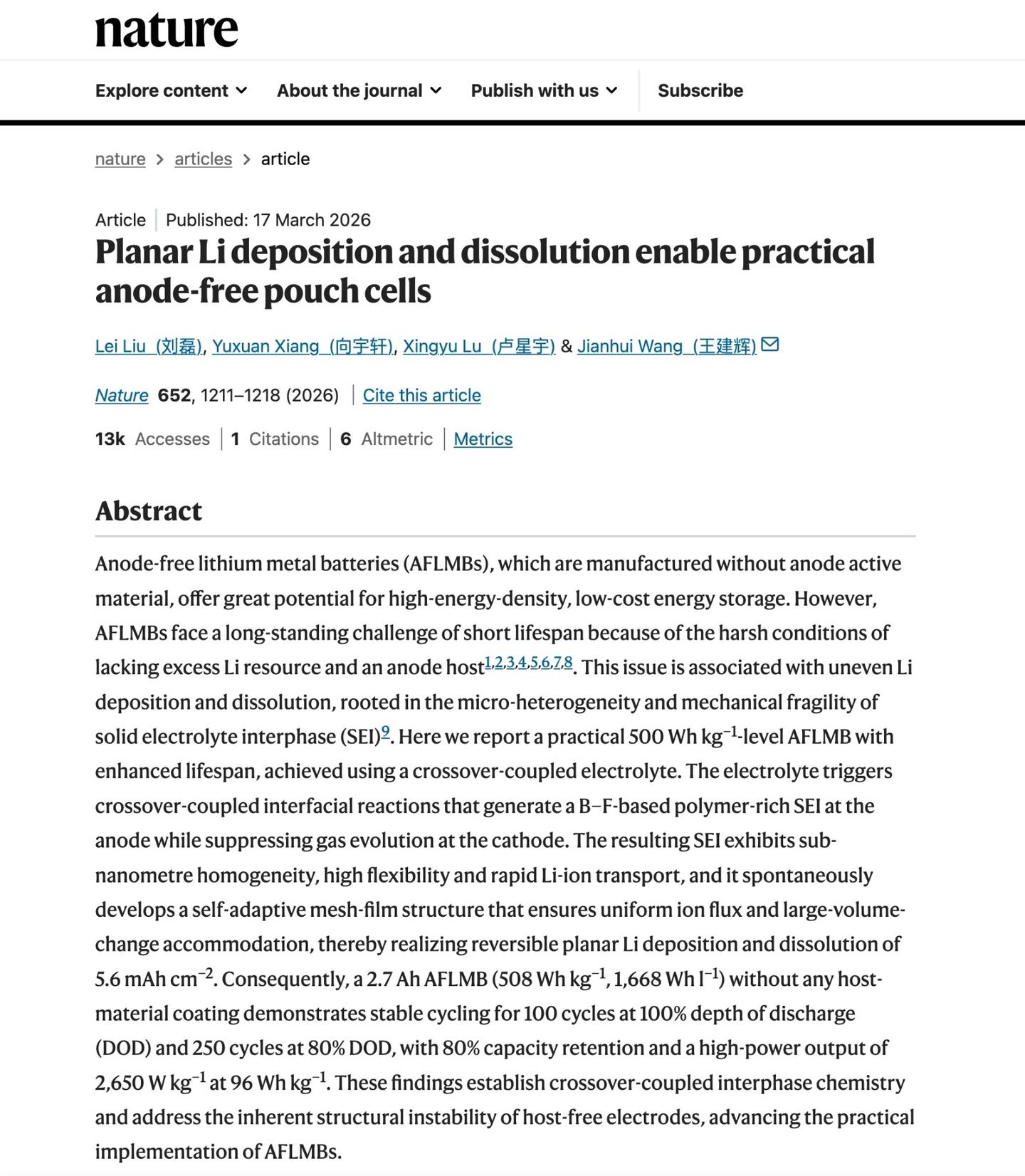
💡高密度電池的突破對於邊緣 AI 硬體與自主機器人的未來發展至關重要。
⚡ 30-Second TL;DR
有什麼變化
西湖大學團隊研究成果發表於 Nature 期刊
為什麼重要
這項技術透過大幅提升能量密度,可能徹底改變行動裝置與電動車的儲能方式,代表著向更高效、輕量化電源解決方案的轉變。
下一步行動
密切關注無負極電池的商業化時間表,以便為未來的邊緣運算裝置調整硬體電源管理策略。
誰應關注:Developers & AI Engineers
關鍵要點
- •西湖大學團隊研究成果發表於 Nature 期刊
- •無負極電池架構顯著降低了重量與體積
- •技術正從實驗室研究轉向產業化階段
🧠 深度解析
Web-grounded analysis with 17 cited sources.
🔑 增強重點摘要
- •The breakthrough by Westlake University, published in Nature on March 17, 2026, details a novel "crossover-coupled electrolyte" that creates a B-F-based polymer-rich solid electrolyte interphase (SEI) at the anode, while simultaneously suppressing gas evolution at the cathode.
- •This advanced electrolyte design enables a 2.7 Ah anode-free lithium metal battery (AFLMB) pouch cell to achieve a high energy density of 508 Wh kg⁻¹ and 1668 Wh L⁻¹.
- •The developed anode-free battery demonstrates enhanced longevity, maintaining 80% capacity after 100 cycles at 100% depth of discharge (DoD) and 250 cycles at 80% DoD, alongside a high-power output of 2650 W kg⁻¹ at 96 Wh kg⁻¹.
- •The resulting SEI exhibits sub-nanometer homogeneity, high flexibility, and rapid Li-ion transport, spontaneously forming a self-adaptive mesh-film structure that ensures uniform ion flux and accommodates significant volume changes, crucial for reversible planar Li deposition/dissolution.
- •Anode-free battery technology is projected to offer a 50-80% improvement in energy density over current lithium-ion technologies, with theoretical energy densities potentially exceeding 500 Wh/kg.
📊 競品分析▸ Show
| Company/Institution | Approach/Key Feature | Claimed/Demonstrated Performance (if available) |
|---|---|---|
| Westlake University | Crossover-coupled electrolyte, B-F-based polymer-rich SEI | 508 Wh kg⁻¹, 1668 Wh L⁻¹, 100 cycles at 100% DoD, 250 cycles at 80% DoD (80% retention) |
| QuantumScape | Anode-free architecture, proprietary solid-state ceramic separator, lithium-metal anode | 325-440 Wh/kg (900-1,100 Wh/l) for solid-state, 800 cycles (80% capacity retention) as of 2020 |
| Solid Power | All-solid-state batteries | Focused on safety and energy density, partnering with automotive manufacturers |
| Panasonic | Developing anode-free technology | Expects ~25% increase in EV battery capacity |
| Samsung SDI | Semi-anode-free, minimal initial anode structure, high-concentration electrolyte, nano-engineered separators | Demonstrated 900 Wh/L target under laboratory conditions |
| CATL | "Self-generated anode" technology | Boosts ion conductivity by a hundredfold through a nanoscale interfacial layer |
| Pacific Northwest National Laboratory (PNNL) | Anode-free device using a salt/salt electrolyte mixture | High energy density, eliminates dendrite growth, lower production cost |
| Northwestern Polytechnical University (Prof. Ma Yue) | Anode-less pouch battery, pre-lithiated separator strategy | 450 Wh/kg, 1,355 Wh/L |
🛠️ 技術深入
- Anode-free batteries are designed without a pre-existing anode; instead, a metal anode (typically lithium) is formed in situ on a current collector during the initial charging cycle from charge carriers supplied by the cathode.
- The Westlake University breakthrough utilizes a "crossover-coupled electrolyte" to induce specific interfacial reactions.
- These reactions lead to the formation of a boron-fluorine (B-F)-based polymer-rich Solid Electrolyte Interphase (SEI) at the anode.
- This SEI is characterized by sub-nanometer homogeneity, high flexibility, and efficient lithium-ion transport.
- The SEI also spontaneously develops a self-adaptive mesh-film structure, which is critical for ensuring uniform ion flux and accommodating the significant volume changes that occur during lithium plating and stripping.
- The design also suppresses gas evolution at the cathode, contributing to overall battery stability.
- The elimination of the anode material significantly reduces the overall weight and volume of the battery cell, contributing to higher energy density.
- A primary technical challenge in anode-free battery development is mitigating lithium dendrite growth, which can lead to short circuits and reduced cycle life.
- Other strategies to address these challenges include the use of solid-state electrolytes (ceramic or polymer), artificial SEI layers, 3D current collectors, and advanced separator designs.
🔮 前景展望AI analysis grounded in cited sources
Anode-free battery technology will significantly accelerate the adoption of electric vehicles.
The potential for higher energy density (exceeding 500 Wh/kg) and reduced weight/volume will enable longer driving ranges and more compact battery packs, addressing key consumer concerns for EVs.
The simplified manufacturing process of anode-free batteries will lead to lower production costs for energy storage solutions.
Eliminating the anode material and associated processing steps can reduce material costs by up to 15% and streamline production lines, making batteries more affordable.
Enhanced safety features will become a standard for next-generation batteries, particularly in high-energy applications.
Anode-free designs, especially with innovations like the stable SEI developed by Westlake University, aim to mitigate dendrite formation, a primary cause of internal short circuits and thermal runaway in conventional lithium-ion batteries.
⏳ 時間線
1970s
Concept of anode-free batteries first emerged, though technical limitations hindered practical application.
2015
Accelerated development trajectory for anode-free battery technology began.
2019
Demonstration of stable cycling beyond 200 cycles for anode-free batteries in research settings.
2021
Development of specialized electrolyte formulations to mitigate dendrite formation in anode-free systems.
2025-04
CATL introduced its "self-generated anode" technology.
2026-03-17
Westlake University published its breakthrough findings on planar Li deposition and dissolution in anode-free pouch cells in Nature.
📎 來源 (17)
Factual claims are grounded in the sources below. Forward-looking analysis is AI-generated interpretation.
📰
AI 週報
閱讀本週精選 AI 大事摘要 →
👉相關動態

AI 策展新聞聚合。所有內容版權歸原始發布者所有。
原始來源: 钛媒体 ↗