🐯虎嗅•較早收集於 9m
特斯拉 FSD Supervised 正式進入中國市場
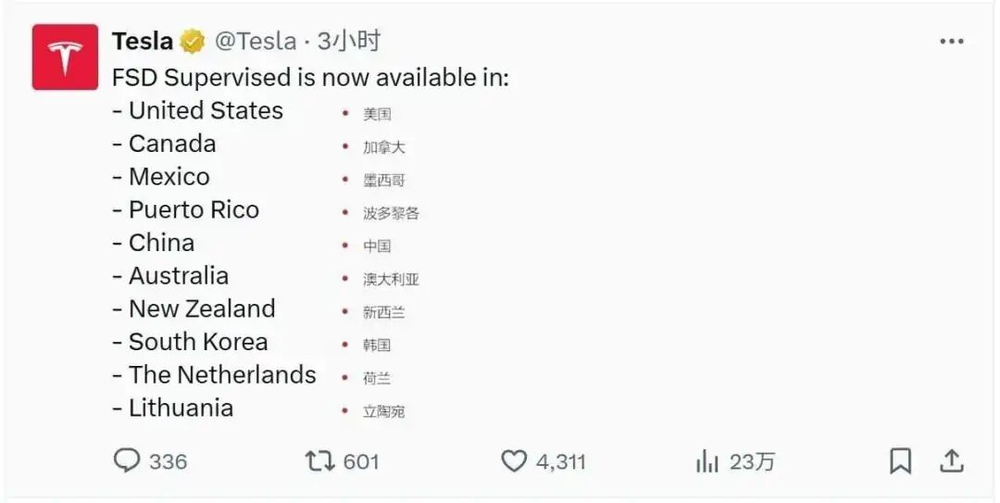
💡Tesla FSD 是端到端 AI 駕駛的產業標竿,其進入中國市場是全球 AI 版圖的重大轉變。
⚡ 30-Second TL;DR
有什麼變化
特斯拉在 X 官方帳號將中國列為 FSD Supervised 可用地區。
為什麼重要
特斯拉進入中國市場將加劇高階自動駕駛領域的競爭,迫使華為、小鵬等本土廠商加速端到端 AI 模型的開發。
下一步行動
監控端到端自動駕駛模型在複雜城市環境中的表現,以作為對標特斯拉即將到來的本土部署之基準。
誰應關注:Developers & AI Engineers
關鍵要點
- •特斯拉在 X 官方帳號將中國列為 FSD Supervised 可用地區。
- •公司正於中國主要城市招募近 90 個研發與測試職位。
- •技術準備包括更新車主手冊以納入 FSD V14 功能,並準備進行本土數據訓練。
- •硬體限制(HW3.0 與 HW4.0)可能導致舊款車型無法使用完整 FSD 功能。
🧠 深度解析
Web-grounded analysis with 23 cited sources.
🔑 增強重點摘要
- •The official May 21, 2026, announcement formalized FSD Supervised availability in China, but full regulatory approval for a fleet-wide rollout is still pending, with Tesla targeting Q3 2026 for broader clearance.
- •Tesla has established a dedicated data center in Shanghai and partnered with Baidu for mapping services to comply with Chinese data localization rules, and has adapted its in-car voice assistant using ByteDance's Doubao model and DeepSeek Chat for AI interactions.
- •Unlike other global markets where Tesla discontinued the one-time FSD purchase in February 2026 for a subscription-only model, China retains the one-time purchase option at 64,000 yuan (approximately $9,400 USD), with no monthly subscription yet introduced.
- •HW4's FSD computer is 3-5 times faster than HW3, featuring 5-megapixel cameras compared to HW3's 1.2-megapixel units, offering superior environmental perception and smoother responses, and receives full FSD V14.x updates first, while HW3 gets optimized "lite" versions.
- •The recruitment drive for Smart Driving Test Technicians and ADAS Test Operators spans nine major Chinese cities, including Beijing, Shanghai, and Guangzhou, indicating a significant operational investment to accelerate localization and real-world testing.
📊 競品分析▸ Show
| Feature/Aspect | Tesla FSD Supervised (China) | XPeng XNGP | Huawei ADS 3.0 | BYD (with LiDAR option) | Baidu Apollo Go (Robotaxi) |
|---|---|---|---|---|---|
| Automation Level | L2 (Supervised) | L2+ (targeting L3 in ~2 years) | L2+ (Urban NOA) | L2+ (with LiDAR) | L4 (Robotaxi) |
| Pricing (China) | 64,000 yuan (one-time purchase) | Not specified (integrated into vehicle packages) | Not specified (integrated into vehicle packages) | 12,000 yuan (LiDAR option for Seagull) | Service-based (robotaxi fares) |
| Key Features | Auto lane change, summon, autopark, predictive AI (V14), audio inputs, real-time blocked road detection | Localized scenario adaptation, domestic data accumulation, urban NOA | Deeply deployed urban NOA | LiDAR sensors, Urban NOA (on some models) | Autonomous taxi service, large fleet operations |
| Hardware Focus | Vision-only (HW3/HW4 cameras) | Cameras, radar, ultrasonic, often LiDAR | Cameras, radar, ultrasonic, often LiDAR | Cameras, radar, ultrasonic, LiDAR | Cameras, radar, ultrasonic, LiDAR |
| Market Position | Entering competitive L2+ market, aims for broader regulatory approval | Strong domestic player, claims to surpass Tesla in local conditions | Leading in urban NOA ADAS market | Expanding advanced features to affordable segments | Dominant in China's robotaxi sector |
🛠️ 技術深入
- FSD V14 Core Enhancements: The system now utilizes auto-regressive transformers, enabling its AI to predict the movement of objects, pedestrians, and vehicles rather than merely reacting, thereby mimicking human-like decision-making.
- Audio Input Integration: FSD V14 is the first version to actively incorporate audio inputs, primarily for detecting emergency vehicles, with potential for broader sound recognition in the future.
- Increased Processing Capacity: FSD V14 features a larger model and context size, allowing it to process three times more information, leading to more refined decision-making.
- Navigation and Perception Integration: The update includes a deeper integration of navigation and routing into the vision-based neural network, enabling real-time handling of blocked roads and detours based purely on visual data, overcoming limitations of static maps.
- Improved Urban Driving & Planning: V14 offers enhanced negotiation of complex intersections, unprotected left turns, and better gap acceptance for merges on highways. It also refines handling for lane changes, vehicle cut-ins, and road obstacles.
- Hardware Differences (HW3 vs. HW4):
- Processing Power: HW4's FSD computer is 3-5 times faster than HW3, powered by AMD Ryzen APUs, facilitating more complex autonomous driving computations.
- Camera System: HW4 features 5-megapixel cameras, a significant upgrade from HW3's 1.2-megapixel units, offering sharper imagery, better low-light performance (via red-tinted lenses), and a wider field of view with a streamlined two-camera setup.
- Performance & Reliability: HW4 provides smoother responses, superior environmental perception, and greater reliability, especially in adverse conditions, handling traffic signs, parking, and highway assist with higher precision compared to HW3.
- Software Update Cadence: HW4 receives full, advanced FSD updates (e.g., v14.x) first, while HW3 typically receives optimized "lite" versions with a delay.
- Power Consumption: HW4 consumes approximately twice as much power at idle compared to HW3.
🔮 前景展望AI analysis grounded in cited sources
Tesla's FSD launch will intensify competition and accelerate autonomous driving innovation in China.
Tesla's entry into the market, especially with regulatory approval for L3 automated driving already legalized in China, is expected to drive greater competition among domestic EV makers like XPeng and Huawei, pushing them to further advance their own smart driving systems.
Tesla will likely introduce a subscription-based FSD model in China once full regulatory approval for a broader rollout is secured.
Tesla globally discontinued the one-time FSD purchase in February 2026, shifting to a subscription-only model in most markets, and the current one-time purchase in China is an exception that will likely evolve once full regulatory approval is in place.
The distinction between HW3 and HW4 capabilities will become a more significant factor for FSD performance and customer satisfaction in China.
HW4's superior processing power, camera resolution, and ability to receive full, faster software updates for FSD V14.x will likely lead to a noticeably better user experience compared to HW3, potentially creating a two-tiered FSD experience for Chinese owners.
⏳ 時間線
2024-09
Tesla announced plans to roll out FSD in China and Europe in Q1 2025, pending regulatory approval.
2025-05-30
Tesla China rebranded FSD as "Intelligent Assisted Driving" and offered FSD transfer, indicating early localization efforts and regulatory adaptation.
2025-11
Elon Musk announced partial FSD approval in China, with hopes for full approval by February or March 2026.
2026-02-03
China's MIIT and other authorities issued new national guidelines for cross-border automotive data flow, identifying 27 categories of "important data".
2026-04-23
During the Q1 2026 earnings call, Tesla's CFO expressed confidence in a Q3 2026 target for broader regulatory clearance in China.
2026-05-21
Tesla officially confirmed FSD (Supervised) support for China on its X account, formalizing its availability after Elon Musk's recent visit.
📎 來源 (23)
Factual claims are grounded in the sources below. Forward-looking analysis is AI-generated interpretation.
📰
AI 週報
閱讀本週精選 AI 大事摘要 →
👉相關動態

AI 策展新聞聚合。所有內容版權歸原始發布者所有。
原始來源: 虎嗅 ↗