🗾ITmedia AI+ (日本)•較早收集於 10h
OpenAI 將 Codex 整合至 ChatGPT 手機 App,實現遠端程式碼管理
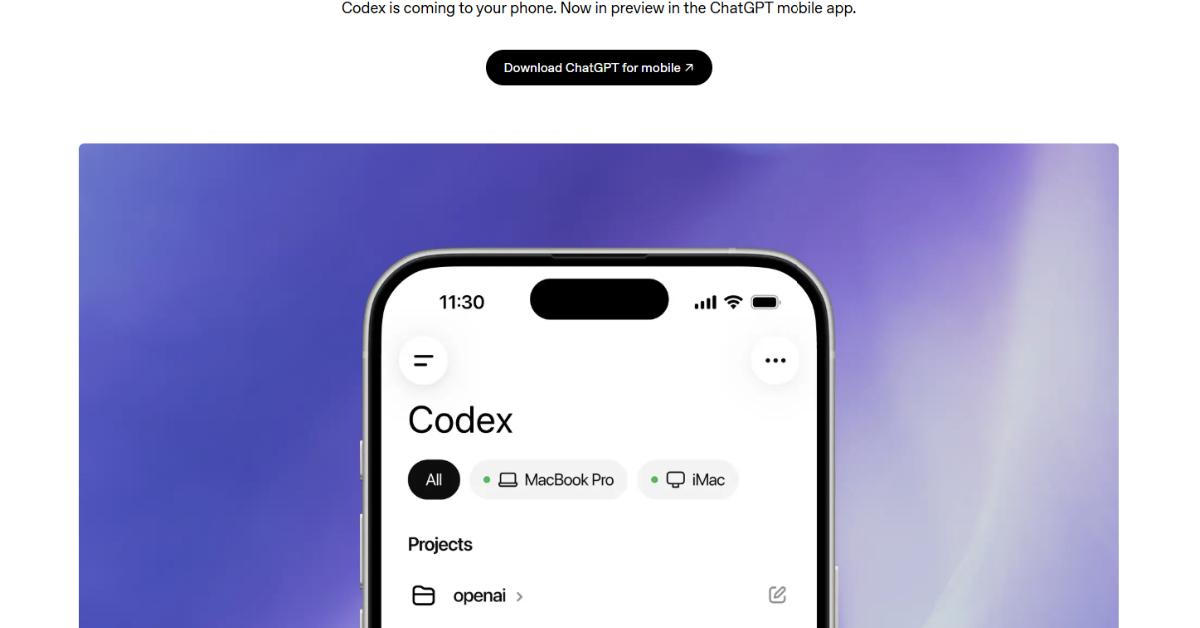
💡透過全新的手機整合功能,隨時隨地管理您的自動化編碼代理,實現即時任務核准。
⚡ 30-Second TL;DR
有什麼變化
Codex 代理現已整合至 iOS 與 Android 版 ChatGPT App
為什麼重要
此整合縮短了行動裝置與桌面開發工作流程之間的距離,使開發者能在自動化編碼環境中獲得更快的響應速度。
下一步行動
下載最新版 ChatGPT 手機 App,並在設定中連結您的 macOS 開發環境,以便進行遠端任務核准。
誰應關注:Developers & AI Engineers
關鍵要點
- •Codex 代理現已整合至 iOS 與 Android 版 ChatGPT App
- •支援從手機端即時監控並核准電腦上的編碼任務
- •目前僅支援 macOS,Windows 版本即將推出
🧠 深度解析
Web-grounded analysis with 40 cited sources.
🔑 增強重點摘要
- •The 'Codex agent' mentioned is a new, autonomous iteration launched in May 2025, distinct from the original Codex model that powered GitHub Copilot, functioning as a cloud-based software engineering agent capable of parallel task execution within a sandboxed environment.
- •The mobile integration allows developers to monitor progress, review outputs, approve changes, switch AI models, and launch new tasks remotely, acting as an intermediary to keep files and credentials secure on the connected machine.
- •Windows support for the dedicated Codex app was officially launched on March 4, 2026, featuring a native agent sandbox and PowerShell support, making the 'coming soon' status in the original article outdated.
- •Codex is included with most paid ChatGPT plans (Plus, Pro, Business, Enterprise/Edu) and is also available for Free and Go tiers with stricter rate limits.
- •The mobile integration utilizes a secure relay layer to enable trusted machines to be reachable across devices without direct exposure to the public internet, while also syncing active session state and context.
📊 競品分析▸ Show
Competitor Analysis: AI Coding Agents with Mobile Integration
| Feature / Product | OpenAI Codex (via ChatGPT Mobile) | GitHub Copilot (via GitHub Mobile) | Anthropic Claude Code (via RemoteCode/Claude Code Dispatch) | MiraBridge AI Code Remote |
|---|---|---|---|---|
| Core Functionality | Autonomous coding agent for end-to-end task execution, bug fixing, feature development, code review, and repository analysis. | AI pair programmer, code suggestions, chat, issue-to-PR conversion, code review. | Autonomous coding agent for reading/editing files, running commands, and complex engineering problems. | Mobile control surface for supervising AI coding work, approving changes, monitoring terminal output. |
| Mobile Integration | Real-time monitoring and approval of PC-based coding tasks; acts as an intermediary. | Chat integration, agent task management, code review, issue-to-PR conversion, and code navigation. | Mobile access for monitoring and steering agentic coding sessions. | Supervises AI coding work on desktop from Android, follows active sessions, approves tool actions, reviews code changes. |
| Execution Environment | Cloud-based sandboxed environment for autonomous execution. | Primarily IDE-based suggestions; agent tasks can run in cloud or local environments. | Terminal-based agent, can run locally. | Connects to local desktop client; code never leaves the machine. |
| Supported Platforms (Desktop) | macOS (Apple Silicon & Intel), Windows (native app with sandbox, WSL2 support), Linux (CLI). | VS Code, Visual Studio, JetBrains IDEs, Neovim, GitHub CLI, Windows Terminal Canary. | Terminal-based, compatible with various systems. | Desktop client for Mac. |
| Pricing/Access | Included with ChatGPT Plus, Pro, Business, Edu, and Enterprise plans; also available for Free and Go tiers with stricter rate limits. | Individual, Business, and Enterprise licenses; Chat available for all plans. | Specifics not detailed, but often involves API keys for underlying models. | Free on local network/VPN; Pro subscription for remote access. |
| Key Differentiator | Focus on full autonomous task delegation and parallel multi-agent workflows with robust sandboxing and remote approval. | Deep integration with GitHub ecosystem, strong code completion, and conversational assistance within the IDE and mobile. | Strong reasoning models for planning and execution, often praised for complex, instruction-heavy work. | Emphasizes local control and privacy, ensuring code remains on the user's machine while offering remote monitoring. |
🛠️ 技術深入
- Agent Loop Architecture: Codex operates through a sophisticated agent loop that orchestrates interactions between users, language models, and various tools. This loop manages prompt incorporation, inference calls, tool execution, and conversation state, with a clear distinction between the reasoning model and the execution harness.
- Cloud-based Sandboxed Execution: The Codex agent runs in a secure, isolated cloud sandbox environment. This architecture allows it to execute code, run tests, and produce changes in a controlled setting, connect with GitHub repositories, and operate independently.
- Underlying Models: The current iteration of Codex is powered by specialized models, including
codex-1(a variant of OpenAI'so3reasoning model) and laterGPT-5.2-CodexandGPT-5.3-Codex. These models are fine-tuned descendants of the GPT family, optimized for code understanding, generation, and long-horizon tasks, with improvements in context compaction and performance in Windows environments. - Multi-surface App Server Architecture: OpenAI utilizes a detailed App Server architecture, a bidirectional JSON-RPC protocol, to decouple the core agent logic from its various client surfaces (CLI, IDE extensions, web app, macOS/Windows desktop apps, and third-party integrations). This server acts as the source of truth for long-running tasks.
- Windows-Native Sandbox: For Windows, OpenAI developed its own native sandbox implementation, which includes PowerShell support and uses restricted tokens/Access Control Lists (ACLs) and network controls to enforce isolation. Alternatively, Codex can be configured to run within Windows Subsystem for Linux 2 (WSL2).
- macOS 'Computer Use' Feature: On macOS, Codex can interact with graphical user interfaces by leveraging an advanced accessibility feature (AX Tree) to see and operate Mac applications in the background, based on technology acquired from the 'Sky' app. This enables automation of GUI tasks where command-line tools or APIs are insufficient.
- Conversation Primitives: The system models interactions using three primitives: an 'Item' (atomic unit of input/output with a lifecycle), a 'Turn' (sequence of items from a single unit of agent work), and a 'Thread' (a long-running conversation).
- Security Measures: Codex incorporates robust security features including sandboxing, explicit approval policies for actions (with an auto-review mode for low-risk actions), network policies, and agent-native telemetry for auditing and understanding agent behavior.
🔮 前景展望AI analysis grounded in cited sources
The integration will accelerate the shift towards 'agentic' software development.
By enabling developers to delegate entire coding tasks and review outputs remotely via mobile, the role of the developer will increasingly shift from direct coding to specification, review, and architectural oversight.
Developer productivity will significantly increase, reducing downtime.
The ability to monitor and approve coding tasks on the go allows developers to keep projects moving and make critical decisions without being tied to a workstation, thereby minimizing interruptions and maximizing continuous development cycles.
Competition in the AI coding agent market will intensify further.
OpenAI's move to mobile integration for Codex is a direct response to similar offerings from competitors like Anthropic's Claude Code and GitHub Copilot, indicating a rapid and aggressive evolution in the market for comprehensive AI-powered developer tools.
⏳ 時間線
2021-08
OpenAI introduces original Codex model, a fine-tuned GPT-3 for code generation, powering GitHub Copilot.
2023-03
OpenAI deprecates the original Codex models from its API.
2025-05-15
OpenAI launches the new, autonomous Codex as a full software engineering agent, integrated into ChatGPT for paid users.
2025-12-18
OpenAI releases GPT-5.2-Codex, an advanced agentic coding model optimized for complex software engineering and cybersecurity.
2026-02-06
OpenAI introduces GPT-5.3-Codex, further expanding the capabilities of the Codex agent.
2026-03-04
OpenAI launches the dedicated Codex app for Windows, including a native agent sandbox and PowerShell support.
2026-04-17
OpenAI rolls out the updated Codex app for Mac with a native 'computer use' tool for GUI interaction.
2026-05-15
OpenAI integrates its Codex autonomous coding agent into the ChatGPT mobile app for iOS and Android.
📎 來源 (40)
Factual claims are grounded in the sources below. Forward-looking analysis is AI-generated interpretation.
- Google Search Source
- Google Search Source
- Google Search Source
- Google Search Source
- Google Search Source
- Google Search Source
- Google Search Source
- Google Search Source
- Google Search Source
- Google Search Source
- Google Search Source
- Google Search Source
- Google Search Source
- Google Search Source
- Google Search Source
- Google Search Source
- Google Search Source
- Google Search Source
- Google Search Source
- Google Search Source
- Google Search Source
- Google Search Source
- Google Search Source
- Google Search Source
- Google Search Source
- Google Search Source
- Google Search Source
- Google Search Source
- Google Search Source
- Google Search Source
- Google Search Source
- Google Search Source
- Google Search Source
- Google Search Source
- Google Search Source
- Google Search Source
- Google Search Source
- Google Search Source
- Google Search Source
- Google Search Source
📰
AI 週報
閱讀本週精選 AI 大事摘要 →
👉相關動態



AI 策展新聞聚合。所有內容版權歸原始發布者所有。
原始來源: ITmedia AI+ (日本) ↗