來源ITmedia AI+ (日本)•較早收集於 2h
影片・音聲視聽時的「腦反應」預測──Meta開發的腦活動預測AI「TRIBE v2」的可能性
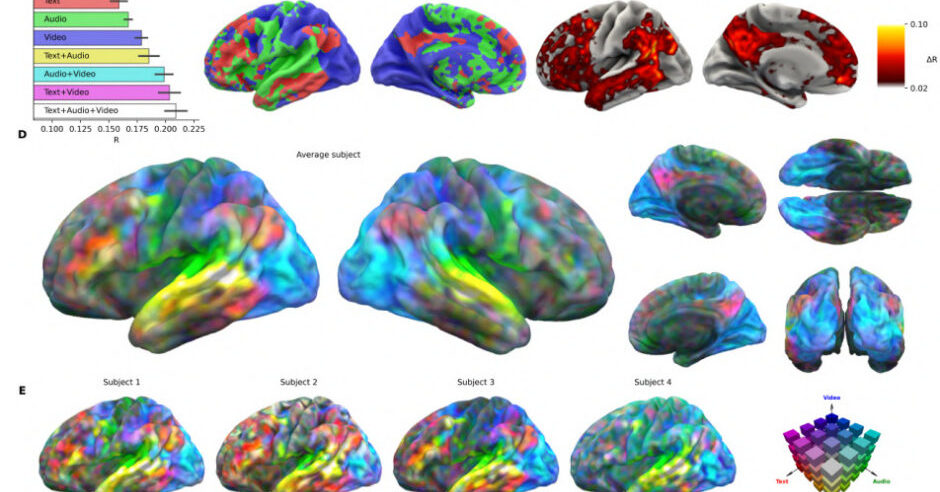
💡Meta新模型模擬影片引發腦反應──神經AI研究遊戲規則改變者(30字)
⚡ 30 秒速覽
有什麼變化
TRIBE v2預測視覺、聽覺、語言輸入的腦部反應
為什麼重要
推動AI在神經科學的進展,可能加速腦部研究與人機互動設計。降低人類腦掃描研究的倫理成本。
下一步行動
下載Meta的TRIBE v2論文,並測試其腦部預測示範(若有)。
誰應關注:Researchers & Academics
關鍵要點
- •TRIBE v2預測視覺、聽覺、語言輸入的腦部反應
- •設計用於體內矽神經科學模擬
- •Meta研究人員開發的多模態基盤模型
🧠 深度解析
本篇為 AI 生成分析,非原文內容。
🔑 增強重點摘要
- •TRIBE v2 utilizes a self-supervised learning architecture trained on massive datasets of naturalistic stimuli, allowing it to map high-level semantic features to specific cortical regions without requiring task-specific fine-tuning.
- •The model demonstrates superior cross-modal generalization, successfully predicting neural responses to unseen video-audio combinations by leveraging shared latent representations of multimodal input.
- •Meta's research aims to reduce the reliance on invasive or costly fMRI/MEG data collection by providing a high-fidelity 'digital twin' of human sensory processing for rapid hypothesis testing.
🛠️ 技術深入
- •Architecture: Employs a transformer-based backbone that integrates pre-trained vision (e.g., DINOv2) and audio-language encoders to extract hierarchical features.
- •Training Objective: Uses a contrastive learning framework to align multimodal inputs with neural activity patterns recorded from large-scale neuroimaging datasets.
- •Decoding Mechanism: Implements a linear readout layer that maps the model's internal latent space to voxel-wise brain activity, optimized for spatial and temporal resolution.
- •Input Modalities: Processes synchronized video frames, audio waveforms, and text transcripts to simulate the multisensory integration occurring in the human brain.
🔮 前景展望基於引用來源的 AI 分析
TRIBE v2 will significantly reduce the number of human subjects required for early-stage cognitive neuroscience studies.
By enabling in-silico simulations, researchers can filter hypotheses and refine experimental designs before committing to expensive and time-consuming human neuroimaging trials.
The model will be integrated into future brain-computer interface (BCI) development pipelines.
The ability to accurately predict neural responses to external stimuli provides a foundational framework for improving the decoding accuracy of non-invasive BCI systems.
⏳ 時間線
2024-05
Meta releases initial research on multimodal foundation models for neural decoding.
2025-09
Meta publishes preliminary findings on the scalability of TRIBE architecture for sensory prediction.
2026-03
Meta officially unveils TRIBE v2 and the associated paper on in-silico neuroscience.
📰
AI 週報
閱讀本週精選 AI 大事摘要 →
👉相關動態
AI 策展新聞聚合。所有內容版權歸原始發布者所有。
原始來源: ITmedia AI+ (日本) ↗
每週電子報
每週一封,可隨時退訂。