來源ITmedia AI+ (日本)•較早收集於 83m
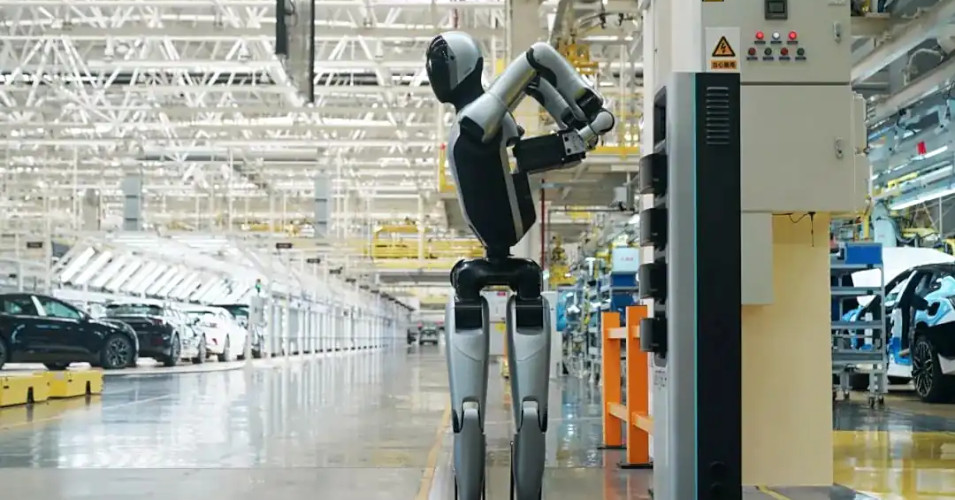
中國人形機器人加速商用化
#humanoid-robots#commercialization#robotics-chinachinese-humanoid-robots36kr
💡中國人形機器人透過機器人友善工廠商用化—具身AI競賽關鍵(45字)
⚡ 30 秒速覽
有什麼變化
中國人形機器人進入商用化階段
為什麼重要
中國快速推出人形機器人,挑戰全球具身AI競爭者。強調實務部署而非實驗室完美,可能降低採用門檻。
下一步行動
評估您的現場機器人友善度,以加速具身AI試點項目。
誰應關注:Founders & Product Leaders
關鍵要點
- •中國人形機器人進入商用化階段
- •實地試錯累積真實世界數據
- •機器人友善現場實現快速部署
🧠 深度解析
本篇為 AI 生成分析,非原文內容。
🔑 增強重點摘要
- •Chinese humanoid manufacturers are increasingly utilizing 'digital twin' simulation environments to train reinforcement learning models before deploying to physical factory floors, significantly reducing the hardware wear-and-tear during the initial learning phase.
- •The Chinese government has integrated humanoid robot development into its 'New Productive Forces' economic policy, providing direct subsidies and tax incentives to companies that achieve specific localization rates for core components like harmonic drives and sensors.
- •A major shift in the supply chain is the rapid vertical integration of actuator production, with leading Chinese humanoid firms now manufacturing their own high-torque density motors to bypass reliance on traditional Japanese and European suppliers.
📊 競品分析▸ Show
| Feature | Chinese Humanoids (e.g., Unitree, Fourier) | Tesla Optimus | Figure AI | Boston Dynamics (Atlas) |
|---|---|---|---|---|
| Primary Focus | Industrial/Manufacturing | Mass Production/Consumer | General Purpose/Logistics | R&D/Complex Mobility |
| Pricing Strategy | Aggressive (Targeting <$20k) | Target <$20k | Premium/Enterprise | High-end/Custom |
| Key Benchmark | Rapid iteration/Cost-efficiency | Scale/AI Integration | Foundation Model/Dexterity | Hardware Durability/Agility |
🛠️ 技術深入
- Actuator Architecture: Adoption of quasi-direct drive (QDD) actuators to achieve high back-drivability and force control, essential for safe human-robot interaction.
- Control Systems: Transition from traditional PID control to Whole-Body Control (WBC) frameworks combined with Transformer-based policy models for complex manipulation tasks.
- Sensor Fusion: Integration of multi-modal sensing including depth cameras, LiDAR, and tactile skin sensors to enable object recognition and precise grasping in unstructured environments.
- Compute: Utilization of high-performance edge computing modules (often based on NVIDIA Jetson or custom RISC-V architectures) to handle real-time inference for locomotion and vision.
🔮 前景展望基於引用來源的 AI 分析
Chinese humanoid manufacturers will achieve a sub-$15,000 unit cost by Q4 2027.
Aggressive domestic supply chain integration and government-backed scale-up initiatives are rapidly driving down the bill of materials (BOM) for core components.
Humanoid robots will replace at least 10% of manual assembly line labor in Chinese EV factories by 2028.
The current focus on 'robot-friendly' work environments allows for immediate, high-ROI deployment in structured manufacturing tasks.
⏳ 時間線
2023-08
Chinese Ministry of Industry and Information Technology releases guidelines for humanoid robot innovation.
2024-01
Beijing Humanoid Robot Innovation Center established as the first provincial-level innovation center for the sector.
2024-11
China releases the 'Humanoid Robot Standardization Roadmap' to unify technical requirements for commercial deployment.
2025-06
Major Chinese EV manufacturers begin pilot testing humanoid robots for final assembly line tasks.
📰
AI 週報
閱讀本週精選 AI 大事摘要 →
👉相關動態
AI 策展新聞聚合。所有內容版權歸原始發布者所有。
原始來源: ITmedia AI+ (日本) ↗
每週電子報
每週一封,可隨時退訂。