Zoox Reveals Its Robotaxi Safety Math
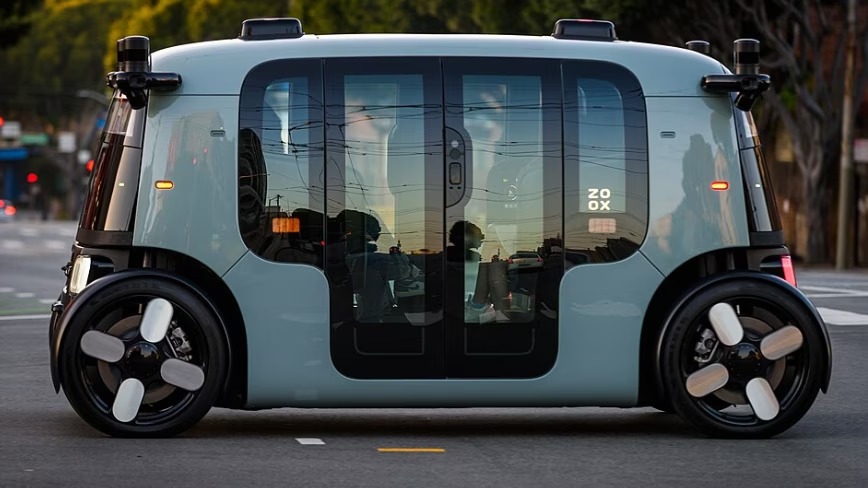
💡See how Zoox turns robotaxi software, vehicle, and fleet risks into one safety metric.
⚡ 30-Second TL;DR
What Changed
Zoox disclosed the reasoning behind its safer-than-human-drivers claim.
Why It Matters
A unified miles-per-event metric could make autonomous-driving safety claims easier to compare and audit. However, practitioners will still need access to underlying assumptions, validation data, and incident definitions to judge whether the estimate is reliable.
What To Do Next
Adapt Zoox's miles-per-event framework to your autonomous-system evaluations, separating software, hardware, and operational risk before aggregating them.
Key Points
- •Zoox disclosed the reasoning behind its safer-than-human-drivers claim.
- •Its primary safety metric is the predicted rate of collision, injury, and fatality events per mile.
- •The total risk estimate combines driving software, vehicle design, and fleet operations.
- •The disclosure follows Zoox's recall of every robotaxi it owns three weeks earlier.
🧠 Deep Insight
AI-generated analysis for this event.
🔑 Enhanced Key Takeaways
- •The recall was triggered by a software glitch affecting the vehicle's collision avoidance system when encountering specific types of cross-traffic at intersections.
- •Zoox's safety methodology utilizes a 'Safety Case' framework, which aligns with ISO 26262 standards for functional safety in road vehicles.
- •The company's risk model incorporates 'disengagement' data from previous testing phases to calibrate the probability of human-intervention-required scenarios.
- •Zoox is utilizing a proprietary simulation platform that runs millions of virtual miles daily to validate the safety metrics against edge-case scenarios.
- •Regulatory bodies, including the NHTSA, have requested additional transparency regarding how Zoox defines a 'collision event' in its predictive modeling.
📊 Competitor Analysis▸ Show
| Feature | Zoox (Robotaxi) | Waymo (Driver) | Cruise (Origin/Bolt) |
|---|---|---|---|
| Vehicle Design | Purpose-built carriage | Retrofitted SUV | Purpose-built / Retrofitted |
| Safety Metric | Predictive risk per mile | Real-world miles per disengagement | Historical crash rate comparison |
| Regulatory Status | Fleet recall (2026) | Active / Operational | Limited / Testing |
🛠️ Technical Deep Dive
- The safety architecture relies on a multi-layered sensor fusion stack including LiDAR, radar, and high-resolution cameras with 360-degree coverage.
- The software stack utilizes a redundant compute architecture where a secondary system can execute a 'minimal risk maneuver' if the primary system fails.
- The risk assessment model employs Bayesian inference to update the probability of collision events based on real-time environmental variables.
- Vehicle design features include bidirectional steering and four-wheel independent steering to enhance maneuverability in tight urban environments.
🔮 Future ImplicationsAI analysis grounded in cited sources
⏳ Timeline
Weekly AI Recap
Read this week's curated digest of top AI events →
👉Related Updates



AI-curated news aggregator. All content rights belong to original publishers.
Original source: The Next Web (TNW) ↗