Zhipu AI faces cash crunch despite GLM-5.2 success
💡A rare look at the massive capital burn and business model challenges facing China's top AI model labs.
⚡ 30-Second TL;DR
What Changed
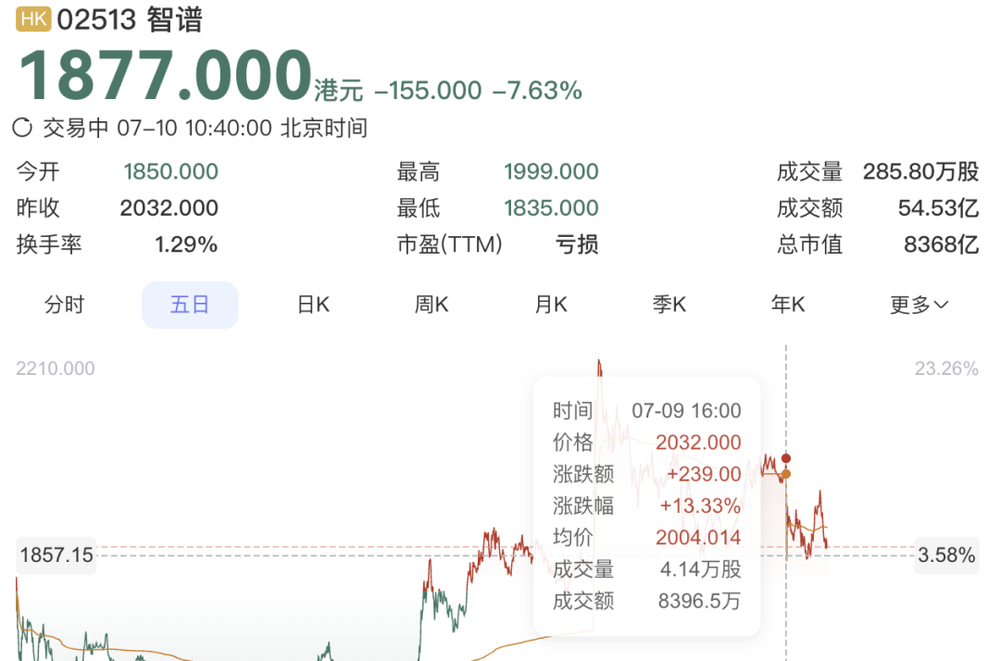
Zhipu AI announced a 31.375 billion HKD share placement to sustain R&D through 2027.
Why It Matters
The financial strain highlights the extreme capital intensity of the 'AI arms race' for Chinese model labs. Zhipu's shift toward API-driven revenue will be critical for long-term sustainability.
What To Do Next
Evaluate GLM-5.2 via OpenRouter to determine if its performance-to-cost ratio justifies migrating workloads from established US-based models.
Key Points
- •Zhipu AI announced a 31.375 billion HKD share placement to sustain R&D through 2027.
- •GLM-5.2 model performance rivals top-tier models like Claude Opus and OpenAI's offerings.
- •Revenue is currently dominated by low-margin local deployment (73.7%) rather than scalable API services.
- •The company spent over 93% of its IPO proceeds in just six months.
🧠 Deep Insight
AI-generated analysis for this event — not the original article.
🔑 Enhanced Key Takeaways
- •Zhipu AI's recent capital raise is reportedly linked to the escalating costs of procuring high-end H200 and B200 GPU clusters required to train the next iteration of the GLM architecture.
- •The company has faced increasing scrutiny from institutional investors regarding its 'compute-to-revenue' ratio, which currently lags behind domestic peers like Moonshot AI and MiniMax.
- •To address the low-margin local deployment issue, Zhipu AI has initiated a strategic pivot toward 'Agent-as-a-Service' (AaaS) models, aiming to capture higher-margin enterprise workflows by 2027.
- •The 31.375 billion HKD placement has triggered a valuation adjustment among secondary market investors, reflecting concerns over the sustainability of the current AI infrastructure spending cycle in China.
- •Zhipu AI has begun integrating proprietary 'sparse-activation' techniques into GLM-5.2 to reduce inference latency, a move designed to make their API services more competitive against OpenAI's GPT-5 series.
📊 Competitor Analysis▸ Show
| Feature | Zhipu AI (GLM-5.2) | OpenAI (GPT-5) | Moonshot AI (Kimi) |
|---|---|---|---|
| Architecture | Mixture-of-Experts (MoE) | Dense/Hybrid | Long-Context Transformer |
| Primary Revenue | Local Deployment (73.7%) | API/Subscription | API/Consumer App |
| Benchmark (MMLU) | ~89.5% | ~92.0% | ~86.0% |
| Pricing Strategy | High-touch Enterprise | Tiered API | Volume-based API |
🛠️ Technical Deep Dive
- GLM-5.2 utilizes a sophisticated Mixture-of-Experts (MoE) architecture with a total parameter count exceeding 1.8 trillion, though active parameters per token are significantly lower.
- The model incorporates a novel 'Cross-Modal Attention' mechanism that allows for native integration of visual and audio tokens without separate encoder modules.
- Implementation relies on a custom-built distributed training framework, 'CogView-Distribute,' optimized for high-latency interconnects common in domestic data centers.
- The model supports a context window of up to 2 million tokens, utilizing a Ring Attention variant to manage memory overhead during long-sequence processing.
🔮 Future ImplicationsAI analysis grounded in cited sources
⏳ Timeline
📰 Event Coverage
Weekly AI Recap
Read this week's curated digest of top AI events →
👉Related Updates


AI-curated news aggregator. All content rights belong to original publishers.
Original source: 虎嗅 ↗
This is a summary, not the original. Read the source, or get the weekly briefing.
The weekly digest
One email a week. Unsubscribe anytime.