YouTube's AI content purge impacts legitimate human creators

💡Understand how YouTube's automated AI moderation is impacting content strategy and the risks of 'faceless' channel bans.
⚡ 30-Second TL;DR
What Changed
YouTube terminated 16 channels with 35 million combined subscribers in January 2026.
Why It Matters
This highlights the risks of relying on automated moderation for AI content, potentially forcing creators to adopt specific visual styles to avoid false-positive bans.
What To Do Next
If you are a faceless creator, diversify your platform presence and ensure your content metadata clearly signals human editorial oversight to avoid automated flagging.
Key Points
- •YouTube terminated 16 channels with 35 million combined subscribers in January 2026.
- •The enforcement falls under the 'inauthentic content' policy, formerly known as 'repetitious content'.
- •Legitimate creators who use faceless formats are being caught in the platform's automated purge of AI-generated content.
🧠 Deep Insight
Background and context from public sources — not the original article. 37 sources cited.
🔑 Enhanced Key Takeaways
- •The January 2026 purge by YouTube impacted channels that collectively garnered 4.7 billion lifetime views and an estimated $10 million in annual ad revenue.
- •The policy's renaming from 'repetitious content' to 'inauthentic content' in July 2025 marked a strategic shift to target content perceived as spammy, mass-produced, or template-based, moving beyond mere mechanical repetition.
- •YouTube's AI-assisted moderation systems are designed to act as 'pattern classifiers,' evaluating entire production pipelines for signs of automated, scalable output, such as high upload frequency, script similarity, visual template reuse, and consistent metadata, rather than solely assessing individual video quality.
- •While cracking down on 'AI slop' used for content farms, YouTube simultaneously encourages creators to leverage AI tools for creative assistance, such as generating backgrounds for Shorts, drafting scripts, or developing video ideas.
- •The term 'AI slop' broadly refers to low-quality, often error-filled, purposeless, and mass-produced AI-generated content that lacks significant human oversight and unique creative input.
📊 Competitor Analysis▸ Show
| Platform | AI Content Moderation Approach | AI Content Disclosure Requirements | Prohibited AI Content Examples |
|---|---|---|---|
| YouTube | Hybrid (AI classifiers + human reviewers); AI detects 'significant photorealistic AI use' and patterns of automated output (e.g., upload frequency, template reuse); 'Likeness management technology' for deepfakes. | Required for realistic altered or AI-generated content; automatic labeling if creator fails to disclose and systems detect it; C2PA watermarks recognized. | Mass-produced, repetitive, low-effort 'AI slop' lacking human creative input; content that misleads viewers about real people, places, or events. |
| TikTok | Hybrid (AI + human moderators); AI for initial detection of obvious violations (visuals, audio, text, metadata); flagged content sent for human review. | Encouraged for completely generated or significantly edited content; automatic labeling for TikTok effects using AI; false disclosure is a violation. | Fake authoritative sources or crisis events; falsely showing public figures in certain contexts (e.g., bullied, endorsing); likeness of minors or private figures without permission. |
| Facebook (Meta) | Hybrid (AI + human reviewers); AI scans and filters billions of posts in real-time; human moderators for contextual judgment; increasing reliance on AI for repetitive tasks. | Focus on preventing misinformation and harmful content; community labeling models (similar to X's Community Notes) for potentially misleading posts. | Content related to hate speech, violence, nudity, misinformation, terrorism, child exploitation, drugs, fraud, online scams. |
🛠️ Technical Deep Dive
- YouTube employs a combination of machine learning technologies, specifically AI classifiers, and human reviewers to enforce its Community Guidelines and detect potentially violative content at scale.
- AI systems continuously enhance the speed and accuracy of YouTube's content moderation, particularly in identifying novel forms of abuse.
- The platform's internal systems are capable of detecting 'significant photorealistic AI use' and can automatically apply an AI label to videos if a creator fails to disclose AI generation.
- YouTube integrates C2PA watermarks, an industry standard, to identify and flag generative AI creations.
- Specialized 'likeness management technology,' including synthetic-singing identification within Content ID, has been developed to automatically detect and manage AI-generated content that simulates identifiable individuals' faces or voices.
- The content moderation algorithm has evolved to recognize the 'rhythm' of a bot, identifying channels that exhibit patterns consistent with automated production rather than unique human creative fingerprints.
- YouTube's enforcement model functions as a 'pattern classifier,' evaluating the entire production pipeline for characteristics indicative of automated, scalable output, such as high upload frequency, script similarity, visual template reuse, and metadata regularity.
🔮 Future ImplicationsAI analysis grounded in cited sources
⏳ Timeline
📎 Sources (37)
Factual claims are grounded in the sources below. Forward-looking analysis is AI-generated interpretation.
- medium.com
- outlierkit.com
- aithinkerlab.com
- google.com
- purelandbali.com
- grokipedia.com
- medium.com
- advertisingbusiness.org
- scalelab.com
- mediacopilot.ai
- tech-now.io
- forbes.com
- decrypt.co
- fandom.com
- youtube.com
- youtube.com
- dictionary.com
- merriam-webster.com
- youtube.com
- google.com
- blog.youtube
- engadget.com
- medium.com
- lifehacker.com
- pcmag.com
- icuc.social
- neowork.com
- scoredetect.com
- tiktok.com
- tiktok.com
- neowork.com
- youtube.com
- msu.edu
- youtube.com
- google.com
- mashable.com
- tubebuddy.com
Weekly AI Recap
Read this week's curated digest of top AI events →
👉Related Updates
Same topic
Explore #content-moderation
Same product
More on youtube
Same source
Latest from The Next Web (TNW)
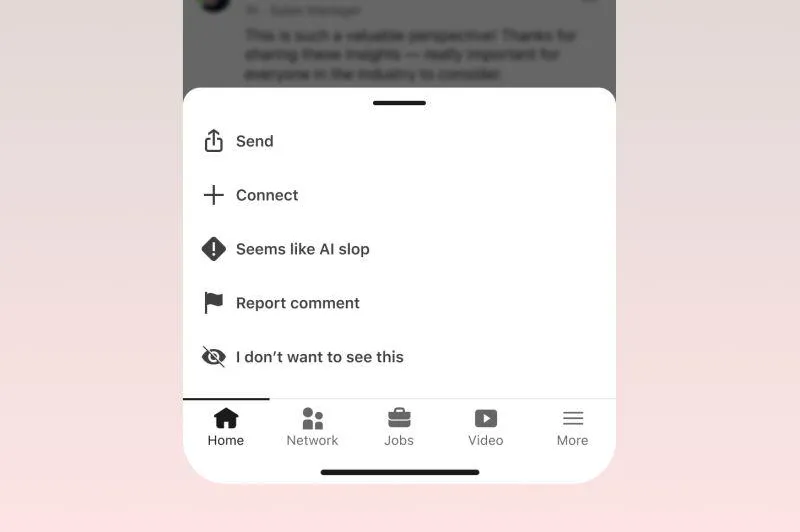
LinkedIn’s AI Slop Reports Surpass One Million Clicks

Opus 4.6’s Explicit-Content Guardrails Are Easily Bypassed

LinkedIn’s AI Slop Button Tops One Million Clicks

Anthropic Expands Claude Mythos 5 for Defensive Security
AI-curated news aggregator. All content rights belong to original publishers.
Original source: The Next Web (TNW) ↗
This is a summary, not the original. Read the source, or get the weekly briefing.
Weekly AI briefing
One email a week. Unsubscribe anytime.