Your Harness, Your Memory
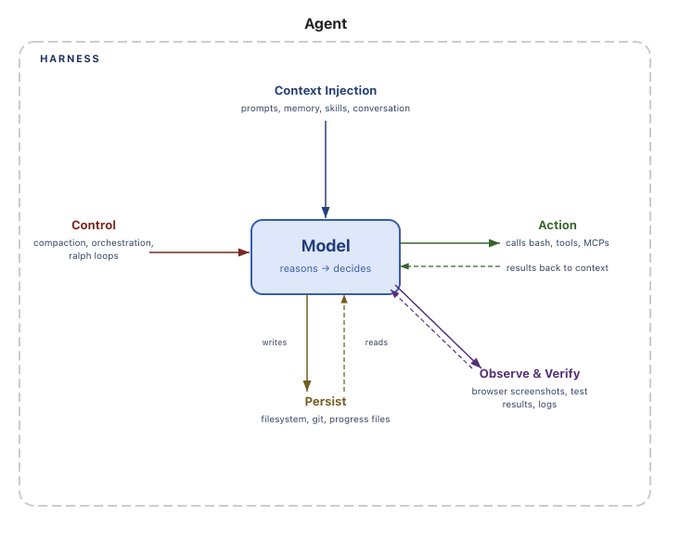
💡LangChain warns: proprietary agent harnesses steal your memory control—go open now.
⚡ 30-Second TL;DR
What Changed
Agent harnesses dominate agent building and are here to stay.
Why It Matters
This analysis pushes AI builders toward open-source harnesses for better control and flexibility in agent development. Proprietary options risk vendor lock-in and limited memory customization.
What To Do Next
Test LangChain's open agent harnesses to regain memory control in your builds.
Key Points
- •Agent harnesses dominate agent building and are here to stay.
- •Harnesses are intimately tied to agent memory management.
- •Closed harnesses behind proprietary APIs yield agent control.
- •Open harnesses recommended to retain full sovereignty.
🧠 Deep Insight
AI-generated analysis for this event — not the original article.
🔑 Enhanced Key Takeaways
- •The 'harness' architecture in LangChain refers to the abstraction layer that manages agent state, tool execution, and memory persistence, effectively decoupling the reasoning engine (LLM) from the operational environment.
- •Proprietary agent harnesses often implement 'black-box' memory optimization, which can lead to non-deterministic agent behavior and difficulty in debugging long-term context retention.
- •Open-source harnesses enable 'memory sovereignty' by allowing developers to swap vector databases or graph-based memory stores without migrating the entire agent orchestration logic.
📊 Competitor Analysis▸ Show
| Feature | LangChain (Open Harness) | Proprietary Agent Platforms (e.g., OpenAI Assistants API) | Enterprise Agent Frameworks (e.g., Microsoft AutoGen) |
|---|---|---|---|
| Control | Full (Self-hosted) | Limited (API-dependent) | High (Configurable) |
| Memory | Pluggable (Vector/Graph) | Managed (Black-box) | Modular (Customizable) |
| Pricing | Infrastructure costs | Usage-based (Token/Storage) | License/Infrastructure |
| Benchmarks | Community-driven | Vendor-specific | Research-focused |
🛠️ Technical Deep Dive
- •Harnesses utilize a 'State Manager' pattern to serialize agent context, allowing for the suspension and resumption of agent execution across distributed nodes.
- •Memory integration typically involves a 'Memory Interface' that abstracts CRUD operations between the agent's working memory (short-term) and external storage (long-term).
- •Implementation often relies on asynchronous event loops to handle tool-use latency while maintaining state consistency in the harness layer.
🔮 Future ImplicationsAI analysis grounded in cited sources
⏳ Timeline
Weekly AI Recap
Read this week's curated digest of top AI events →
👉Related Updates
AI-curated news aggregator. All content rights belong to original publishers.
Original source: LangChain Blog ↗
This is a summary, not the original. Read the source, or get the weekly briefing.
The weekly digest
One email a week. Unsubscribe anytime.