Your Coding Agent Is Only as Smart as Its Data
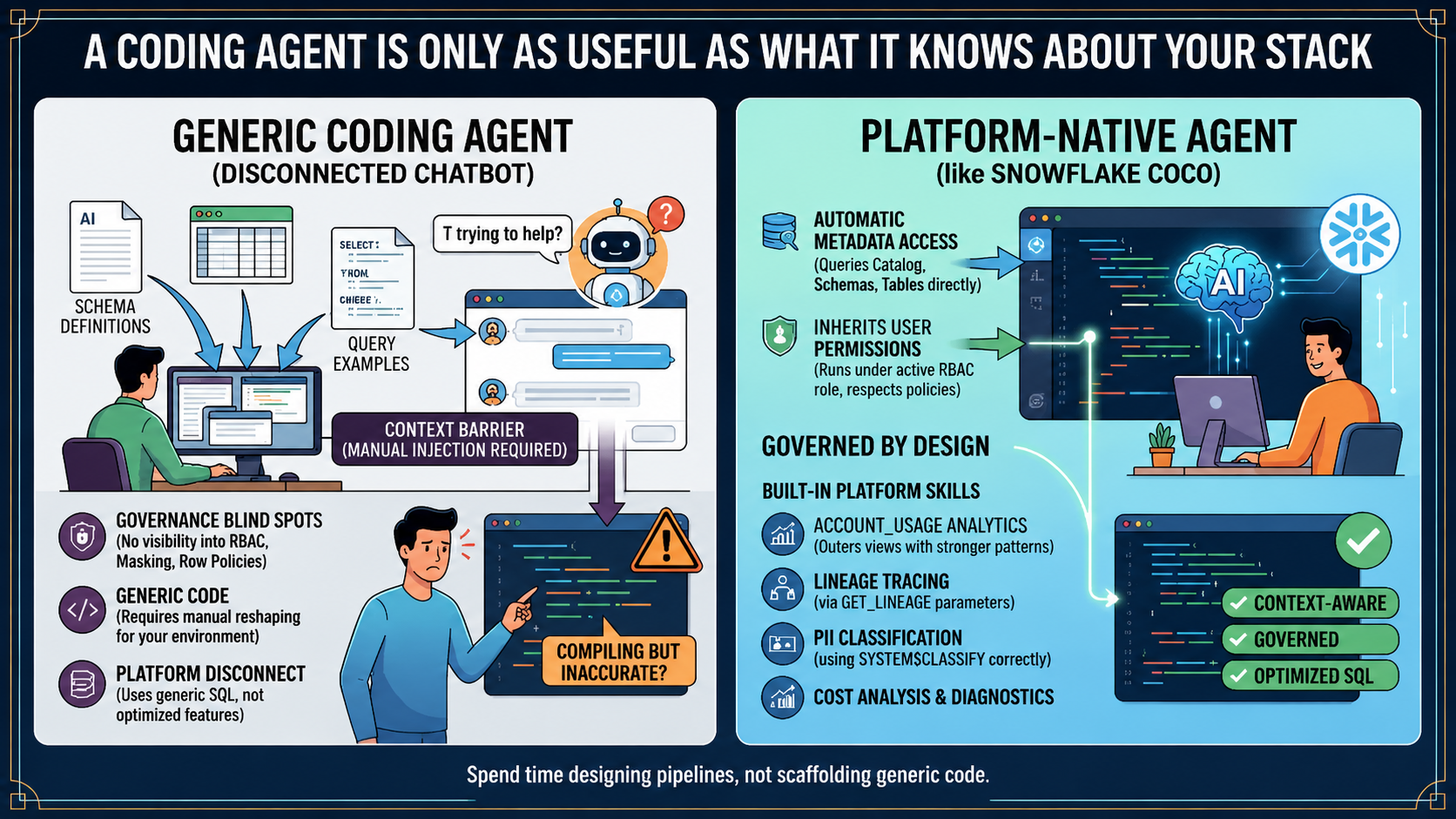
💡Learn why better data context—not just a stronger model—may determine your Coding Agent’s real-world value.
⚡ 30-Second TL;DR
What Changed
Coding-agent usefulness is closely tied to the quality and breadth of its available data.
Why It Matters
This perspective shifts coding-agent evaluation from model benchmarks toward context quality and enterprise data integration. Organizations with fragmented or inaccessible engineering knowledge may see limited returns even when using capable models.
What To Do Next
Run a pilot that connects your Coding Agent to one representative repository, documentation set, and issue tracker, then measure task completion quality against a context-limited baseline.
Key Points
- •Coding-agent usefulness is closely tied to the quality and breadth of its available data.
- •Repository context, engineering workflows, and organizational knowledge can improve generated code and recommendations.
- •Teams should evaluate data integration and context access, not just model capability, when selecting a Coding Agent.
🧠 Deep Insight
Web-grounded analysis with 40 cited sources.
🔑 Enhanced Key Takeaways
- •AI coding tools have evolved from simple autocomplete to sophisticated agentic systems capable of planning, implementing, and testing entire features autonomously.
- •Retrieval Augmented Generation (RAG) is a crucial technique for coding agents to access and utilize an entire coding environment as a source of relevant context, improving accuracy and reducing the need for manual adjustments.
- •Enterprise-tier coding agents like GitHub Copilot Business and Enterprise offer robust data privacy guarantees, explicitly stating that proprietary code and prompts are not used for training public AI models.
- •Effective context engineering involves strategies like "just-in-time" context loading, where agents dynamically retrieve relevant data using lightweight identifiers rather than pre-processing all information upfront.
- •New benchmarks, such as ContextBench, are emerging to specifically evaluate the context retrieval abilities of coding agents, moving beyond end-to-end success rates to analyze how agents explore, retrieve, and utilize code context during problem-solving.
📊 Competitor Analysis▸ Show
| Agent Name | Key Features (Context/Data Focus) | Pricing (as of June-August 2026) | Benchmarks (as of June-August 2026) |
|---|---|---|---|
| GitHub Copilot | Draws context from surrounding code; Enterprise tiers block proprietary code from model training; duplication detection filter. | Free, Pro ($10/mo), Pro+ ($39/mo), Max ($100/mo); Enterprise ($39/user/mo + GitHub Enterprise Cloud $21/user/mo = $60/user/mo effective). Code completions free, agent mode uses credits. | Tuned for safe, well-scoped tasks; no published SWE-bench score. |
| Cursor | AI-native IDE with fast autocomplete and cloud agent capabilities; strong editor UX, multi-file edits. | Free, Pro ($20/mo), Pro+ ($60/mo), Ultra ($200/mo). Credit pool, Auto mode effectively unlimited. | Artificial Analysis Coding Agent Index: 62 (Composer 2); can struggle with large refactors or repo-wide understanding. |
| Claude Code (Anthropic) | Terminal-first, deep repo context, high token use; conversational agent works in terminal, IDE, browser with consistent context model; uses "just-in-time" context loading. | Pro ($20/mo) limited, Max ($100/mo) for real volume. | SWE-bench Verified: 88.6% (Claude Opus 4.8); Terminal-Bench 2.1: 74.6%. |
| OpenAI Codex | Cloud VMs, parallel jobs, sandbox limits; works as background worker for batch tasks (READMEs, typo fixes, refactors). | New Go tier ($8/mo), Plus ($20/mo), Pro ($100/mo). | Terminal-Bench 2.1: 88.8% (GPT-5.5); Terminal-Bench 2.0: 82.7% (GPT-5.5); SWE-Bench Pro: 58.6% (GPT-5.5). |
| Devin | Most hands-off, autonomous agent capable of seeing work through from start to finish. | Not explicitly detailed in search results. | Low outside success rates on fuzzy tasks; most autonomous. |
| Amazon Q Developer | AWS coding assistant with agentic capabilities for feature implementation, refactoring, and software upgrades. | Not explicitly detailed in search results. | SWE-bench Verified: 49%. |
| Augment Code | Built for very large codebases with a 200k-token Context Engine; Code Review Agent. | Not explicitly detailed in search results. | Code Review Agent achieved highest accuracy on public benchmark for AI-assisted code review. |
🛠️ Technical Deep Dive
- Context Management Techniques:
- Retrieval Augmented Generation (RAG): Coding agents utilize RAG to access and integrate an entire coding environment, including GitHub repositories, internal wikis, and API documentation, as a source of relevant context for code generation and chat queries, leading to more customized and accurate AI suggestions.
- "Just-in-Time" Context Loading: Instead of pre-processing all relevant data, agents maintain lightweight identifiers (e.g., file paths, stored queries, web links) and dynamically load data into context at runtime using tools, mimicking human cognitive processes.
- Sub-agent Architectures: To overcome context window limitations, specialized sub-agents handle focused tasks with their own clean context windows, returning condensed, distilled summaries of their work (e.g., 1,000-2,000 tokens) to a main coordinating agent.
- Context Files: These machine-readable files encode organizational intent, governance, and metadata, providing AI systems with a blueprint to build, optimize, and self-heal data pipelines safely and intelligently.
AGENTS.mdFiles: A technique for optimizing agent context by storing relevant information across threads, including coding rules and error fixes, enabling the agent to learn and avoid past mistakes.
- Model Adaptation:
- Fine-tuning LLMs: Large Language Models (LLMs) like Codex, StarCoder, and Code Llama can be fine-tuned on proprietary codebases to significantly improve their relevance to an organization's unique coding standards and internal libraries.
- Parameter-Efficient Fine-Tuning (PEFT): Techniques such as Low-Rank Adaptation (LoRA) are employed during fine-tuning to reduce computational requirements while preserving model performance.
- Architectural Considerations:
- Context Architecture: Refers to the infrastructure and methods used to store, surface, and deliver context to an AI agent, often involving context libraries and RAG-specific infrastructure.
- Security and Permissions: Context architecture often incorporates mechanisms to ensure agents operate with the same permissions as the user, thereby restricting access to only authorized data.
- Model Context Protocol (MCP): An open standard designed for connecting AI assistants to external tools and data sources, facilitating interoperability and data access.
🔮 Future ImplicationsAI analysis grounded in cited sources
⏳ Timeline
📎 Sources (40)
Factual claims are grounded in the sources below. Forward-looking analysis is AI-generated interpretation.
- coderabbit.ai
- aws.com
- mightybot.ai
- dev.to
- medium.com
- thenewstack.io
- kinde.com
- github.com
- gitguardian.com
- trust.page
- github.com
- anthropic.com
- alphaxiv.org
- arxiv.org
- arxiv.org
- github.com
- getdx.com
- firecrawl.dev
- daily.dev
- faros.ai
- vellum.ai
- verdent.ai
- matillion.com
- towardsdatascience.com
- medium.com
- arxiv.org
- huggingface.co
- rubrik.com
- wjarr.com
- stackoverflow.blog
- dev.to
- aws.com
- facebook.com
- ijnrd.org
- af.net
- jetbrains.com
- uvik.net
- gartner.com
- sundeepteki.org
- ibm.com
Weekly AI Recap
Read this week's curated digest of top AI events →
👉Related Updates


AI-curated news aggregator. All content rights belong to original publishers.
Original source: InfoQ中国 ↗