World's First Embodied AI Hackathon
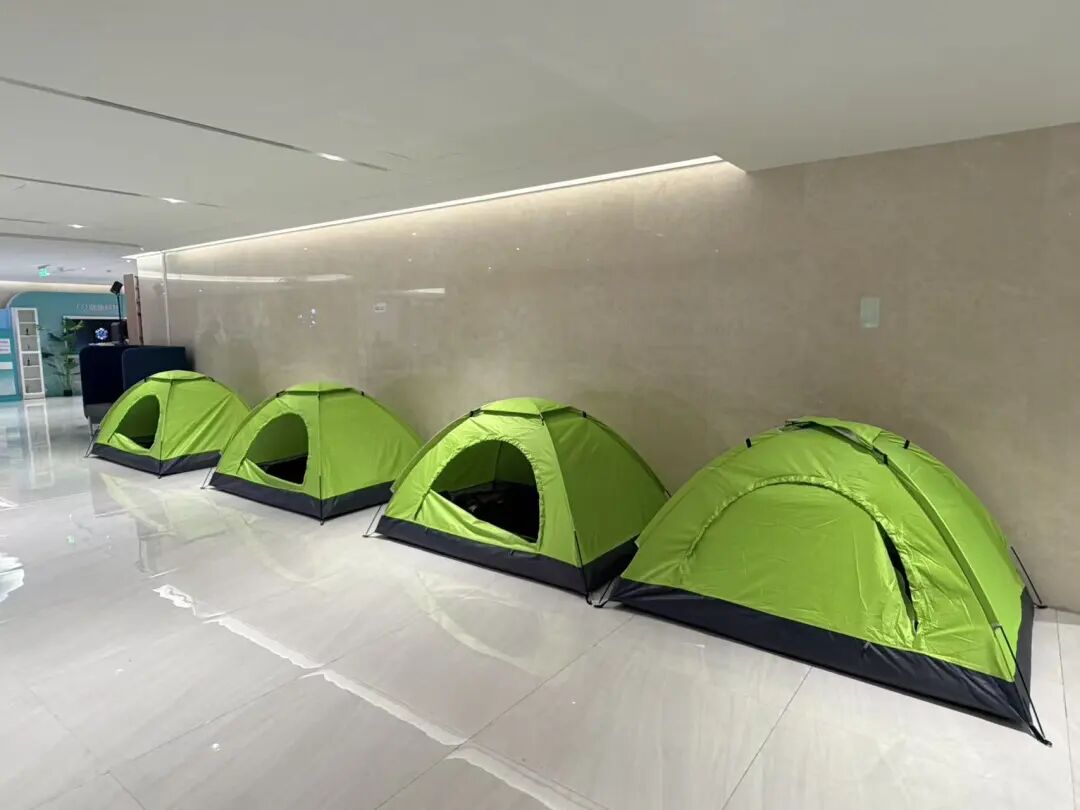
First hardware hackathon pushes embodied AI generalization—essential for real-world robot devs
30-Second TL;DR
What Changed
20 teams used high-performance six-axis arms for tasks like grasping rings, fruit classification by language, cable plugging, and word spelling with blocks.
Why It Matters
Accelerates embodied AI progress by crowdsourcing real-world generalization challenges, fostering open ecosystems like OpenClaw. Early home service deployment tests complex open environments, driving model iteration for practical robotics.
What To Do Next
Download WALL-OSS and test generalization on your robotic arm with randomized environments.
Key Points
- •20 teams used high-performance six-axis arms for tasks like grasping rings, fruit classification by language, cable plugging, and word spelling with blocks.
- •A-list allows fixed environments; B-list randomizes positions, lighting, surfaces to test true generalization.
- •Supported by open base models WALL-OSS, Pi0.5, Nvidia DreamZero; emphasizes real data collection over simulation.
Deep Insight
AI-generated analysis for this event — not the original article.
Enhanced Key Takeaways
- •The hackathon served as a strategic data-collection pipeline for Zivariable, aiming to bridge the 'sim-to-real' gap by generating high-quality, human-in-the-loop datasets for their proprietary foundation models.
- •Zivariable's partnership with 58 Daojia marks a shift toward 'Robot-as-a-Service' (RaaS) business models, specifically targeting the commercial cleaning sector to validate embodied AI in unstructured, high-traffic environments.
- •The event highlighted a growing trend in the Chinese robotics ecosystem toward open-source standardization, with WALL-OSS being positioned as a foundational framework to reduce development barriers for embodied AI startups.
Competitor Analysis
- Zivariable Robotics
- Industrial/Service Arms
- Figure AI
- Humanoid General Purpose
- Tesla (Optimus)
- Humanoid General Purpose
- Zivariable Robotics
- Real-world hackathon/RaaS
- Figure AI
- Simulation + Human Teleop
- Tesla (Optimus)
- Massive fleet data/FSD
- Zivariable Robotics
- WALL-OSS (Open)
- Figure AI
- Closed
- Tesla (Optimus)
- Closed
- Zivariable Robotics
- Commercial/Industrial
- Figure AI
- General Purpose/Labor
- Tesla (Optimus)
- Manufacturing/Home
| Feature | Zivariable Robotics | Figure AI | Tesla (Optimus) |
|---|---|---|---|
| Primary Focus | Industrial/Service Arms | Humanoid General Purpose | Humanoid General Purpose |
| Data Strategy | Real-world hackathon/RaaS | Simulation + Human Teleop | Massive fleet data/FSD |
| Open Ecosystem | WALL-OSS (Open) | Closed | Closed |
| Target Market | Commercial/Industrial | General Purpose/Labor | Manufacturing/Home |
Technical Deep Dive
- •WALL-OSS Architecture: Utilizes a transformer-based policy network capable of multi-modal input fusion (vision, tactile, and proprioceptive data).
- •Compute Infrastructure: The 100+ PFLOPs cluster is optimized for distributed training of embodied policies, leveraging Nvidia's latest GPU architectures for low-latency inference.
- •Generalization Testing: The B-list leaderboard utilizes dynamic domain randomization, altering object textures, lighting conditions, and camera angles in real-time to prevent policy overfitting.
- •Hardware Interface: The six-axis robotic arms are integrated with high-frequency force-torque sensors to enable precise cable insertion and delicate object manipulation.
Future ImplicationsAI analysis grounded in cited sources
Timeline
- 2025-06Zivariable Robotics secures Series A funding to develop embodied AI foundation models.
- 2026-01Launch of the first robot cleaning service pilot in partnership with 58 Daojia.
- 2026-03Official release of the WALL-OSS open-source embodied intelligence framework.
- 2026-04Hosting of the inaugural global embodied intelligence developer conference in Shenzhen.
Weekly AI Recap
Read this week's curated digest of top AI events →
AI-curated news aggregator. All content rights belong to original publishers.
Original source: 36氪 ↗
This is a summary, not the original. Read the source, or get the weekly briefing.
The weekly digest
One email a week. Unsubscribe anytime.