World Models Enter Their Foundational Year
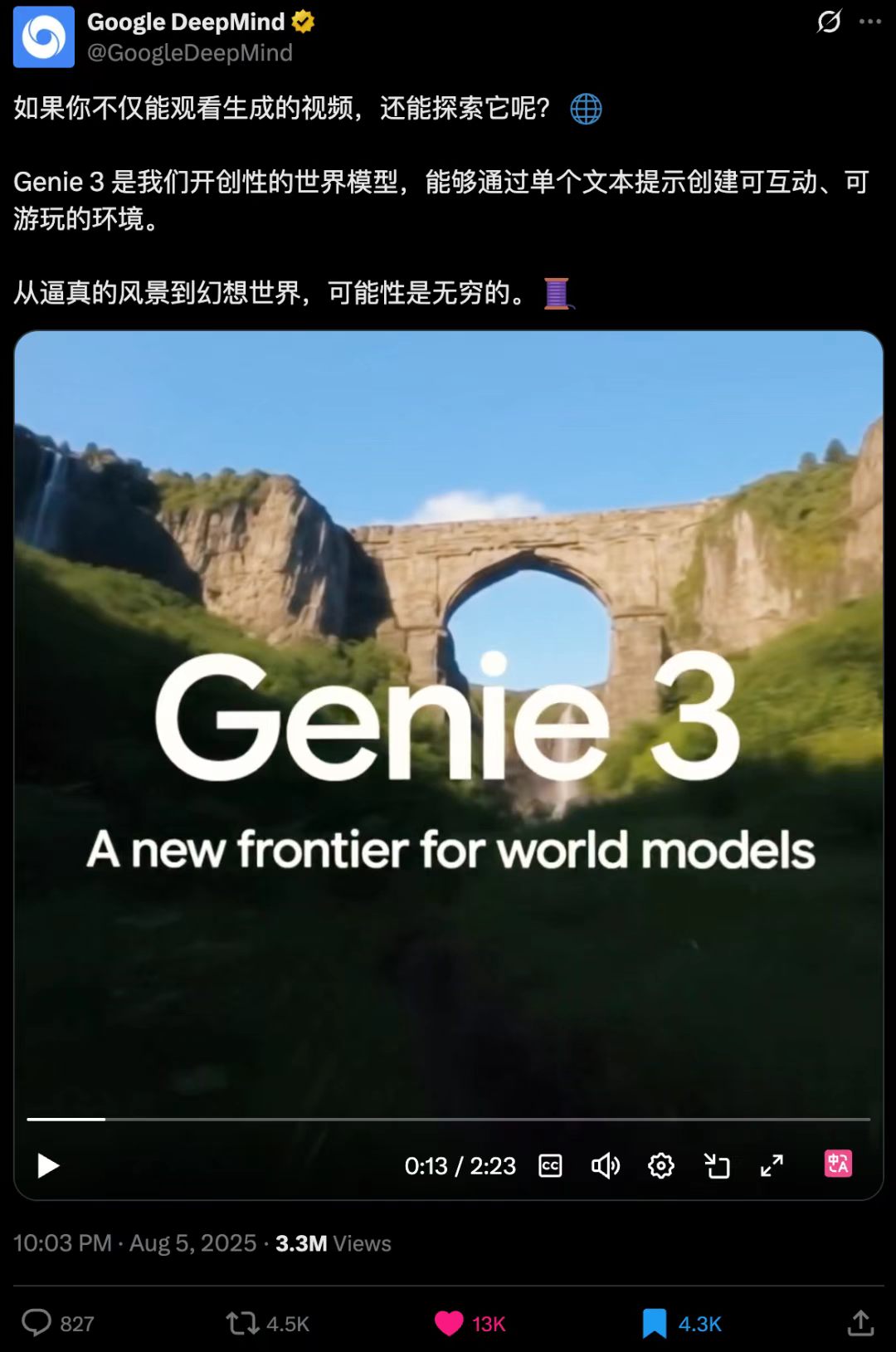
💡A concise signal that world models may be entering a new development phase.
⚡ 30-Second TL;DR
What Changed
The article frames the current period as the inaugural year for world models.
Why It Matters
If the trend continues, world models could become a major research and product theme for embodied AI, simulation, and planning systems. Practitioners should treat this article as a directional signal rather than evidence of a specific breakthrough.
What To Do Next
Build a small world-model prototype in MuJoCo and measure how accurately it predicts the next state from short action sequences.
Key Points
- •The article frames the current period as the inaugural year for world models.
- •Its tone suggests that momentum around world models is accelerating.
- •The excerpt provides no concrete product launch, benchmark result, or implementation detail.
🧠 Deep Insight
AI-generated analysis for this event.
🔑 Enhanced Key Takeaways
- •World models are shifting from passive predictive architectures to active agents capable of planning, reasoning, and interacting with simulated or real-world environments.
- •The transition to 'foundational' status is driven by the integration of video generation models (like Sora or Veo) with spatial-temporal reasoning capabilities, moving beyond simple next-token prediction.
- •Key research challenges currently include 'world model collapse'—where models lose long-term coherence—and the high computational cost of training on high-fidelity, multi-modal sensory data.
- •Major AI labs are increasingly utilizing synthetic data generated by world models to train autonomous systems, effectively creating a feedback loop that reduces reliance on human-labeled datasets.
- •The industry is moving toward a standardized definition of world models as systems that maintain an internal representation of physical laws, object permanence, and causal relationships.
📊 Competitor Analysis▸ Show
| Feature | Sora (OpenAI) | Veo (Google DeepMind) | Gen-3 Alpha (Runway) |
|---|---|---|---|
| Primary Focus | High-fidelity physical simulation | Scalable world understanding | Creative/Cinematic control |
| Architecture | Diffusion Transformer (DiT) | Transformer-based video generation | Latent Diffusion Model |
| Benchmark | VBench (Physical consistency) | Internal world-model metrics | User-preference alignment |
🛠️ Technical Deep Dive
- Architecture: Most modern world models utilize a Transformer-based backbone combined with a VAE (Variational Autoencoder) or latent space compressor to handle high-dimensional video inputs.
- Predictive Mechanism: Models employ autoregressive tokenization of visual patches, often augmented with temporal attention layers to maintain consistency across frames.
- Training Objective: Beyond next-frame prediction, models are increasingly trained on 'action-conditioned' objectives, where the model predicts the outcome of specific agentic interventions.
- Memory Systems: Integration of long-context windows (up to 1M+ tokens) allows models to maintain state persistence in complex, multi-object scenes.
🔮 Future ImplicationsAI analysis grounded in cited sources
⏳ Timeline
Weekly AI Recap
Read this week's curated digest of top AI events →
👉Related Updates


AI-curated news aggregator. All content rights belong to original publishers.
Original source: 钛媒体 ↗