WMO Warns of Strong El Niño Accelerating Global Warming
💡Understand climate-driven infrastructure risks that could impact global data center operations and energy costs.
⚡ 30-Second TL;DR
What Changed
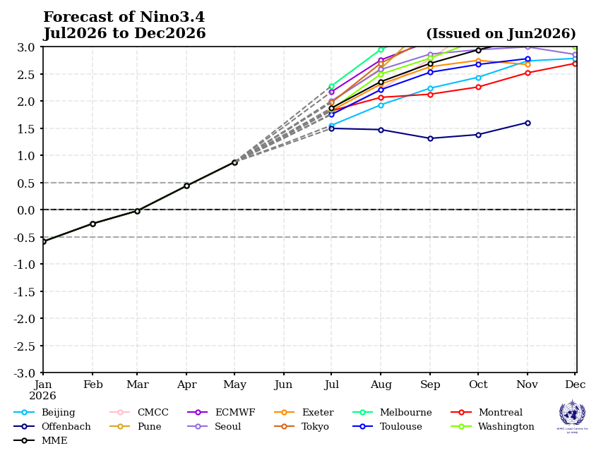
WMO reports accelerated formation of a strong El Niño event
Why It Matters
Climate volatility impacts data center cooling requirements and supply chain stability for global tech operations.
What To Do Next
Incorporate climate risk modeling into your infrastructure planning to prepare for potential energy grid instabilities.
Key Points
- •WMO reports accelerated formation of a strong El Niño event
- •Global temperature rise is expected to be further exacerbated
- •Increased risk of extreme weather and climate anomalies globally
🧠 Deep Insight
AI-generated analysis for this event — not the original article.
🔑 Enhanced Key Takeaways
- •The WMO utilizes the Oceanic Niño Index (ONI), which measures sea surface temperature anomalies in the Niño 3.4 region, as the primary metric for classifying El Niño intensity.
- •El Niño events typically trigger a reversal of the Walker Circulation, causing trade winds to weaken or reverse, which suppresses the upwelling of cold, nutrient-rich water along the South American coast.
- •Historical data indicates that strong El Niño events are frequently followed by a transition to La Niña, creating a multi-year cycle of climate volatility known as ENSO (El Niño-Southern Oscillation).
- •The 2023-2024 El Niño event was one of the strongest on record, contributing significantly to the global temperature anomalies observed in 2025.
- •WMO climate models incorporate satellite altimetry data to monitor sea level height anomalies, which serve as a leading indicator for the heat content buildup in the tropical Pacific.
🛠️ Technical Deep Dive
- ENSO monitoring relies on the Tropical Pacific Observing System (TPOS), a network of moored buoys (TAO/TRITON array) that provide real-time data on subsurface temperatures.
- Climate models use Coupled General Circulation Models (CGCMs) to simulate the interaction between the ocean and the atmosphere, specifically tracking the thermocline depth.
- The Oceanic Niño Index (ONI) threshold for a strong event is defined as a 3-month running mean of sea surface temperature anomalies in the Niño 3.4 region exceeding +1.5 degrees Celsius.
🔮 Future ImplicationsAI analysis grounded in cited sources
⏳ Timeline
Weekly AI Recap
Read this week's curated digest of top AI events →
👉Related Updates




AI-curated news aggregator. All content rights belong to original publishers.
Original source: cnBeta (Full RSS) ↗
This is a summary, not the original. Read the source, or get the weekly briefing.
Weekly AI briefing
One email a week. Unsubscribe anytime.