Whiteboard Gets Context-Aware AI Agents
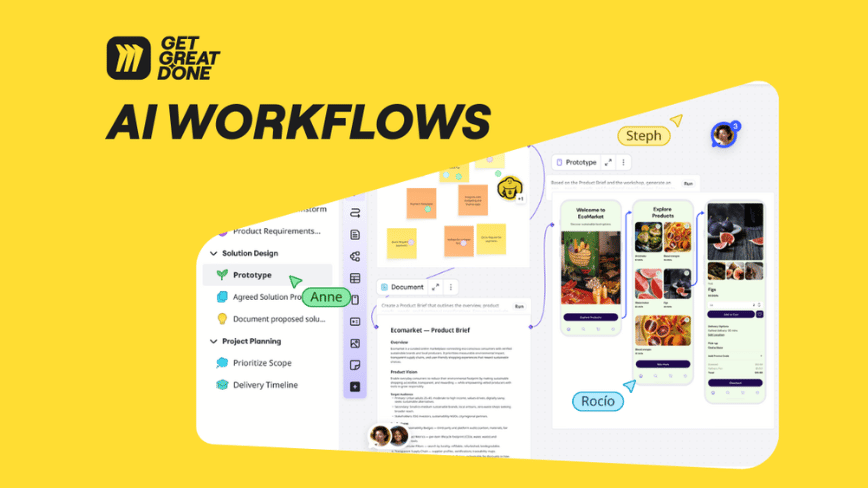
💡Context-aware AI agents end whiteboard-to-prompt copying drudgery for teams.
⚡ 30-Second TL;DR
What Changed
AI agents integrated directly into team whiteboards
Why It Matters
Streamlines team collaboration by making whiteboard content instantly AI-ready, boosting productivity in ideation phases. Ideal for AI practitioners using visual planning tools.
What To Do Next
Test the new whiteboard AI agents to automate context extraction for your next team brainstorming session.
Key Points
- •AI agents integrated directly into team whiteboards
- •Agents interpret spatial context from sticky notes and diagrams
- •Solves pain of manually feeding whiteboard data to external AI tools
🧠 Deep Insight
AI-generated analysis for this event — not the original article.
🔑 Enhanced Key Takeaways
- •The integration utilizes multimodal Large Vision-Language Models (LVLMs) that map 2D coordinate data from whiteboard canvases to semantic relationships, allowing the AI to distinguish between 'grouped' ideas versus 'sequential' workflows.
- •Privacy-preserving local processing options are being introduced to allow teams to keep sensitive brainstorming data on-premises or within private cloud VPCs, addressing enterprise concerns regarding data leakage into public LLM training sets.
- •The agents support 'bi-directional synchronization,' meaning the AI can not only summarize a board but also automatically generate new sticky notes or rearrange existing elements based on user-defined strategic frameworks like SWOT or Agile retrospectives.
📊 Competitor Analysis▸ Show
| Feature | Whiteboard AI Agents | Miro Assist | FigJam AI |
|---|---|---|---|
| Spatial Context Awareness | High (Native) | Medium (Text-focused) | Medium (Template-focused) |
| Bi-directional Editing | Yes | Limited | Limited |
| Pricing Model | Per-seat/Usage | Per-seat/Add-on | Per-seat/Add-on |
🛠️ Technical Deep Dive
- Architecture: Employs a custom-trained Vision Transformer (ViT) encoder coupled with a lightweight LLM backbone to interpret spatial topology.
- Data Representation: Converts whiteboard objects into a graph-based JSON schema where nodes represent sticky notes/shapes and edges represent spatial proximity or connector lines.
- Latency Optimization: Uses edge-caching of vector embeddings to ensure sub-second response times when querying large, complex boards.
🔮 Future ImplicationsAI analysis grounded in cited sources
⏳ Timeline
Weekly AI Recap
Read this week's curated digest of top AI events →
👉Related Updates


AI-curated news aggregator. All content rights belong to original publishers.
Original source: The Next Web (TNW) ↗
This is a summary, not the original. Read the source, or get the weekly briefing.
The weekly digest
One email a week. Unsubscribe anytime.