WhatsApp Designs Privacy-Preserving Scam Alerts
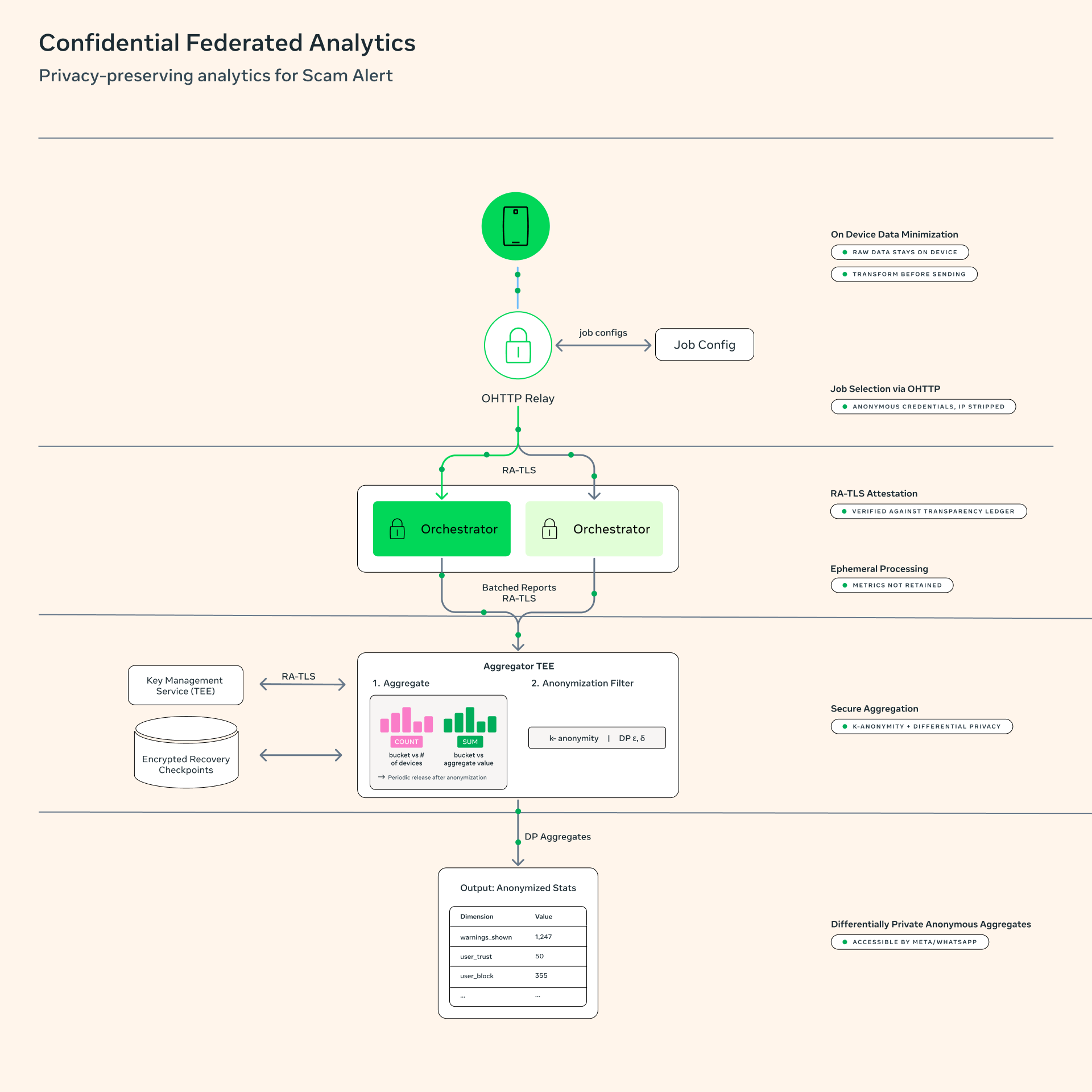
💡See how WhatsApp aims to detect AI-powered scams without breaking end-to-end encryption.
⚡ 30-Second TL;DR
What Changed
Scam Alert targets evolving threats including impersonation, social engineering, and AI-generated lures.
Why It Matters
If successful, the approach could provide a useful model for deploying AI-assisted scam detection without centralized access to private conversations. It also raises the bar for security products by requiring both effective protection and independently verifiable privacy claims.
What To Do Next
Review Meta’s Scam Alert engineering details and map its stated verifiability guarantees against your own privacy-preserving moderation threat model.
Key Points
- •Scam Alert targets evolving threats including impersonation, social engineering, and AI-generated lures.
- •The system is being designed to preserve WhatsApp’s end-to-end encryption and message privacy.
- •Meta emphasizes verifiability guarantees so the protection can be independently checked or validated.
- •The announcement presents an early design rather than a broadly documented, finished product.
🧠 Deep Insight
AI-generated analysis for this event.
🔑 Enhanced Key Takeaways
- •The system utilizes on-device machine learning models to analyze metadata and message patterns for suspicious activity without decrypting content.
- •Meta is leveraging Private Set Intersection (PSI) protocols to allow the app to check if a sender is associated with known scam indicators without revealing the user's contact list to Meta servers.
- •The design incorporates a 'Trust Score' mechanism that evaluates account age, frequency of message sending, and behavioral anomalies to flag potential impersonators.
- •WhatsApp is integrating this feature with its existing 'Safety Tools' suite, which already includes automatic blocking of suspicious links and unknown international numbers.
- •The architecture relies on a client-side 'Privacy-Preserving Signal' that alerts users only when a high-confidence threshold of malicious intent is detected, minimizing false positives.
📊 Competitor Analysis▸ Show
| Feature | WhatsApp (Scam Alert) | Signal (Safety Tools) | Telegram (Spam Protection) |
|---|---|---|---|
| Privacy Approach | On-device E2EE analysis | Minimal metadata collection | Server-side filtering |
| Scam Detection | AI-based behavioral analysis | User-reported/Link blocking | Community-driven/Automated |
| Verifiability | Open-design/Auditable | Open-source client/server | Proprietary server-side |
| Pricing | Free | Free | Free (Premium options) |
🛠️ Technical Deep Dive
- Uses Trusted Execution Environments (TEEs) on mobile hardware to process sensitive scam-detection heuristics in an isolated memory enclave.
- Implements Differential Privacy to aggregate threat intelligence from user reports without linking specific scam patterns to individual user identities.
- Employs a local Bloom filter to store and query known malicious identifiers, ensuring the device can perform checks offline.
- Utilizes a lightweight transformer-based model optimized for mobile NPUs to detect social engineering linguistic patterns locally.
🔮 Future ImplicationsAI analysis grounded in cited sources
⏳ Timeline
Weekly AI Recap
Read this week's curated digest of top AI events →
👉Related Updates
AI-curated news aggregator. All content rights belong to original publishers.
Original source: Meta Engineering Blog ↗