Westlake University achieves breakthrough in anode-free battery tech
💡High-density battery breakthroughs are critical for the future of edge AI hardware and autonomous robotics.
⚡ 30-Second TL;DR
What Changed
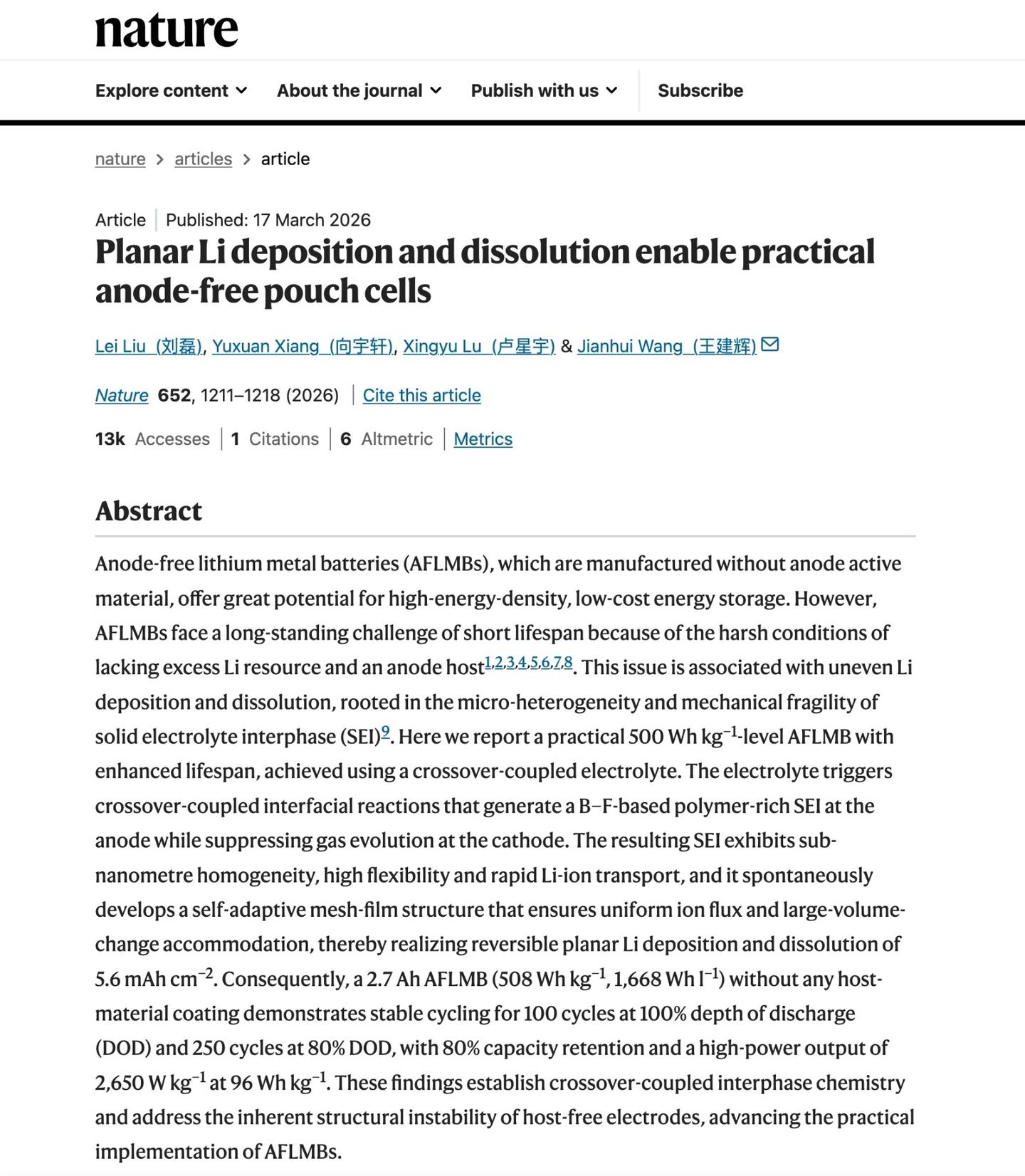
Westlake University team published findings in Nature
Why It Matters
This could revolutionize energy storage for mobile devices and electric vehicles by drastically increasing energy density. It represents a shift toward more efficient, lightweight power solutions.
What To Do Next
Monitor the commercialization timeline of anode-free batteries to adjust hardware power management strategies for future edge devices.
Key Points
- •Westlake University team published findings in Nature
- •Anode-free battery architecture significantly reduces weight and volume
- •Technology is transitioning from lab research to industrialization
🧠 Deep Insight
Web-grounded analysis with 17 cited sources.
🔑 Enhanced Key Takeaways
- •The breakthrough by Westlake University, published in Nature on March 17, 2026, details a novel "crossover-coupled electrolyte" that creates a B-F-based polymer-rich solid electrolyte interphase (SEI) at the anode, while simultaneously suppressing gas evolution at the cathode.
- •This advanced electrolyte design enables a 2.7 Ah anode-free lithium metal battery (AFLMB) pouch cell to achieve a high energy density of 508 Wh kg⁻¹ and 1668 Wh L⁻¹.
- •The developed anode-free battery demonstrates enhanced longevity, maintaining 80% capacity after 100 cycles at 100% depth of discharge (DoD) and 250 cycles at 80% DoD, alongside a high-power output of 2650 W kg⁻¹ at 96 Wh kg⁻¹.
- •The resulting SEI exhibits sub-nanometer homogeneity, high flexibility, and rapid Li-ion transport, spontaneously forming a self-adaptive mesh-film structure that ensures uniform ion flux and accommodates significant volume changes, crucial for reversible planar Li deposition/dissolution.
- •Anode-free battery technology is projected to offer a 50-80% improvement in energy density over current lithium-ion technologies, with theoretical energy densities potentially exceeding 500 Wh/kg.
📊 Competitor Analysis▸ Show
| Company/Institution | Approach/Key Feature | Claimed/Demonstrated Performance (if available) |
|---|---|---|
| Westlake University | Crossover-coupled electrolyte, B-F-based polymer-rich SEI | 508 Wh kg⁻¹, 1668 Wh L⁻¹, 100 cycles at 100% DoD, 250 cycles at 80% DoD (80% retention) |
| QuantumScape | Anode-free architecture, proprietary solid-state ceramic separator, lithium-metal anode | 325-440 Wh/kg (900-1,100 Wh/l) for solid-state, 800 cycles (80% capacity retention) as of 2020 |
| Solid Power | All-solid-state batteries | Focused on safety and energy density, partnering with automotive manufacturers |
| Panasonic | Developing anode-free technology | Expects ~25% increase in EV battery capacity |
| Samsung SDI | Semi-anode-free, minimal initial anode structure, high-concentration electrolyte, nano-engineered separators | Demonstrated 900 Wh/L target under laboratory conditions |
| CATL | "Self-generated anode" technology | Boosts ion conductivity by a hundredfold through a nanoscale interfacial layer |
| Pacific Northwest National Laboratory (PNNL) | Anode-free device using a salt/salt electrolyte mixture | High energy density, eliminates dendrite growth, lower production cost |
| Northwestern Polytechnical University (Prof. Ma Yue) | Anode-less pouch battery, pre-lithiated separator strategy | 450 Wh/kg, 1,355 Wh/L |
🛠️ Technical Deep Dive
- Anode-free batteries are designed without a pre-existing anode; instead, a metal anode (typically lithium) is formed in situ on a current collector during the initial charging cycle from charge carriers supplied by the cathode.
- The Westlake University breakthrough utilizes a "crossover-coupled electrolyte" to induce specific interfacial reactions.
- These reactions lead to the formation of a boron-fluorine (B-F)-based polymer-rich Solid Electrolyte Interphase (SEI) at the anode.
- This SEI is characterized by sub-nanometer homogeneity, high flexibility, and efficient lithium-ion transport.
- The SEI also spontaneously develops a self-adaptive mesh-film structure, which is critical for ensuring uniform ion flux and accommodating the significant volume changes that occur during lithium plating and stripping.
- The design also suppresses gas evolution at the cathode, contributing to overall battery stability.
- The elimination of the anode material significantly reduces the overall weight and volume of the battery cell, contributing to higher energy density.
- A primary technical challenge in anode-free battery development is mitigating lithium dendrite growth, which can lead to short circuits and reduced cycle life.
- Other strategies to address these challenges include the use of solid-state electrolytes (ceramic or polymer), artificial SEI layers, 3D current collectors, and advanced separator designs.
🔮 Future ImplicationsAI analysis grounded in cited sources
⏳ Timeline
📎 Sources (17)
Factual claims are grounded in the sources below. Forward-looking analysis is AI-generated interpretation.
Weekly AI Recap
Read this week's curated digest of top AI events →
👉Related Updates

AI-curated news aggregator. All content rights belong to original publishers.
Original source: 钛媒体 ↗