Weifan Intelligence secures funding for brain-inspired robot chips
💡New domestic robot brain chip aiming to replace Nvidia Jetson with lower power and higher efficiency.
⚡ 30-Second TL;DR
What Changed
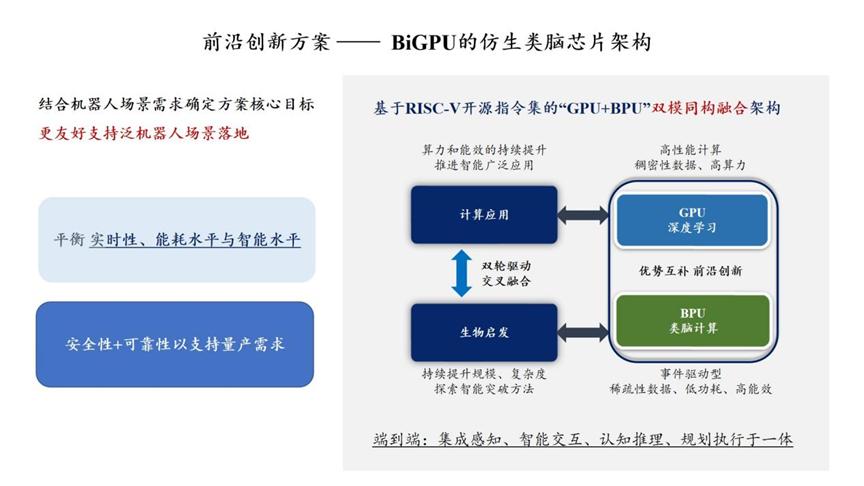
Developed Brain-Inspired GPU (BiGPU) architecture for embodied AI.
Why It Matters
This could significantly lower the barrier for deploying high-performance embodied AI on edge devices, reducing dependence on Nvidia Jetson platforms.
What To Do Next
Monitor Weifan Intelligence's progress on their unified software toolchain to see if it can simplify your edge-robotics deployment pipeline.
Key Points
- •Developed Brain-Inspired GPU (BiGPU) architecture for embodied AI.
- •Achieves SNN and ANN structural unification to share instruction sets and toolchains.
- •Targets 2027 Q2 for mass production of the robot brain chip.
- •Reduces power consumption by converting standard neural networks to SNN-based accumulation.
🧠 Deep Insight
Web-grounded analysis with 7 cited sources.
🔑 Enhanced Key Takeaways
- •Weifan Intelligence was established in May 2025, originating from the Peking University Brain-like Chip Laboratory (PAICORE Lab).
- •The company's strategic goal is to develop a fully domestic robot core computing solution, aiming to reduce China's current dependence on foreign-made chips, such as NVIDIA's Jetson series, for embodied intelligence applications.
- •The seed funding round, amounting to hundreds of millions of yuan, was co-led by Zhongguancun Capital and its subsidiary Qihang Investment, with additional investment from Shanghai Future Industry Fund, Shixi Capital, BAW Storage, Yanchuang Group, Haiyi Investment, and Tanyuan Venture Capital.
- •Co-founder Yin Jilei brings over two decades of experience in the semiconductor industry, having held significant roles in chip research and development at companies like IBM, GlobalFoundries, MTK, and VIA.
- •The BiGPU architecture is specifically engineered to support state-of-the-art (SOTA) large models used in embodied intelligence, integrating both brain-like computing and general-purpose GPU capabilities.
🛠️ Technical Deep Dive
- The BiGPU architecture integrates brain-like computing with general-purpose GPU computing capabilities, specifically designed for SOTA large models in embodied intelligence.
- It achieves structural unification of Spiking Neural Networks (SNNs) and Artificial Neural Networks (ANNs) by sharing instruction formats and address addressing.
- This unification allows for a single instruction set and software toolchain, which significantly reduces development complexity and ecological access costs compared to traditional heterogeneous systems.
- Power consumption is reduced by incorporating a brain-like computing mechanism that converts standard neural networks to SNN-based accumulation.
- Neuromorphic chips, in general, enhance efficiency by co-locating memory and computation, mimicking the synaptic organization of the mammalian brain to achieve low-latency and energy-efficient processing.
- The conversion of ANNs to SNNs, a core aspect of this technology, aims to minimize conversion errors and maintain performance with low latency, although challenges include quantization and unevenness errors.
🔮 Future ImplicationsAI analysis grounded in cited sources
⏳ Timeline
📎 Sources (7)
Factual claims are grounded in the sources below. Forward-looking analysis is AI-generated interpretation.
Weekly AI Recap
Read this week's curated digest of top AI events →
👉Related Updates
AI-curated news aggregator. All content rights belong to original publishers.
Original source: 36氪 ↗