WeCom Updates Rules to Curb Excessive Marketing to Seniors
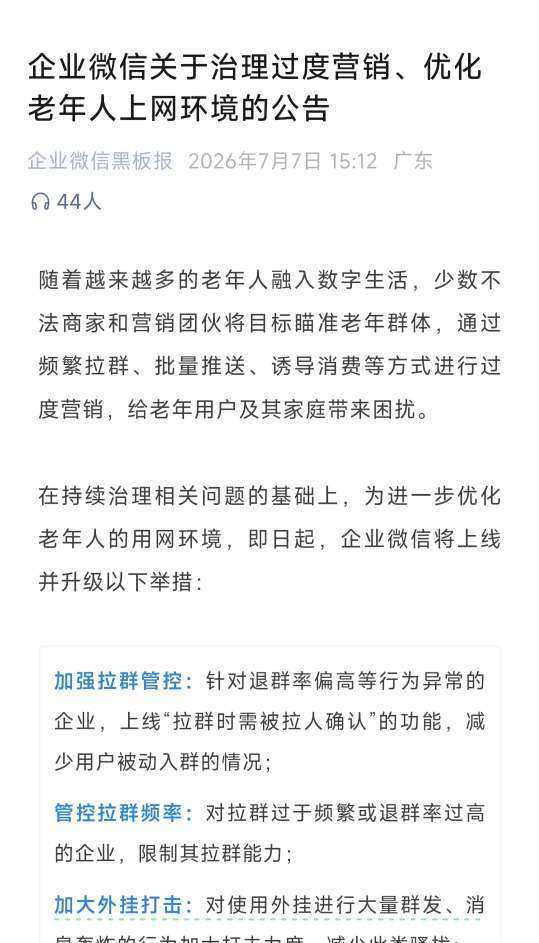
💡Platform policy shift: WeCom tightens group invitation and anti-spam rules to protect vulnerable users.
⚡ 30-Second TL;DR
What Changed
Mandatory confirmation required for adding users to groups.
Why It Matters
Platform-level policy changes regarding user privacy and anti-spam measures will force marketers to adopt more ethical, permission-based engagement strategies.
What To Do Next
Review your automated CRM and lead-gen workflows to ensure they comply with new opt-in requirements for group invitations.
Key Points
- •Mandatory confirmation required for adding users to groups.
- •New policies specifically target and restrict excessive marketing to the elderly.
- •Effort to improve digital safety and user experience for senior demographics.
🧠 Deep Insight
AI-generated analysis for this event — not the original article.
🔑 Enhanced Key Takeaways
- •The update is part of a broader 'Clean Internet' campaign in China, aligning with regulatory pressures from the Cyberspace Administration of China (CAC) to protect vulnerable demographics.
- •WeCom has integrated AI-driven content moderation filters specifically trained to detect 'elderly-targeted scams' and 'misleading health marketing' within private group chats.
- •The new rules include a 'Senior Mode' toggle that automatically restricts third-party mini-program access to sensitive personal data unless explicitly authorized by a family guardian.
- •Tencent has introduced a reporting mechanism that allows family members to link accounts, enabling them to receive alerts when elderly users are added to large, high-risk marketing groups.
- •This policy shift follows a series of public complaints regarding 'private traffic' marketing tactics where companies exploited WeCom's business-to-consumer features to bypass public platform advertising restrictions.
📊 Competitor Analysis▸ Show
| Feature | WeCom (Enterprise WeChat) | DingTalk (Alibaba) | Lark (ByteDance) |
|---|---|---|---|
| Target Audience | Enterprise/B2C Marketing | Enterprise/Education | Enterprise/Collaboration |
| Elderly Protection | High (New Regulatory Focus) | Moderate | Low |
| Marketing Controls | Strict (New Restrictions) | Moderate | Low |
| Pricing | Freemium | Freemium | Freemium |
🛠️ Technical Deep Dive
- Implementation of a heuristic-based risk engine that monitors group invitation frequency and metadata patterns to identify potential spam bots.
- Deployment of natural language processing (NLP) models optimized for detecting deceptive marketing language, such as exaggerated health claims or financial solicitation, in real-time.
- Update to the client-side permission framework requiring a cryptographic handshake between the inviter and the invitee for group entry.
- Integration of a cross-platform identity verification system to ensure that 'Guardian' accounts have verified familial links before accessing restricted monitoring features.
🔮 Future ImplicationsAI analysis grounded in cited sources
⏳ Timeline
Weekly AI Recap
Read this week's curated digest of top AI events →
👉Related Updates
AI-curated news aggregator. All content rights belong to original publishers.
Original source: cnBeta (Full RSS) ↗
This is a summary, not the original. Read the source, or get the weekly briefing.
The weekly digest
One email a week. Unsubscribe anytime.