Weaviate Launches Agent Skills
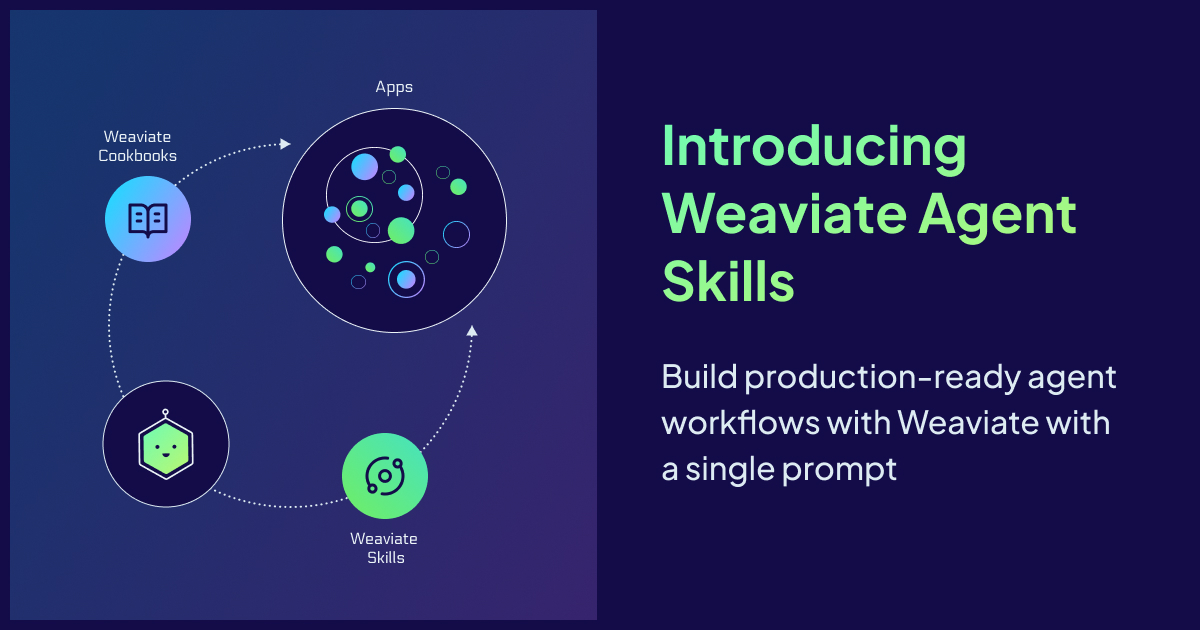
💡Build prod-ready AI agents on Weaviate with one prompt in Copilot/Cursor/Claude—huge for RAG devs.
⚡ 30-Second TL;DR
What Changed
Introduces Agent Skills for agent workflows
Why It Matters
This feature democratizes agent development, allowing AI builders to rapidly prototype and deploy scalable agentic apps on Weaviate without deep coding. It could boost adoption of vector databases in agentic AI stacks, competing with emerging agent frameworks.
What To Do Next
Test Agent Skills by prompting a simple workflow in GitHub Copilot within your Weaviate instance.
Key Points
- •Introduces Agent Skills for agent workflows
- •Enables single-prompt creation of production-ready agents
- •Integrates with Claude Code, Cursor, and GitHub Copilot
🧠 Deep Insight
Background and context from public sources — not the original article. 4 sources cited.
🔑 Enhanced Key Takeaways
- •Weaviate positions Agent Skills as a bridge between vector databases and agentic AI frameworks, enabling developers to build autonomous workflows without extensive custom development[1]
- •The integration with Claude Code, Cursor, and GitHub Copilot reflects the 2026 trend of embedding AI agents directly into developer tools and IDEs[2]
- •Agent Skills leverage Weaviate's hybrid search capabilities (vector + keyword) to provide richer context for agent reasoning, addressing a key limitation of pure vector-only databases[3]
- •This capability aligns with the 2026 agentic AI architecture pattern of multi-agent orchestration, where specialized agents coordinate across different functions[1]
- •Single-prompt agent creation reduces the barrier to entry for production-ready agents, democratizing agentic AI development beyond specialized ML teams[2]
📊 Competitor Analysis▸ Show
| Capability | Weaviate Agent Skills | Qdrant | FalkorDB | LangChain/LlamaIndex |
|---|---|---|---|---|
| Vector Search Speed | Moderate (0.45-0.48s avg) | Ultra-fast (<0.001s) | Fast (0.001-0.003s) | Framework-dependent |
| Hybrid Search | Native (vector + keyword) | Vector-only | Graph-optimized | Requires integration |
| Agent Orchestration | Native via Agent Skills | Not primary focus | Not primary focus | Extensive support |
| IDE Integration | Claude Code, Cursor, GitHub Copilot | Limited | Limited | Broad ecosystem |
| Multimodal Support | Yes (AI-native platform) | Limited | Limited | Framework-dependent |
| Use Case Strength | Complex semantic + relational queries | Real-time vector similarity | Complex relationship queries | General-purpose agents |
🛠️ Technical Deep Dive
• Agent Skills Architecture: Built on Weaviate's GraphQL-first design, enabling agents to query both semantic vectors and structured metadata in unified operations • Reasoning Pattern Support: Integrates with ReAct (Reason + Act) and Chain-of-Thought patterns native to modern agentic frameworks[2] • Multi-Agent Coordination: Supports the 2026 orchestration layer pattern where specialized agents (Sales, Research, Compliance, Finance, Support) coordinate through a central orchestrator[1] • Hybrid Context Retrieval: Combines vector similarity search with keyword matching and relationship traversal, providing richer context for LLM reasoning compared to vector-only databases[3] • IDE-Native Development: Leverages Claude Code, Cursor, and GitHub Copilot's code generation capabilities to reduce boilerplate and accelerate agent workflow creation • Production Readiness: Includes built-in support for human-in-the-loop gates, approval workflows, and audit logging—critical for enterprise deployment[1]
🔮 Future ImplicationsAI analysis grounded in cited sources
Weaviate's Agent Skills announcement signals a consolidation trend in the agentic AI stack: vector databases are evolving from pure search infrastructure into full-stack agent development platforms. This threatens specialized agent frameworks (LangChain, LlamaIndex) by embedding orchestration capabilities directly into the data layer. The IDE integration pattern (Claude Code, Cursor, GitHub Copilot) suggests 2026 will see agent development shift from specialized platforms to mainstream developer tools, accelerating adoption but also commoditizing agent frameworks. For enterprises, this reduces vendor lock-in by enabling multi-database agent architectures, but increases complexity in choosing between speed-optimized (Qdrant), relationship-optimized (FalkorDB), and feature-rich (Weaviate) platforms. The single-prompt creation model may drive rapid proliferation of agents, intensifying focus on governance, compliance, and human oversight mechanisms—areas where Weaviate's native HITL support provides competitive advantage.
⏳ Timeline
📎 Sources (4)
Factual claims are grounded in the sources below. Forward-looking analysis is AI-generated interpretation.
Weekly AI Recap
Read this week's curated digest of top AI events →
👉Related Updates
AI-curated news aggregator. All content rights belong to original publishers.
Original source: Weaviate Blog ↗
This is a summary, not the original. Read the source, or get the weekly briefing.
Weekly AI briefing
One email a week. Unsubscribe anytime.