Wayve Eyes Pothole-Proof Self-Driving Cars with £1bn Boost
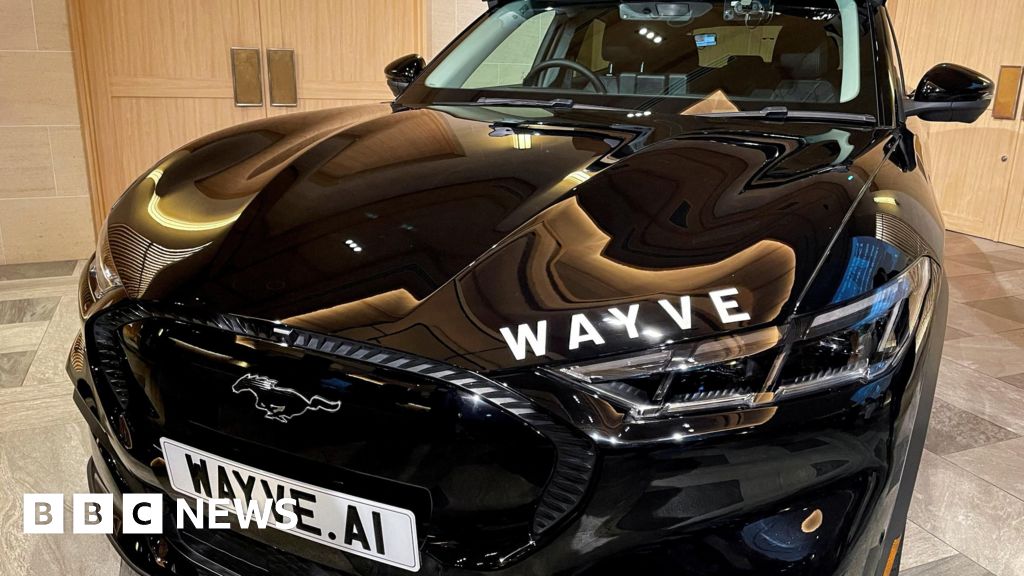
💡£1bn AV funding + pothole-proof AI claim: boosts embodied AI real-world progress.
⚡ 30-Second TL;DR
What Changed
Wayve claims self-driving cars resilient to potholes.
Why It Matters
Massive £1bn funding accelerates embodied AI for AV, boosting real-world robustness research. Signals investor faith in mapless autonomy tech amid AV industry competition.
What To Do Next
Explore Wayve's end-to-end AV papers on arXiv for pothole-handling model techniques.
Key Points
- •Wayve claims self-driving cars resilient to potholes.
- •Confident all cars will achieve full autonomy.
- •Secured over £1bn in additional investment.
🧠 Deep Insight
Background and context from public sources — not the original article. 3 sources cited.
🔑 Enhanced Key Takeaways
- •Wayve partners with Uber for upcoming UK government robotaxi trials in London starting spring 2026, positioning the city as a global testing hub alongside Waymo and Baidu.[1]
- •Wayve signed a deal with Nissan in December 2025 to develop self-driving cars for sale in Japan and North America by 2027.[1]
- •Wayve's technology is under testing in Ford Mustang Mach-E vehicles on London roads, successfully completing demo drives without intervention.[1]
📊 Competitor Analysis▸ Show
| Feature | Wayve (AV2.0) | Waymo (AV1.0) |
|---|---|---|
| Architecture | End-to-end neural network from raw sensors to driving outputs | Modular sense-plan-act with HD maps and hand-coded rules |
| Mapping | Mapless, data-driven adaptation to new geographies | Relies on high-definition maps |
| Vehicle Compatibility | Agnostic to any vehicle type | Specific to Jaguar I-Pace in London tests |
| Generalization | Handles unexpected scenarios via self-supervised learning | Pre-programmed scenarios |
🛠️ Technical Deep Dive
- •Employs Embodied AI with self-supervised learning on millions of hours of driving data to enable generalization to unseen scenarios without HD maps.[1][2]
- •AV2.0 architecture: Single end-to-end neural network replacing traditional modular 'sense-plan-act' (AV1.0), converting raw sensor inputs directly to safe driving outputs.[2]
- •Domain-optimized model prioritizes automotive safety, supports vehicle-agnostic deployment (e.g., cars, vans), and uses MLops for responsible training and deployment.[2]
- •Solves 'long-tail' edge cases through efficient large-scale learning, building verifiable robustness for eyes-off autonomy.[2]
🔮 Future ImplicationsAI analysis grounded in cited sources
⏳ Timeline
📎 Sources (3)
Factual claims are grounded in the sources below. Forward-looking analysis is AI-generated interpretation.
📰 Event Coverage
Weekly AI Recap
Read this week's curated digest of top AI events →
👉Related Updates



AI-curated news aggregator. All content rights belong to original publishers.
Original source: BBC Technology ↗
This is a summary, not the original. Read the source, or get the weekly briefing.
Weekly AI briefing
One email a week. Unsubscribe anytime.