📊Bloomberg Technology•Stalecollected in 5m
Wayve CEO on End-to-End AV vs Tesla
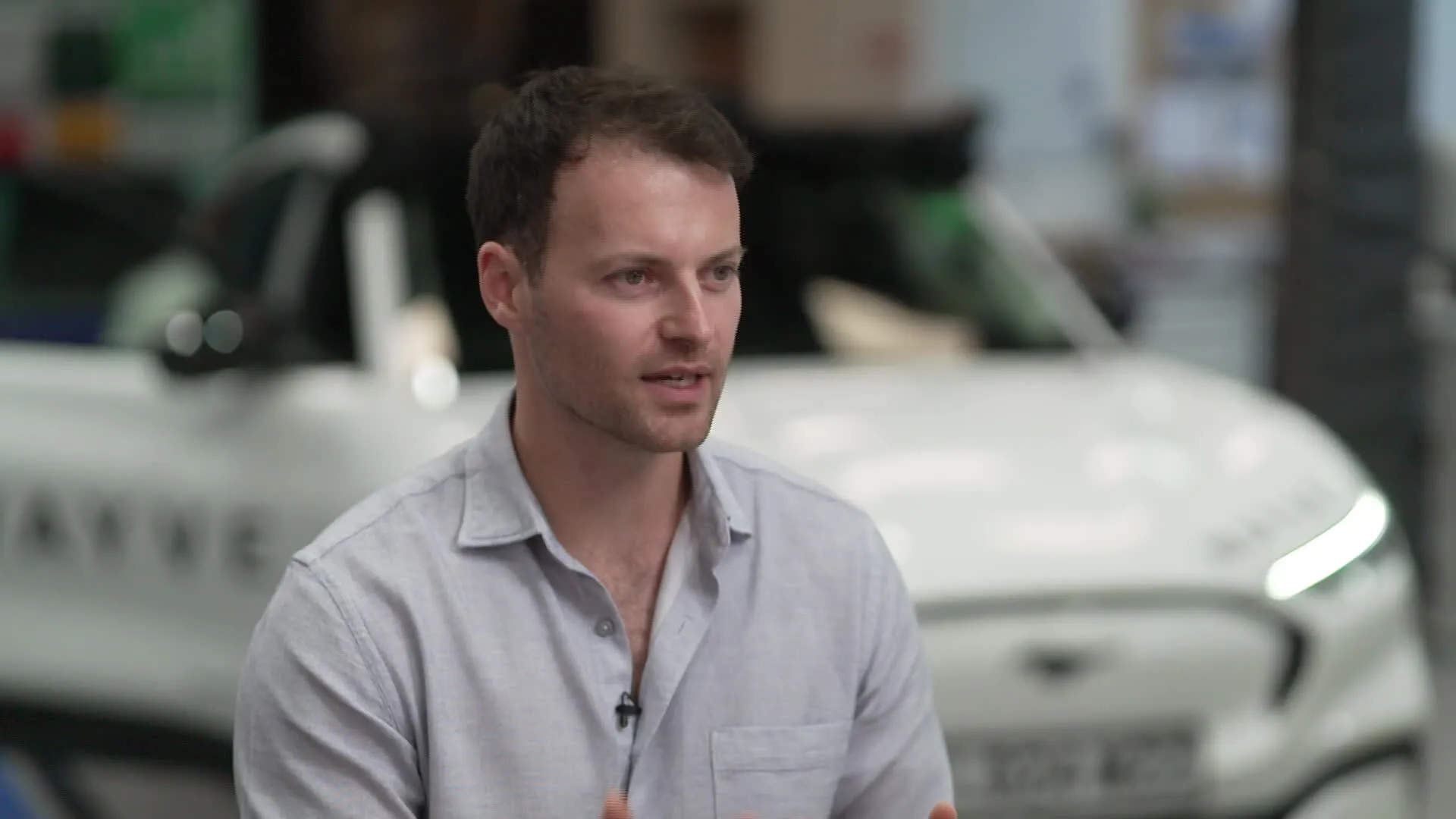
💡Learn why end-to-end AI beats modular AV stacks for scaling (Wayve CEO insights).
⚡ 30-Second TL;DR
What Changed
End-to-end autonomous driving approach by Wayve
Why It Matters
Shifts focus to AI-centric AV scaling, potentially accelerating adoption beyond hardware-heavy rivals.
What To Do Next
Read Wayve's end-to-end AV whitepaper for implementation insights.
Who should care:Researchers & Academics
Key Points
- •End-to-end autonomous driving approach by Wayve
- •Key differences from Tesla and Waymo strategies
- •AI licensing as fastest path to scaling AV tech
🧠 Deep Insight
AI-generated analysis for this event.
🔑 Enhanced Key Takeaways
- •Wayve's 'AV2.0' approach utilizes multimodal foundation models that learn directly from raw sensor data and human driving behavior, bypassing the need for traditional, map-heavy HD-map reliance used by competitors like Waymo.
- •The company's business model focuses on being a 'software-first' provider, aiming to license its embodied AI stack to automotive OEMs rather than operating its own robotaxi fleet, which differentiates its capital expenditure model from vertically integrated competitors.
- •Wayve's recent strategic partnerships, including significant investment rounds from major automotive players like SoftBank, NVIDIA, and Microsoft, underscore a shift toward integrating their end-to-end AI into mass-market consumer vehicles rather than niche commercial fleets.
📊 Competitor Analysis▸ Show
| Feature | Wayve (AV2.0) | Waymo (AV1.0) | Tesla (FSD) |
|---|---|---|---|
| Core Strategy | End-to-End Foundation Model | Modular/Map-based | End-to-End Neural Net |
| Hardware | Sensor Agnostic | LiDAR-heavy | Camera-only |
| Business Model | B2B Licensing | Robotaxi Operator | Consumer Software/Hardware |
| Mapping | Map-less (Generalizable) | HD-Map Dependent | Map-less (Crowdsourced) |
🛠️ Technical Deep Dive
- Architecture: Utilizes 'Embodied AI' foundation models that process high-dimensional sensor inputs (camera, radar, LiDAR) to output driving commands directly.
- Learning Paradigm: Employs imitation learning and reinforcement learning to mimic human driving patterns and handle edge cases without explicit rule-based coding.
- Generalization: Designed for 'zero-shot' transfer, allowing the model to navigate unfamiliar environments without prior mapping or extensive local training data.
- Compute: Leverages large-scale cloud infrastructure for training, with optimized inference engines designed to run on automotive-grade silicon.
🔮 Future ImplicationsAI analysis grounded in cited sources
Wayve will achieve Level 4 autonomy in diverse urban environments faster than competitors relying on HD-maps.
By removing the dependency on pre-mapped high-definition data, the system can scale to new geographic regions without the time-intensive process of mapping every street.
Automotive OEMs will increasingly favor licensing third-party end-to-end AI over developing proprietary autonomous stacks.
The high cost and technical complexity of training foundation models for driving make licensing a more economically viable path for traditional car manufacturers to remain competitive.
⏳ Timeline
2017-05
Wayve founded in Cambridge, UK, by Alex Kendall and Amar Shah.
2019-08
Wayve completes the first public road test of a car using end-to-end deep learning for autonomous driving.
2022-01
Wayve raises $200 million in Series B funding led by Eclipse Ventures.
2024-05
Wayve secures $1.05 billion in Series C funding led by SoftBank, with participation from NVIDIA and Microsoft.
📰
Weekly AI Recap
Read this week's curated digest of top AI events →
👉Related Updates
AI-curated news aggregator. All content rights belong to original publishers.
Original source: Bloomberg Technology ↗