📊Bloomberg Technology•Stalecollected in 5m
Wayve: AI Reshapes Self-Driving Cars
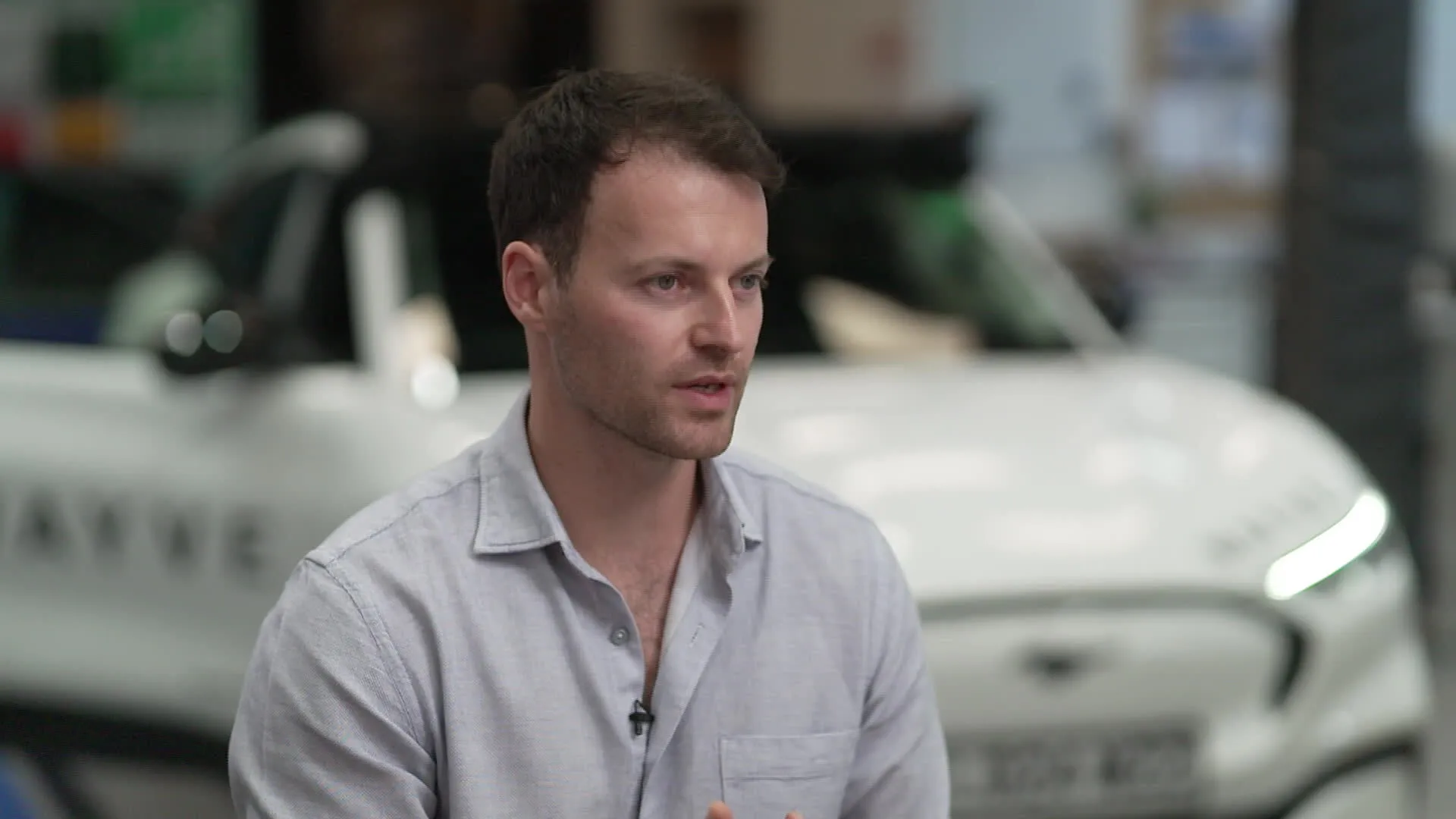
💡Discover onboard AI + real-world learning for faster AV scaling (Wayve view).
⚡ 30-Second TL;DR
What Changed
AI-driven approach with onboard intelligence
Why It Matters
Promotes scalable AI learning over map-dependent systems, influencing robotaxi economics.
What To Do Next
Experiment with real-world data loops in your AV simulation pipeline.
Who should care:Developers & AI Engineers
Key Points
- •AI-driven approach with onboard intelligence
- •Real-world learning for AV development
- •Reshaping build and scale of robotaxis
🧠 Deep Insight
AI-generated analysis for this event.
🔑 Enhanced Key Takeaways
- •Wayve utilizes an 'Embodied AI' approach, moving away from traditional modular, rule-based software stacks toward end-to-end deep learning models that map sensor inputs directly to driving actions.
- •The company has secured significant strategic investment from major automotive and tech players, including SoftBank, NVIDIA, and Microsoft, to accelerate the deployment of its foundation models for autonomous driving.
- •Wayve's technology is designed to be hardware-agnostic, allowing its AI driver to be integrated into various vehicle platforms without requiring the extensive high-definition mapping infrastructure used by competitors like Waymo.
📊 Competitor Analysis▸ Show
| Feature | Wayve | Waymo | Tesla (FSD) |
|---|---|---|---|
| Approach | End-to-end Embodied AI | Modular/Hybrid | End-to-end Neural Net |
| Mapping | Map-less (Generalizable) | HD Map-dependent | Map-less (Vision-only) |
| Hardware | Agnostic | Proprietary Sensor Suite | Vision-only (Cameras) |
| Primary Market | Robotaxi/OEM Licensing | Robotaxi (Public) | Consumer ADAS/Robotaxi |
🛠️ Technical Deep Dive
- •Architecture: Utilizes 'AV2.0' foundation models, which are large-scale multimodal models trained on massive datasets of driving behavior to understand complex urban environments.
- •Learning Mechanism: Employs imitation learning and reinforcement learning to allow the system to generalize to unseen scenarios rather than relying on pre-programmed 'if-then' rules.
- •Sensor Fusion: The model processes raw data from cameras, LiDAR, and radar simultaneously within the neural network to create a unified representation of the world.
- •Compute: Leverages high-performance GPU clusters (often via cloud partnerships) for training, with optimized inference engines for real-time onboard processing.
🔮 Future ImplicationsAI analysis grounded in cited sources
Wayve will shift the autonomous vehicle industry toward a licensing-first business model.
By decoupling the AI software from specific hardware, Wayve is positioned to provide 'driver-as-a-service' to traditional automakers rather than operating its own proprietary fleet.
End-to-end AI models will reduce the cost of autonomous system deployment by eliminating HD mapping requirements.
Removing the need for constant, expensive maintenance of high-definition maps allows for faster scaling across diverse geographic regions.
⏳ Timeline
2017-05
Wayve is founded in Cambridge, UK, by Alex Kendall and Amar Shah.
2019-08
Wayve completes the first public road test of an end-to-end deep learning autonomous vehicle in the UK.
2022-01
Wayve announces a $200 million Series B funding round led by Eclipse Ventures.
2024-05
Wayve raises $1.05 billion in a Series C funding round led by SoftBank, with participation from NVIDIA and Microsoft.
📰
Weekly AI Recap
Read this week's curated digest of top AI events →
👉Related Updates
AI-curated news aggregator. All content rights belong to original publishers.
Original source: Bloomberg Technology ↗