Vercel’s AI SDK Software Factory Scales Agentic Development
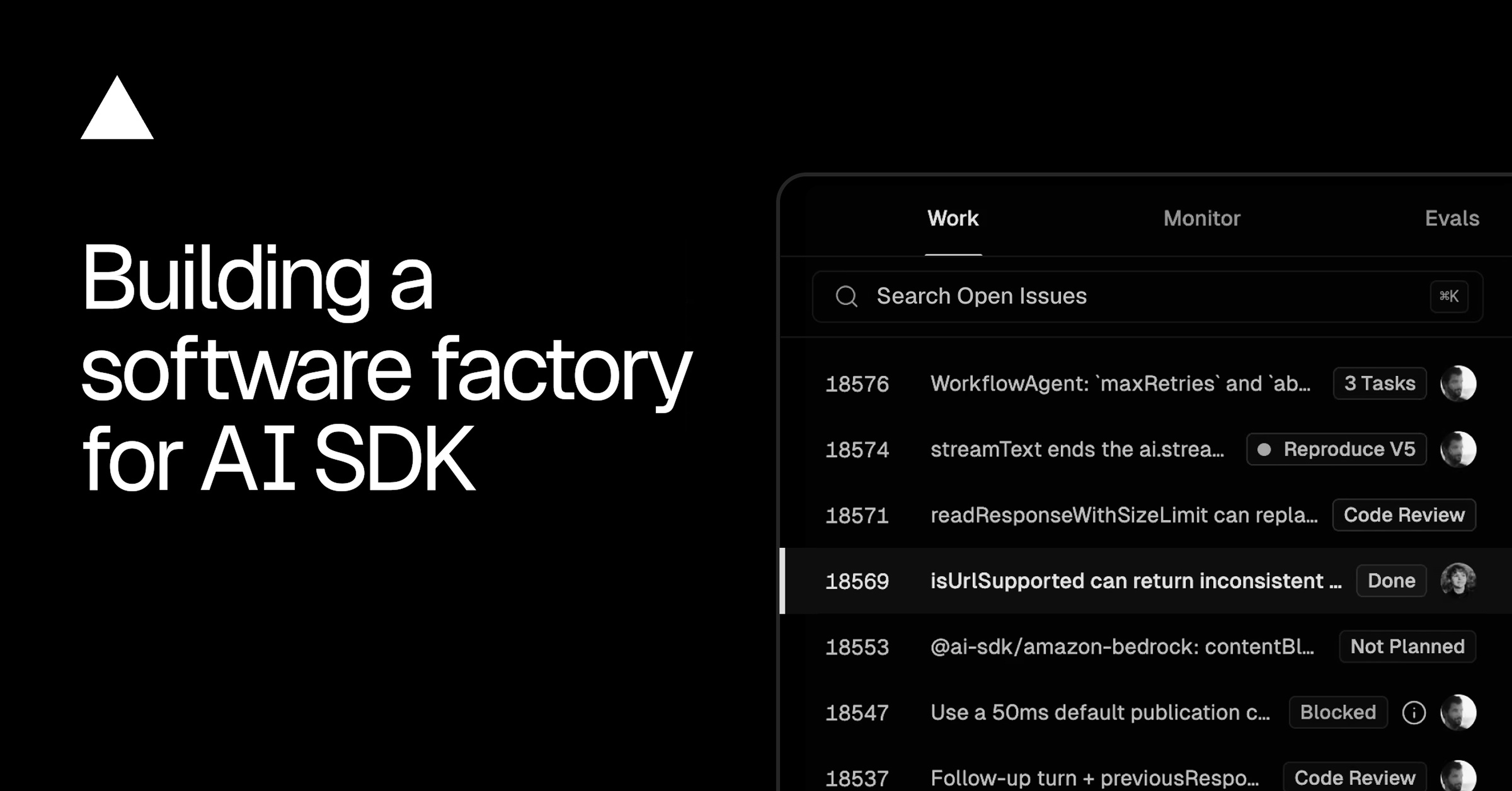
💡See how Vercel uses agents to clear AI SDK backlog while keeping humans in control of releases.
⚡ 30-Second TL;DR
What Changed
The AI SDK receives more than 20 million npm downloads per week and has over 26,000 GitHub stars.
Why It Matters
This approach suggests that mature open-source AI infrastructure projects can scale agent-assisted maintenance without eliminating human oversight. The model may reduce maintainer bottlenecks, but its effectiveness depends on reliable risk assessment and review workflows.
What To Do Next
Pilot a risk-based agent workflow on one repository, measuring agent-authored PRs, issue closures, and the amount of required human review.
Key Points
- •The AI SDK receives more than 20 million npm downloads per week and has over 26,000 GitHub stars.
- •By late June, the project had accumulated more than 1,000 open issues and nearly 800 pull requests.
- •The software factory currently authors 25–35% of merged pull requests and closes 70–80% of issues.
- •Vercel designed the system around reviewer efficiency, with human review depth increasing according to change risk.
🧠 Deep Insight
AI-generated analysis for this event.
🔑 Enhanced Key Takeaways
- •The software factory utilizes a multi-agent orchestration layer that categorizes tasks based on complexity, routing routine maintenance to autonomous agents while escalating architectural changes to human maintainers.
- •Vercel implemented a 'human-in-the-loop' verification protocol where agents must generate comprehensive test suites alongside code changes to ensure regression prevention before a human reviewer is notified.
- •The system integrates directly with Vercel's internal CI/CD pipelines, allowing agents to trigger ephemeral preview deployments for every pull request to validate UI/UX changes in real-time.
- •Data from the software factory indicates that agent-authored PRs have a lower rate of post-merge regressions compared to manual contributions, attributed to the agents' strict adherence to standardized coding patterns.
- •The initiative is part of a broader Vercel strategy to transition the AI SDK from a community-maintained project to a 'production-grade' framework capable of supporting enterprise-scale agentic workflows.
📊 Competitor Analysis▸ Show
| Feature | Vercel AI SDK Factory | GitHub Copilot Workspace | Cursor (Agentic Mode) |
|---|---|---|---|
| Primary Focus | Automated Repository Maintenance | Developer-Assisted Coding | IDE-Integrated Agentic Flow |
| Issue Resolution | High (Automated) | Low (Manual/Assisted) | Low (Manual/Assisted) |
| Human Oversight | Mandatory/Risk-Based | Mandatory | Mandatory |
| Pricing | Open Source / Integrated | Subscription | Subscription |
🛠️ Technical Deep Dive
- The architecture employs a specialized agentic loop that utilizes RAG (Retrieval-Augmented Generation) over the repository's existing codebase and documentation to maintain context consistency.
- Agents are equipped with custom tool definitions that allow them to interact with GitHub APIs, run local test suites, and perform static analysis using tools like ESLint and TypeScript compiler.
- The system uses a tiered model approach, where smaller, faster models handle issue triage and labeling, while larger reasoning models (e.g., GPT-4o or Claude 3.5 Sonnet variants) are invoked for code generation and refactoring.
- Implementation relies on a state machine that tracks the lifecycle of an issue from 'Open' to 'Verified' to 'Merged', ensuring that no agentic action bypasses security or quality gates.
🔮 Future ImplicationsAI analysis grounded in cited sources
⏳ Timeline
Weekly AI Recap
Read this week's curated digest of top AI events →
👉Related Updates
AI-curated news aggregator. All content rights belong to original publishers.
Original source: Vercel News ↗