Using AI agents to migrate legacy rate-limiting systems
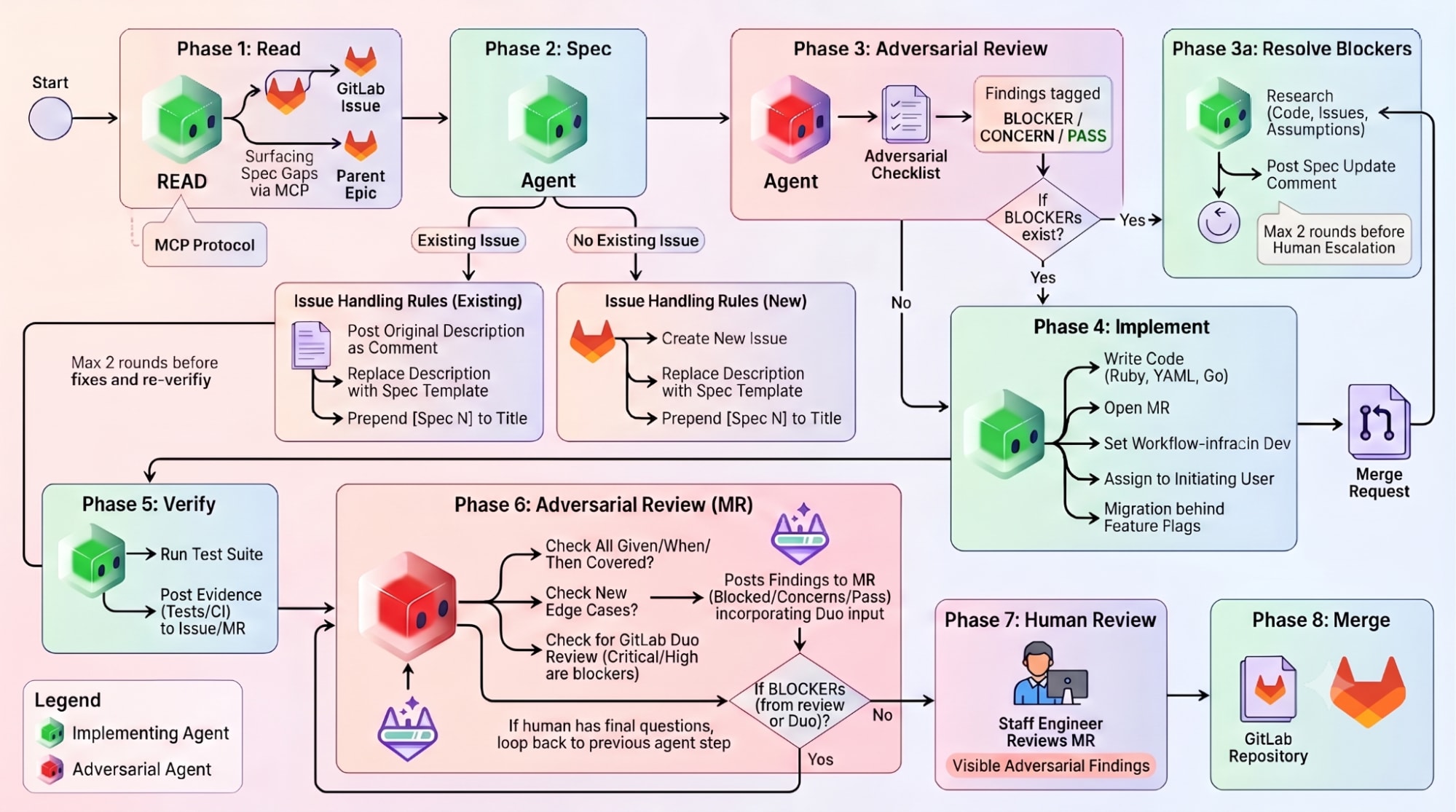
💡Learn how GitLab successfully used AI agents to refactor critical legacy infrastructure without compromising safety.
⚡ 30-Second TL;DR
What Changed
Implemented a strict loop: spec drafting, adversarial review, implementation, and human verification.
Why It Matters
This case study demonstrates that AI agents are effective for refactoring legacy code when paired with rigorous human-defined guardrails. It highlights a shift toward 'agentic' workflows where AI handles the heavy lifting of documentation and testing while humans focus on high-stakes judgment.
What To Do Next
Adopt a 'spec-first' adversarial review loop for your next refactoring project by using AI to generate specs and then manually challenging those specs before writing any code.
Key Points
- •Implemented a strict loop: spec drafting, adversarial review, implementation, and human verification.
- •Used AI agents to handle repetitive tasks like spec writing and pre-reviewing merge requests.
- •Maintained human control over critical rollout phases and architectural decisions to ensure system safety.
- •Successfully unified two disparate rate-limiting paths into a single labkit-ruby implementation.
🧠 Deep Insight
AI-generated analysis for this event — not the original article.
🔑 Enhanced Key Takeaways
- •The migration targeted the consolidation of legacy rate-limiting logic into the 'labkit-ruby' library, which serves as GitLab's standardized instrumentation and observability framework.
- •The project utilized GitLab Duo's 'Code Suggestions' and 'Chat' features to specifically generate RSpec tests that covered edge cases in the legacy system's behavior.
- •Engineers employed an 'adversarial review' pattern where AI agents were prompted to identify potential security vulnerabilities or performance regressions in the generated code before human review.
- •The initiative was part of a broader effort to reduce technical debt in GitLab's monolithic codebase, specifically addressing the maintenance burden of having multiple, inconsistent rate-limiting implementations.
- •The human-in-the-loop workflow required engineers to manually validate the AI-generated migration scripts against production-like traffic patterns in a staging environment before final deployment.
🛠️ Technical Deep Dive
- The migration focused on unifying disparate rate-limiting paths into the labkit-ruby gem, which provides a consistent interface for rate limiting across GitLab services.
- The AI-assisted workflow involved generating RSpec test suites to ensure that the new implementation maintained parity with the legacy system's specific rate-limiting thresholds and bucket algorithms.
- The process utilized GitLab Duo to perform static analysis on the legacy code to extract existing rate-limiting parameters before mapping them to the new labkit-ruby configuration.
- The implementation maintained strict adherence to the Token Bucket algorithm, ensuring that the migration did not alter the underlying traffic shaping logic.
🔮 Future ImplicationsAI analysis grounded in cited sources
⏳ Timeline
Weekly AI Recap
Read this week's curated digest of top AI events →
👉Related Updates
AI-curated news aggregator. All content rights belong to original publishers.
Original source: GitLab Blog ↗
This is a summary, not the original. Read the source, or get the weekly briefing.
The weekly digest
One email a week. Unsubscribe anytime.