Unitree Robot Masters Tasks in 1 Hour via Scaling Laws

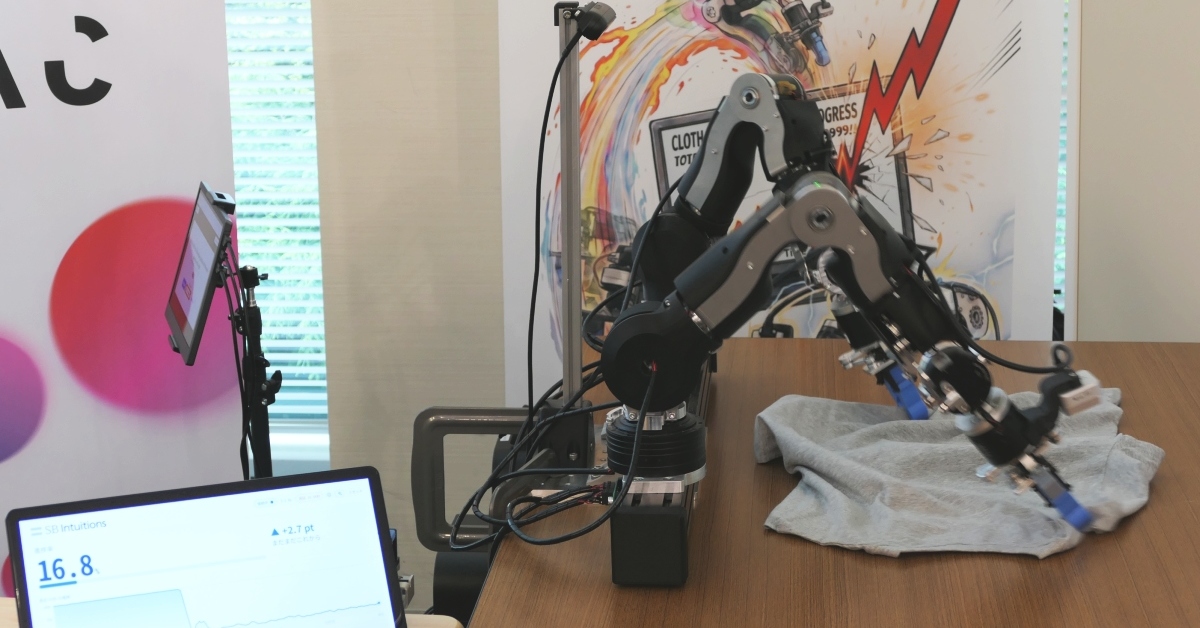
💡Unitree robot hits 99% success via scaling—blueprint for fast embodied training
⚡ 30-Second TL;DR
What Changed
Learns new tasks in 1 hour using scaling laws
Why It Matters
Validates scaling laws for embodied AI, accelerating robotics deployment. Practitioners can apply similar scaling to reduce training times dramatically.
What To Do Next
Test Unitree's SDK to replicate 1-hour task learning in your embodied AI sim.
Key Points
- •Learns new tasks in 1 hour using scaling laws
- •99% success after 1800 repetitions
- •Demonstrates embodied AI scaling effectiveness
- •Pushes boundaries in robotics capabilities
🧠 Deep Insight
AI-generated analysis for this event — not the original article.
🔑 Enhanced Key Takeaways
- •The system utilizes a foundation model architecture specifically optimized for embodied control, moving beyond traditional reinforcement learning by leveraging cross-embodiment data transfer.
- •The 1-hour training time is achieved through a 'warm-start' mechanism where the model utilizes pre-trained representations from a massive dataset of diverse robotic manipulation tasks before fine-tuning on the specific new task.
- •The 99% success rate is contingent on a standardized simulation-to-real (Sim2Real) pipeline that incorporates domain randomization to bridge the reality gap without requiring extensive physical data collection.
📊 Competitor Analysis▸ Show
| Feature | Unitree (Embodied Scaling) | Tesla Optimus | Figure AI |
|---|---|---|---|
| Learning Paradigm | Scaling Laws / Foundation Model | End-to-End Neural Net | Foundation Model / VLA |
| Task Adaptation | ~1 Hour (Fine-tuning) | Ongoing (Data-heavy) | Ongoing (Data-heavy) |
| Primary Focus | Rapid Skill Acquisition | General Purpose Humanoid | General Purpose Humanoid |
🛠️ Technical Deep Dive
- •Architecture: Employs a Transformer-based policy network that processes multimodal inputs (proprioception, visual, and tactile feedback).
- •Scaling Law Implementation: The model performance follows a power-law relationship relative to the number of parameters and the volume of diverse trajectory data, allowing for predictable performance gains.
- •Data Efficiency: Uses a hierarchical learning approach where low-level motor control primitives are frozen, and only high-level task-specific layers are updated during the 1-hour training window.
- •Simulation Environment: Utilizes a high-fidelity physics engine with GPU-accelerated parallel environments to run the 1800 repetitions in a compressed timeframe.
🔮 Future ImplicationsAI analysis grounded in cited sources
⏳ Timeline
Weekly AI Recap
Read this week's curated digest of top AI events →
👉Related Updates

AI-curated news aggregator. All content rights belong to original publishers.
Original source: 量子位 ↗
This is a summary, not the original. Read the source, or get the weekly briefing.
The weekly digest
One email a week. Unsubscribe anytime.