Ukrainian Drones Expose Tank Warfare's Future
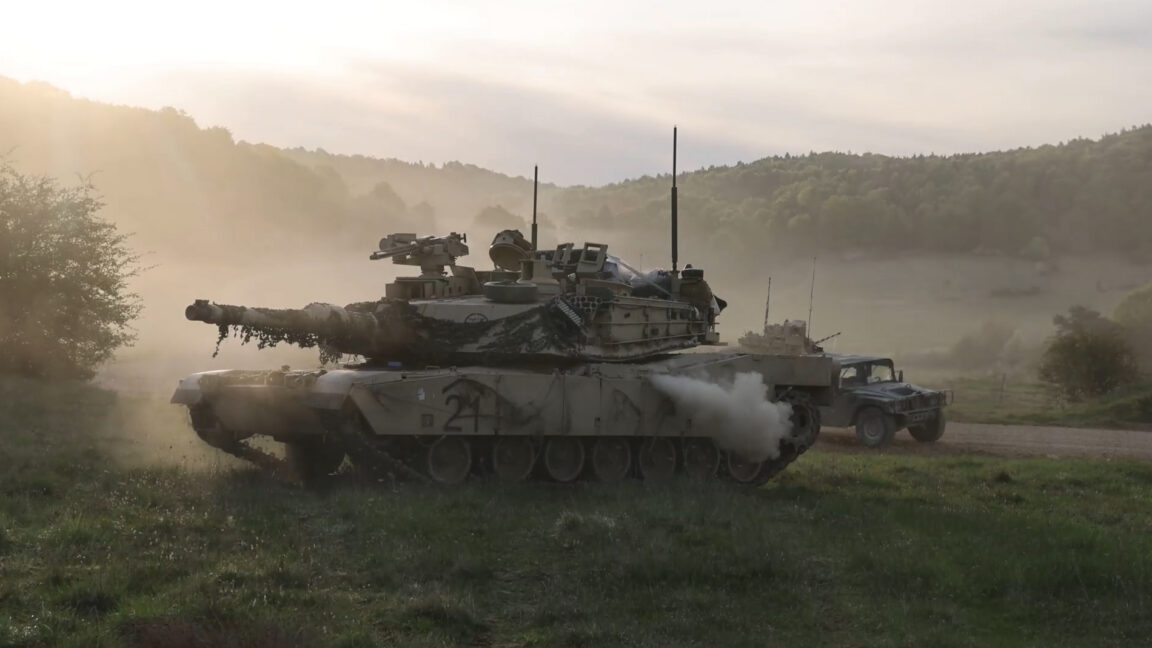
💡A live war game shows how low-cost drones can overwhelm traditional armored formations.
⚡ 30-Second TL;DR
What Changed
Ukrainian drone operators reportedly eliminated a simulated US tank brigade.
Why It Matters
The exercise reinforces the importance of autonomy, low-cost robotics, electronic warfare resilience, and rapid sensor-to-action loops. AI builders working on edge perception or multi-agent systems can draw relevant lessons from the shift toward distributed platforms.
What To Do Next
Evaluate your edge-AI architecture against intermittent connectivity by testing onboard perception and fail-safe behavior in a drone simulation.
Key Points
- •Ukrainian drone operators reportedly eliminated a simulated US tank brigade.
- •The exercise highlighted the battlefield value of distributed aerial systems.
- •US and NATO forces received lessons about adapting armored warfare tactics.
🧠 Deep Insight
AI-generated analysis for this event.
🔑 Enhanced Key Takeaways
- •The exercise, known as 'Combined Resolve,' took place at the Joint Multinational Readiness Center in Hohenfels, Germany, involving the 1st Armored Brigade Combat Team of the 1st Infantry Division.
- •Ukrainian drone operators utilized a mix of commercial off-the-shelf (COTS) FPV drones and modified loitering munitions to bypass traditional electronic warfare (EW) defenses.
- •The simulation revealed that current US Army armored doctrine lacks sufficient organic short-range air defense (SHORAD) assets at the platoon and company levels to counter swarming drone tactics.
- •US commanders noted that the 'transparency' provided by constant drone surveillance made it nearly impossible to achieve tactical surprise or maintain operational security during movement.
- •The event accelerated the US Army's 'Replicator' initiative, shifting focus toward integrating autonomous, low-cost attritable systems into traditional mechanized formations.
🛠️ Technical Deep Dive
- Drone Swarm Architecture: Utilization of decentralized command-and-control (C2) nodes allowing individual operators to hand off target tracking dynamically.
- Signal Processing: Implementation of frequency-hopping spread spectrum (FHSS) techniques to mitigate the impact of localized electronic jamming.
- Payload Integration: Use of modular, 3D-printed mounting systems for high-explosive anti-tank (HEAT) warheads adapted from RPG-7 rounds.
- Sensor Fusion: Integration of thermal and electro-optical (EO) feeds into a unified Common Operational Picture (COP) accessible via encrypted tactical networks.
🔮 Future ImplicationsAI analysis grounded in cited sources
⏳ Timeline
Weekly AI Recap
Read this week's curated digest of top AI events →
👉Related Updates




AI-curated news aggregator. All content rights belong to original publishers.
Original source: Ars Technica ↗