UK Courts Move to Ban Meta Smart Glasses
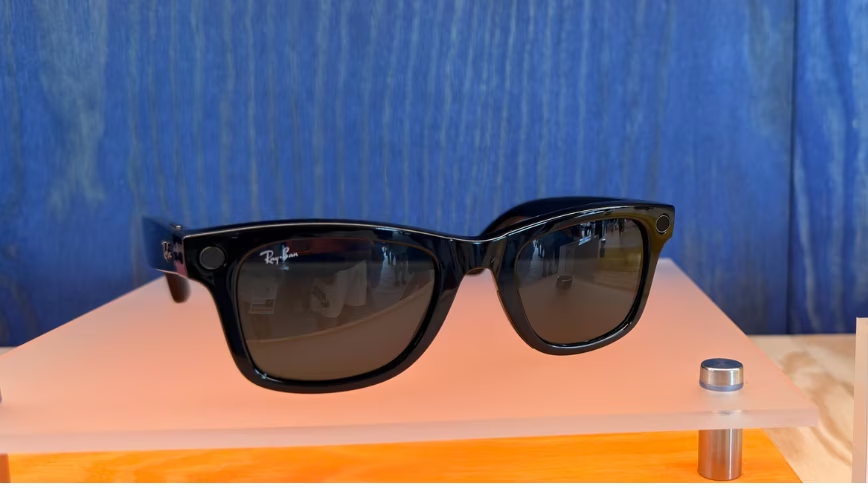
💡A court ban signals tougher privacy rules for AI-enabled cameras and wearable assistants.
⚡ 30-Second TL;DR
What Changed
The ban covers criminal, civil, and family courts across England and Wales.
Why It Matters
The decision could influence how other sensitive venues regulate AI-enabled wearables with cameras and microphones. Developers may face stricter deployment requirements when products can capture people or conversations in controlled environments.
What To Do Next
Add venue-specific camera, microphone, and recording controls to any AI wearable prototype before testing it in courts or other restricted sites.
Key Points
- •The ban covers criminal, civil, and family courts across England and Wales.
- •HMCTS plans to confiscate Meta smart glasses at court entrances.
- •The policy reflects broader concerns about wearable cameras, privacy, and unauthorized recording.
🧠 Deep Insight
AI-generated analysis for this event.
🔑 Enhanced Key Takeaways
- •The ban specifically targets devices with integrated cameras and audio recording capabilities, classifying Meta smart glasses alongside traditional recording equipment like smartphones and cameras which are already restricted in courtrooms.
- •HMCTS officials cited the 'Ray-Ban Meta' branding as a specific point of confusion for security staff, leading to a blanket policy to avoid discretionary errors by entry personnel.
- •Legal experts have noted that this policy aligns with the Contempt of Court Act 1981, which prohibits the unauthorized recording of court proceedings, now extended to include wearable tech.
- •The policy includes a 'check-in' service where visitors can store prohibited devices in secure lockers, similar to existing protocols for professional cameras or recording devices.
- •Data protection advocates have praised the move, noting that the glasses' 'recording' LED indicator is often too small or easily obscured, making it difficult for court staff to verify if a recording is active.
📊 Competitor Analysis▸ Show
| Feature | Ray-Ban Meta Smart Glasses | XREAL Air 2 | Apple Vision Pro |
|---|---|---|---|
| Primary Use | Social/Lifestyle/AI Assistant | AR Display/Media Consumption | Spatial Computing/Work |
| Camera | 12MP Ultra-wide | None | High-res 3D/Spatial |
| Recording Indicator | Physical LED | N/A | Visual/Audio cues |
| Form Factor | Traditional Eyewear | AR Glasses | Headset |
🛠️ Technical Deep Dive
- The Ray-Ban Meta smart glasses utilize a 12MP camera sensor capable of 1080p video recording at 30fps.
- The device features a proprietary 'Capture LED' located on the frame, designed to illuminate when the camera is active to signal recording to bystanders.
- Connectivity is managed via the Meta View app, which handles the transfer of encrypted media files from the glasses to the paired smartphone.
- The hardware includes a custom-designed Qualcomm Snapdragon AR1 Gen 1 platform, optimized for low-power AI processing and image signal processing (ISP).
- Audio input is captured via a five-microphone array, which supports spatial audio recording and beamforming for voice commands.
🔮 Future ImplicationsAI analysis grounded in cited sources
⏳ Timeline
Weekly AI Recap
Read this week's curated digest of top AI events →
👉Related Updates
AI-curated news aggregator. All content rights belong to original publishers.
Original source: The Next Web (TNW) ↗