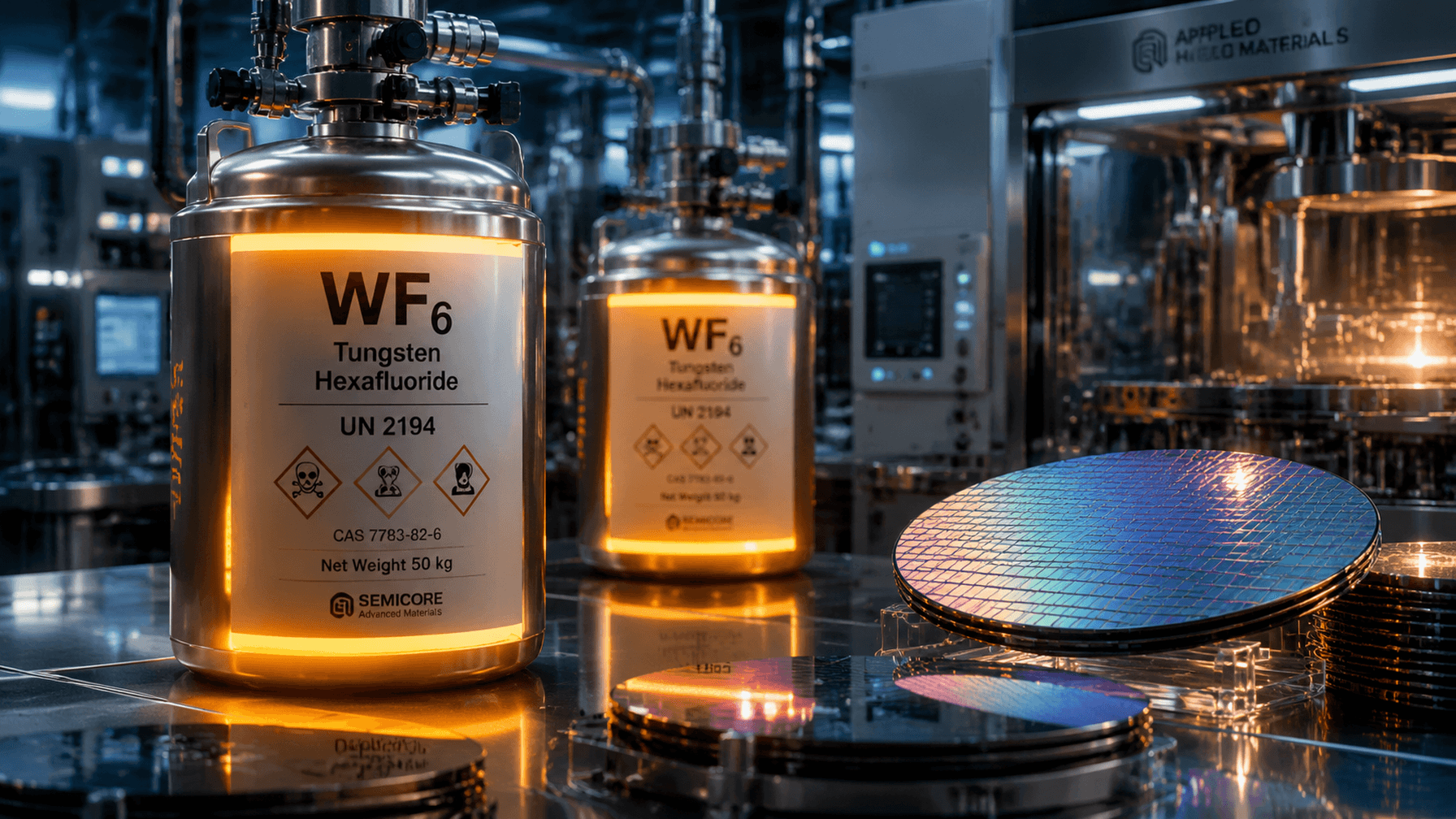
Tungsten Hexafluoride Prices Double Amid AI Chip Surge
💡AI hardware costs are rising; understand how semiconductor material shortages could impact your infrastructure budget.
⚡ 30-Second TL;DR
What Changed
Tungsten hexafluoride prices have doubled over the last six months.
Why It Matters
Rising material costs may lead to increased production expenses for high-end AI chips, potentially impacting hardware pricing and supply availability for AI infrastructure projects.
What To Do Next
Assess your hardware procurement pipeline and buffer against potential lead-time delays for GPU-intensive AI infrastructure projects.
Key Points
- •Tungsten hexafluoride prices have doubled over the last six months.
- •AI computing demand is the primary driver for the semiconductor material shortage.
- •Global supply is tightening due to export controls and strategic production cuts.
🧠 Deep Insight
Background and context from public sources — not the original article. 14 sources cited.
🔑 Enhanced Key Takeaways
- •Tungsten hexafluoride (WF6) is the sole precursor for tungsten deposition in 3D NAND, high-bandwidth memory (HBM), and advanced logic chip fabrication, making it indispensable for current AI computing processes.
- •China controls over 80% of global tungsten mining and refining capacity, giving it significant leverage over the WF6 supply chain, and implemented an export licensing system for tungsten in February 2025.
- •Japanese suppliers, including Kanto Denka and Central Glass, which collectively account for approximately 25% of global WF6 supply, are planning to reduce or permanently halt production starting July 2026 due to difficulties in securing tungsten powder from China.
- •The price of 5N-grade tungsten hexafluoride surged over 200% year-on-year by April 2026, with 6N-grade prices climbing over 190% from early April levels, and South Korean suppliers have notified customers of 70-90% price increases for 2026 contracts.
🛠️ Technical Deep Dive
- Tungsten hexafluoride (WF6) is a colorless, highly corrosive, and extremely toxic gas at standard temperature and pressure.
- It is primarily utilized in chemical vapor deposition (CVD) processes to deposit ultra-thin tungsten films on semiconductor wafers.
- These tungsten films are crucial for forming low-resistivity metallic interconnects, gate electrodes, and barrier layers in integrated circuits, which are essential for high-performance chips.
- Tungsten is favored in these applications due to its high thermal and chemical stability, low resistivity (5.6 μΩ·cm), and very low electromigration, enabling the construction of denser, more powerful processors.
- Electronic-grade WF6 typically requires a purity of 6N (99.9999%) or higher, achieved through the direct reaction of high-purity tungsten metal with fluorine gas, followed by multi-stage purification processes.
- During CVD, WF6 reacts upon contact with a silicon substrate (e.g., 2 WF6 + 3 Si → 2 W + 3 SiF4 below 400 °C) to selectively deposit tungsten on pure silicon.
- Its high vapor pressure contributes to efficient deposition rates.
- WF6 consumption is particularly high in 3D NAND flash memory, where vertically stacked structures necessitate repeated tungsten deposition steps; for instance, a 200-layer design typically involves around 200 deposition cycles.
🔮 Future ImplicationsAI analysis grounded in cited sources
⏳ Timeline
📎 Sources (14)
Factual claims are grounded in the sources below. Forward-looking analysis is AI-generated interpretation.
Weekly AI Recap
Read this week's curated digest of top AI events →
👉Related Updates


AI-curated news aggregator. All content rights belong to original publishers.
Original source: Pandaily ↗
This is a summary, not the original. Read the source, or get the weekly briefing.
Weekly AI briefing
One email a week. Unsubscribe anytime.