Track Bedrock Spend by Team and Project
💡Learn how to attribute Bedrock AI spend to the users, projects, and teams driving it.
⚡ 30-Second TL;DR
What Changed
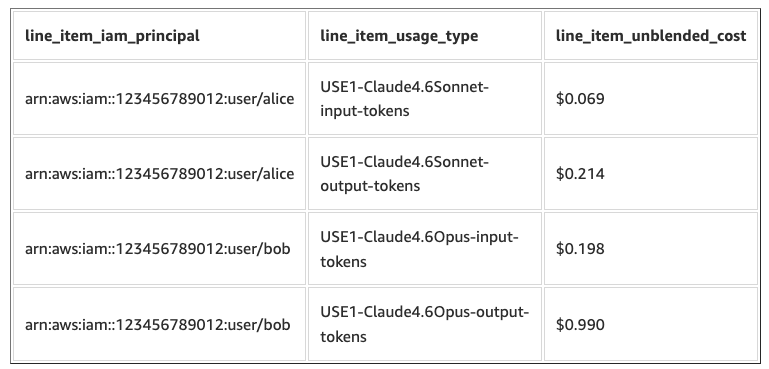
Configure CUR 2.0 to include IAM principal data for Bedrock cost attribution.
Why It Matters
The approach can improve financial accountability for teams deploying generative AI on Bedrock. It gives enterprise practitioners a repeatable way to identify high-spending users or projects and support internal chargeback or budget controls.
What To Do Next
Set up CUR 2.0 with IAM principal data, then reproduce the Amazon Athena queries and CUDOS dashboard workflow for one Bedrock project.
Key Points
- •Configure CUR 2.0 to include IAM principal data for Bedrock cost attribution.
- •Use Amazon Athena queries to analyze Bedrock spending by principal, project, and team.
- •Build CUDOS dashboards to monitor and visualize AI costs across the organization.
🧠 Deep Insight
AI-generated analysis for this event.
🔑 Enhanced Key Takeaways
- •AWS Cost and Usage Report (CUR) 2.0 utilizes a more granular schema that natively supports resource-level cost allocation tags, which are essential for mapping Bedrock API calls to specific IAM principals.
- •The integration relies on the 'line_item_resource_id' and 'line_item_usage_amount' fields within CUR 2.0 to distinguish between different foundation models (e.g., Claude, Titan, Llama) used by the same team.
- •By enabling 'Include resource IDs' in the CUR configuration, organizations can track costs down to the specific model invocation level, rather than just aggregate service-level spending.
- •The CUDOS (Cloud Intelligence Dashboards) framework leverages QuickSight's SPICE engine to process the large datasets generated by high-frequency generative AI workloads, preventing query timeouts in Athena.
- •Cost attribution for Bedrock is complicated by 'Provisioned Throughput' vs. 'On-Demand' pricing models; the CUR 2.0 schema allows for separate tracking of these two distinct billing mechanisms.
📊 Competitor Analysis▸ Show
| Feature | Amazon Bedrock (AWS) | Google Vertex AI | Azure OpenAI Service |
|---|---|---|---|
| Cost Attribution | CUR 2.0 + Athena/CUDOS | Cloud Billing Export + BigQuery | Azure Cost Management + Tags |
| Granularity | IAM Principal/Model ID | Project/Service/Label | Subscription/Resource Group |
| Visualization | QuickSight (CUDOS) | Looker Studio | Power BI |
🛠️ Technical Deep Dive
- CUR 2.0 schema integration requires enabling 'Include resource IDs' in the AWS Billing console to capture the 'resource_id' field, which maps to the Bedrock model ARN.
- Athena queries utilize the 'line_item_usage_start_date' and 'line_item_usage_end_date' to calculate time-series consumption patterns.
- IAM principal data is extracted from the 'identity_arn' field in the CUR, allowing for the mapping of specific users or roles to AI model usage.
- CUDOS dashboards use pre-computed views in Athena to optimize performance when visualizing multi-terabyte billing datasets.
- The implementation requires a Glue Crawler to catalog the CUR 2.0 S3 bucket, enabling SQL-based analysis of cost data.
🔮 Future ImplicationsAI analysis grounded in cited sources
⏳ Timeline
Weekly AI Recap
Read this week's curated digest of top AI events →
👉Related Updates
AI-curated news aggregator. All content rights belong to original publishers.
Original source: AWS Machine Learning Blog ↗