TorchSpec Enables Scaled Speculative Decoding Training
💡PyTorch's TorchSpec scales speculative decoding training for frontier LLMs
⚡ 30-Second TL;DR
What Changed
Introduces TorchSpec for speculative decoding training in PyTorch.
Why It Matters
TorchSpec could accelerate development of faster inference LLMs, reducing compute costs for practitioners training custom models. It positions PyTorch as a leader in scalable AI training infrastructure.
What To Do Next
Visit PyTorch Blog to install TorchSpec and test speculative decoding on your LLM training setup.
Key Points
- •Introduces TorchSpec for speculative decoding training in PyTorch.
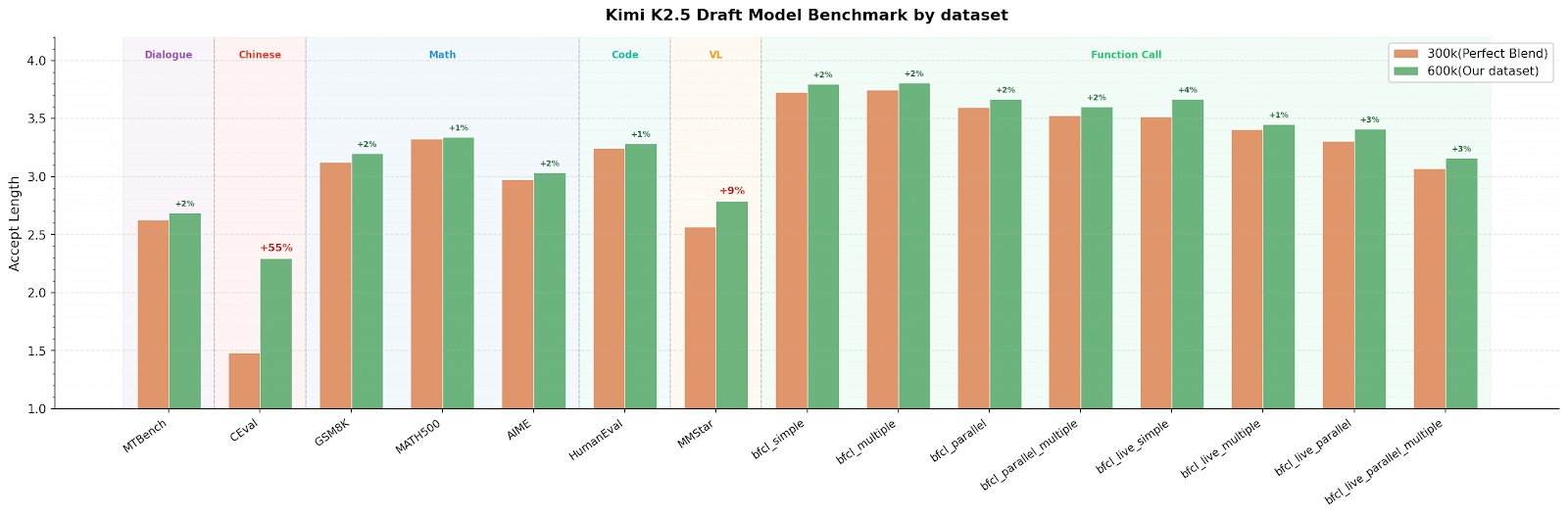
- •Targets scaling to frontier LLMs like Kimi K2.5, GLM 5, Qwen 3.5.
- •Addresses efficiency needs for expanding model scale and capability.
🧠 Deep Insight
Background and context from public sources — not the original article. 8 sources cited.
🔑 Enhanced Key Takeaways
- •TorchSpec employs a two-phase training strategy: phase 1 uses small batches with 4k token sequences via standard causal LM training, while phase 2 uses large batches with 256 token sequences from the base model, with a 5:2 step ratio.[1]
- •Speculator heads attached to the base model outperform smaller draft models like Llama 7B for Llama 70B in both quality and latency gains during speculative decoding training.[1]
- •TorchSpec leverages PyTorch FSDP and IBM FMS for distributed training of speculators at scale.[1]
🛠️ Technical Deep Dive
- •Speculator training avoids KV-cache replication during prediction and modifies attention masks for verifying the N+1th token to ensure outputs match the original model without deviation.[1]
- •Two-phase training: Phase 1 focuses on long sequences (4k tokens) with small batches; Phase 2 shifts to short sequences (256 tokens) with large batches to tune heads to base model outputs, using a 5:2 phase 1 to phase 2 step ratio.[1]
- •Uses PyTorch FSDP for distributed training and IBM FMS, prioritizing attached speculator heads over smaller independent draft models for better efficiency and quality.[1]
🔮 Future ImplicationsAI analysis grounded in cited sources
⏳ Timeline
📎 Sources (8)
Factual claims are grounded in the sources below. Forward-looking analysis is AI-generated interpretation.
Weekly AI Recap
Read this week's curated digest of top AI events →
👉Related Updates
AI-curated news aggregator. All content rights belong to original publishers.
Original source: PyTorch Blog ↗
This is a summary, not the original. Read the source, or get the weekly briefing.
Weekly AI briefing
One email a week. Unsubscribe anytime.