Top 30 Domestic AI Chips and IPO Acceleration
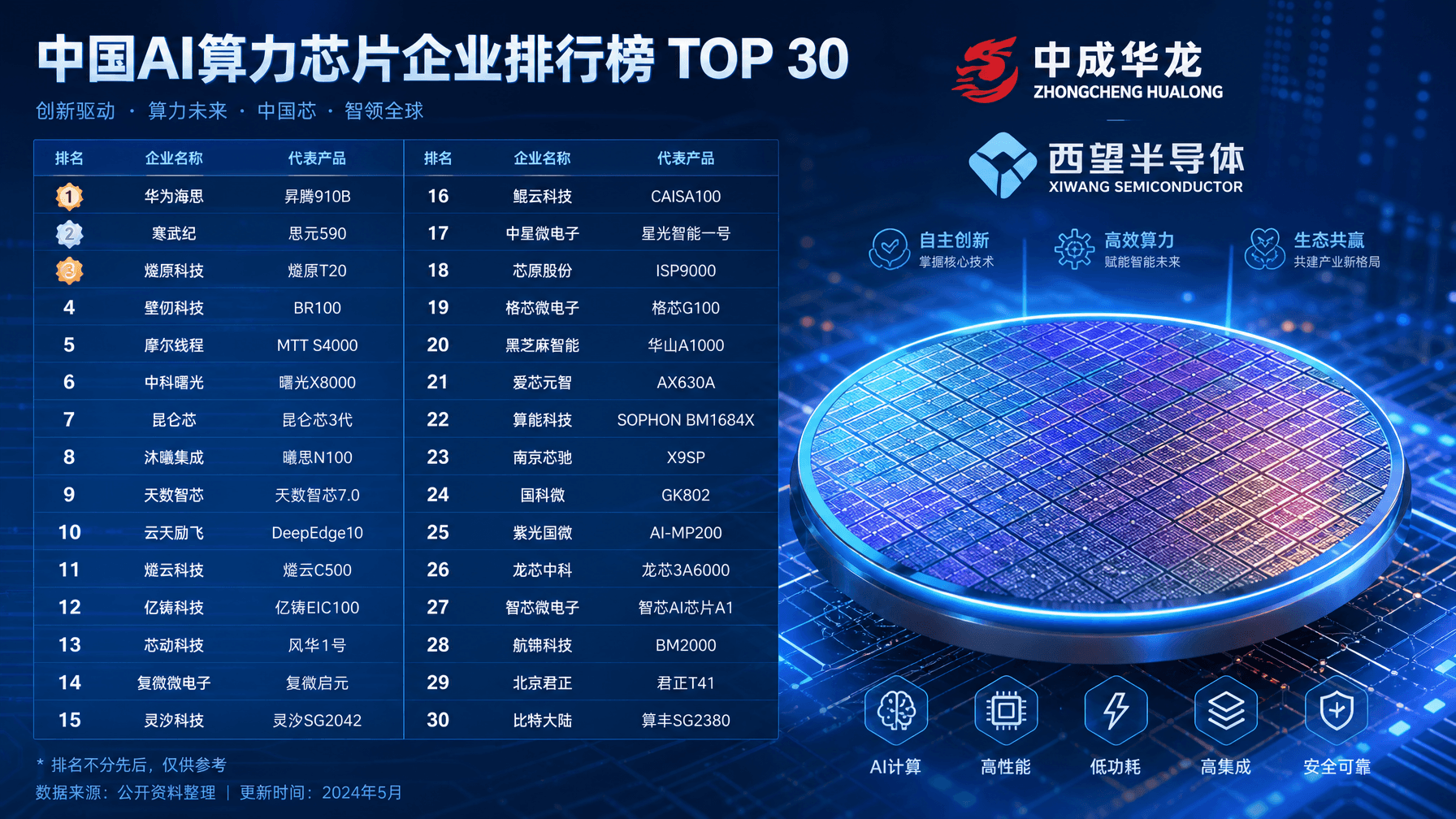
Discover which domestic AI chipmakers are leading the market and preparing for public listing in 2026.
30-Second TL;DR
What Changed
Industry maturation with distinct tier-based segmentation in AI hardware
Why It Matters
The acceleration of domestic chip manufacturers indicates a shift toward self-sufficiency in AI infrastructure, potentially reducing reliance on international GPU suppliers.
What To Do Next
Evaluate the performance benchmarks of the top-tier domestic chips listed to determine if they can serve as viable alternatives for your local inference workloads.
Key Points
- •Industry maturation with distinct tier-based segmentation in AI hardware
- •Zhongcheng Hualong and XiWang identified as key players moving toward IPOs
- •Surging domestic demand for AI computing power driving market consolidation
Deep Insight
AI-generated analysis for this event — not the original article.
Enhanced Key Takeaways
- •The 2026 domestic AI chip list is heavily influenced by the 'National Integrated Circuit Industry Investment Fund' (Big Fund Phase III), which has prioritized funding for high-bandwidth memory (HBM) and advanced packaging integration.
- •Zhongcheng Hualong has successfully transitioned its architecture to support native FP8 precision, significantly reducing latency for large language model (LLM) inference tasks compared to its previous generation.
- •Regulatory shifts in 2026 have mandated that domestic AI chip providers must meet specific 'compute-to-power' efficiency ratios to qualify for government procurement contracts, forcing smaller players to consolidate.
- •XiWang's IPO strategy is reportedly tied to its recent breakthrough in chiplet-based interconnect technology, which allows for the scaling of AI clusters without relying on restricted high-end lithography equipment.
- •Market data indicates that domestic AI chip adoption in China's telecommunications sector has surpassed 40% in 2026, marking a significant shift away from reliance on imported GPU architectures.
Competitor Analysis
- Zhongcheng Hualong (H-Series)
- Proprietary NPU
- XiWang (X-Core)
- Chiplet-based
- NVIDIA (H20/B20)
- Hopper/Blackwell
- Zhongcheng Hualong (H-Series)
- FP8/INT8
- XiWang (X-Core)
- FP16/BF16/FP8
- NVIDIA (H20/B20)
- FP8/FP16/FP32
- Zhongcheng Hualong (H-Series)
- High-speed Mesh
- XiWang (X-Core)
- UCIe-compliant
- NVIDIA (H20/B20)
- NVLink
- Zhongcheng Hualong (H-Series)
- LLM Inference
- XiWang (X-Core)
- Training/Scaling
- NVIDIA (H20/B20)
- General Purpose AI
| Feature | Zhongcheng Hualong (H-Series) | XiWang (X-Core) | NVIDIA (H20/B20) |
|---|---|---|---|
| Architecture | Proprietary NPU | Chiplet-based | Hopper/Blackwell |
| Precision Support | FP8/INT8 | FP16/BF16/FP8 | FP8/FP16/FP32 |
| Interconnect | High-speed Mesh | UCIe-compliant | NVLink |
| Market Focus | LLM Inference | Training/Scaling | General Purpose AI |
Technical Deep Dive
- Zhongcheng Hualong H-Series: Utilizes a custom 5nm process node with a focus on high-density SRAM integration to minimize off-chip memory access.
- XiWang X-Core: Employs a 2.5D packaging solution that enables the integration of heterogeneous compute dies, specifically optimized for transformer-based model architectures.
- Memory Architecture: Both companies have shifted toward LPDDR5X and HBM3 integration to address the memory wall bottleneck in domestic AI training clusters.
- Software Stack: Both platforms utilize a unified compiler framework that supports PyTorch and MindSpore, aiming to lower the barrier for developer migration from CUDA-based environments.
Future ImplicationsAI analysis grounded in cited sources
Timeline
- 2024-11Initial prototype of XiWang's chiplet-based architecture unveiled at the World AI Conference.
- 2025-05Zhongcheng Hualong secures Series D funding to expand production capacity for its H-Series chips.
- 2026-02Government announces new efficiency standards for AI computing hardware, favoring domestic chip architectures.
- 2026-06Release of the 2026 Top 30 Domestic AI Chips list, highlighting the IPO readiness of key industry leaders.
Weekly AI Recap
Read this week's curated digest of top AI events →
Related Updates



AI-curated news aggregator. All content rights belong to original publishers.
Original source: Pandaily ↗
This is a summary, not the original. Read the source, or get the weekly briefing.
The weekly digest
One email a week. Unsubscribe anytime.